Exhibitions
Mireia C. Saladrigues turns the dust of Tarragona into an archive of the city
In 'Polsimarium', the artist collects material traces from different spaces in the territory to explore the memory of places, the passage of time and the transformations that objects undergo. The exhibition, curated by Àngels Miralda, is displayed in the Sarcòfag d'Hipòlit and the Saló de Ball of Casa Canals del Mèdol, in Tarragona, from October 9 to December 13.
There is a memory that is not written in books or necessarily preserved in museums. It is the one that accumulates on surfaces, infiltrates corners and slowly detaches from objects. A memory made of particles, almost imperceptible, that circulate from one place to another and that, despite their fragility, contain fragments of the history of the spaces we inhabit. In Polsimarium , Mireia C. Saladrigues takes this discrete matter as a starting point to build a material inventory of Tarragona.
Over the past few months, the artist has visited different places in the city to collect dust and observe what each sample can reveal about its origin. A pastry shop in the historic center, an archaeological site, a textile work linked to local history, a Roman sarcophagus, a funerary tombstone dedicated to a charioteer or the Mèdol quarry are part of this itinerary. They are places and objects of diverse nature, separated by their functions and chronologies, but united by the same condition: they all accumulate the traces of time and the processes that transform them.
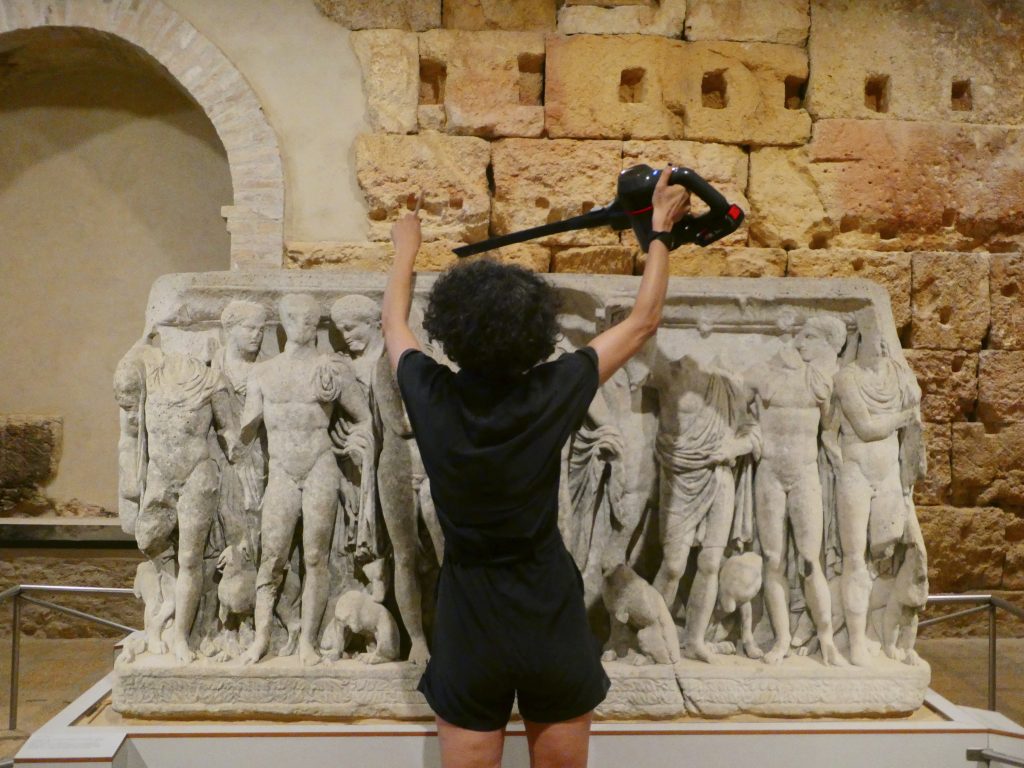
Dust is the result of a multitude of actions. It can arise from digging, cutting, polishing, building, restoring or cleaning, but also from the continuous wear and tear caused by the passage of years. The particles are detached from the surfaces, move, mix with other materials and end up being deposited in spaces different from those where they originated. In this transit, the boundaries between materials become blurred and the origin of each fragment becomes increasingly difficult to determine.
What, then, does dust preserve from the place where it comes from? This is one of the questions that runs through the project. In the same sample, mineral remains, traces of human activity, pollutants, skin cells or organic spores can coexist. Its composition thus becomes a kind of involuntary record of the life of spaces, a layer that is constantly renewed as the city transforms.
Saladrigues' research connects with an artistic practice that has long investigated the processes of transformation of matter, especially through marble, its fragments and phenomena such as erosion, wear and tear or decohesion. In Polsimarium , this exploration expands the scale and moves the attention from the individual object to the territory. Dust ceases to be an insignificant residue to acquire the condition of material witness, capable of establishing relationships between eras, activities and forms of life.
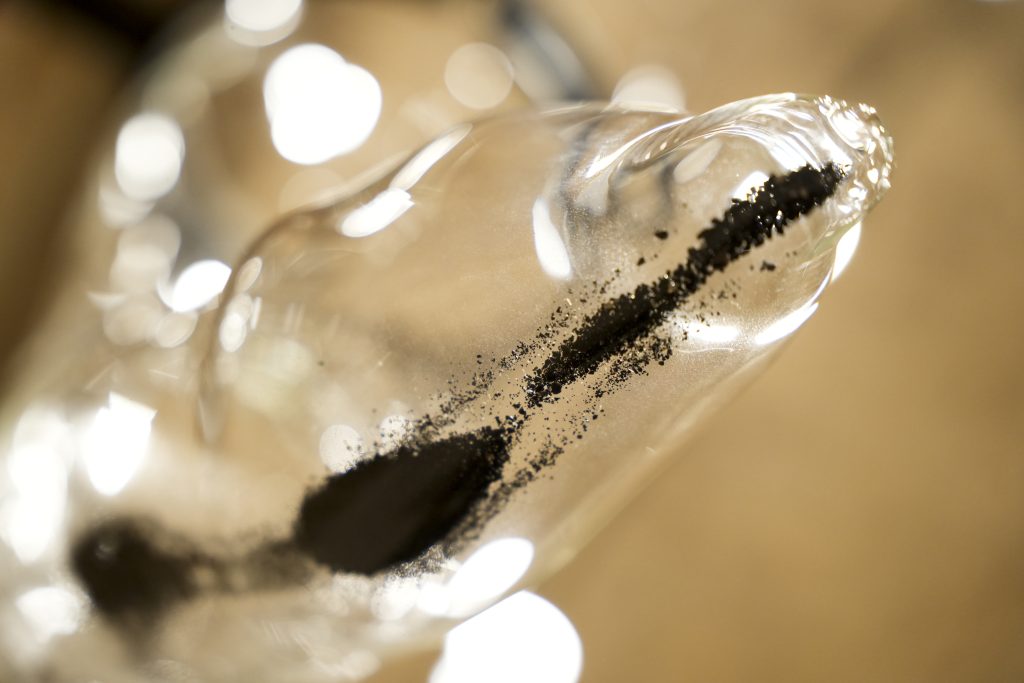
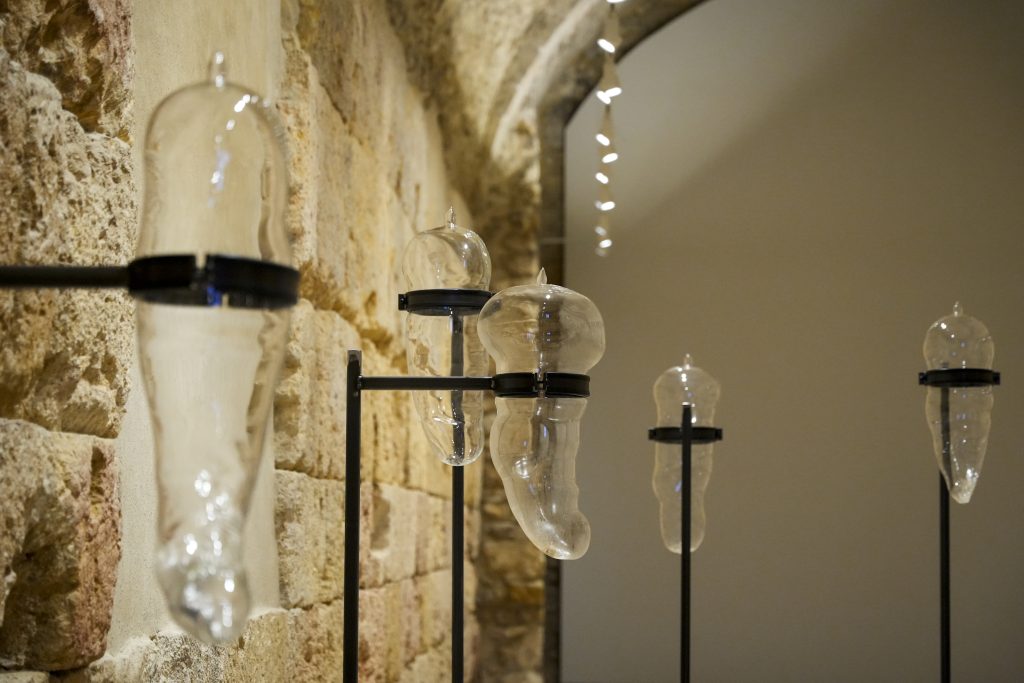
The collected samples are preserved in glass containers made by hand and identified according to their place of origin. Some of these vessels rest on hand-forged iron structures. The joint arrangement forms a unique archive in which each container preserves a small portion of the city. However, this is not a monumental inventory or an exhaustive classification of Tarragona's heritage, but rather an approach that starts from what usually goes unnoticed. The city appears fragmented, contained in small quantities of matter that invite us to reconsider what we understand by trace, document and memory.
The exhibition takes on a particular dimension in the two spaces that host it: the Saló de Ball of Casa Canals and the vault of the Sarcòfag d'Hipòlit, linked to different chapters in the history of Tarragona. In these settings, the dust samples come into relation with architectures and objects that have also experienced processes of transformation, erosion and loss. The context does not function solely as a container for the works, but participates in the same material reflection that articulates the project.
This relationship becomes especially eloquent next to the Roman sarcophagus. The sketchy heads of some of the sculpted figures show an absence, the disappearance of a part of the object over the centuries. Faced with these mutilations, Saladrigues' proposal opens up a suggestive possibility: that part of the lost matter continues to be dispersed throughout the city, displaced and transformed until it is integrated into other sediments. Perhaps even among the particles gathered in Polsimarium .
This hypothesis does not seek to reconstruct what has disappeared, but to make visible the material continuity that unites objects with their environment. What is lost from a place does not necessarily disappear from the world; it can change shape, mix with other remains and begin a new trajectory. In this silent circulation, dust becomes a metaphor for memory, but also a concrete matter that questions the separation between heritage and residue, between what is preserved and what fades.
You may be
interested
...