Exhibitions
Fernando Renes puts the market under the gaze of art
In "MERX", the artist explores the contradictions of hypercapitalism through ceramics, drawing and animation, in a project that connects material culture with the history of La Panera de Lleida.
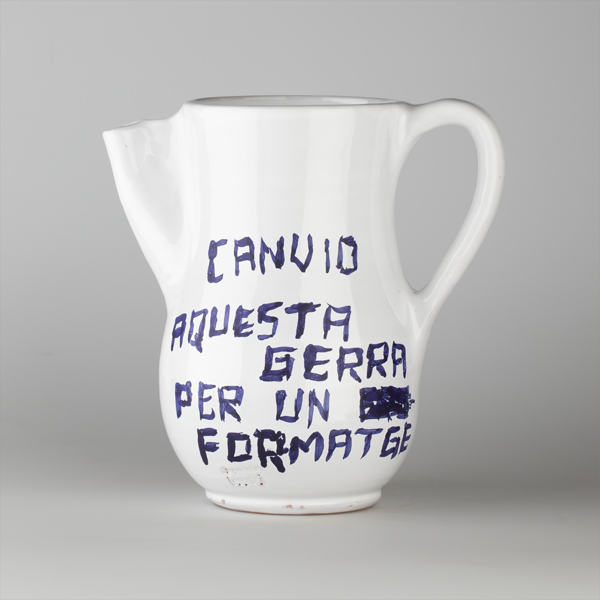
The market is much more than a space for exchange. It is also an ecosystem of relationships, an economic structure and a stage where objects, work and people acquire a certain value. This complexity is the starting point of MERX , the project that Fernando Renes presents at La Panera in Lleida, with the curatorship of Antoni Jové. The proposal takes the concept of merchandise as a common thread to examine the dynamics of contemporary hypercapitalism, in which individuals participate simultaneously as a workforce, consumers and products of a globalized market.
The title refers to the Latin term merx , which means merchandise or movable goods, and opens a field of reflection on the mechanisms that articulate production, circulation and consumption. If the first markets were based on barter, the appearance of money favored the development of increasingly complex transaction systems, progressively regulated by commercial codes and business structures that today operate on a national and international scale. Renes starts from this evolution to propose a plastic and symbolic reading of the economy, attentive to both the objects and the imaginaries that sustain commercial relations.
The exhibition venue itself participates in this reflection. The La Panera building, which originally functioned as a medieval market, establishes a direct link between the commercial history of the space and the issues addressed by the artist. However, the project is not limited to recovering this architectural memory, but broadens the view towards current forms of commercialization and the consequences of an economic model that crosses all areas of life.
Ceramics occupy a central place in this research. Renes is particularly interested in utilitarian objects of local tradition, designed to solve everyday needs such as storage, transportation or cooking. Historically, these pieces were not intended for aesthetic contemplation, but for use. Only more recently, in a context marked by market transformations, have many incorporated an ornamental dimension that contributes to keeping them relevant. In this transition between functionality and decoration, the artist identifies a way to interrogate the relationships between craftsmanship, economic value and consumption.
This perspective also refers to the history of ceramics as a container and instrument for the circulation of goods. The amphorae that transported oil from Baetica to Rome and that, once used, ended up deposited on Mount Testaccio illustrate the relationship between objects, trade routes and the material waste left by economic activity. Ceramics thus become a witness to the exchanges and the social structures that make them possible, while connecting the commercial circuits of the past with the logics of production and consumption of the present.
Faithful to a rigorous and coherent trajectory, often outside of fashions and trends, Fernando Renes articulates the project through a multidisciplinary language that combines drawing, animation, sculpture and ceramics. The proposal includes a large ceramic mural, pieces of traditional ceramics, large-format drawings and audiovisual animations. Far from functioning as independent media, these resources construct a visual universe in which everyday objects acquire new readings and economic processes become matter for artistic experimentation.
With MERX , Renes relates the material dimension of objects to the symbolic value we attribute to them. His proposal invites us to critically observe the mechanisms that transform goods, work and even human experiences into commodities. In La Panera, this approach finds a particularly significant setting: an old market that today hosts a reflection on the persistence and metamorphoses of exchange in contemporary society.
The exhibition can be visited from October 24, 2026 to February 7, 2027 at La Panera in Lleida, with Antoni Jové as curator.
You may be
interested
...