Exhibitions
Dante between chiaroscuro and contemporary chaos
The Divine Comedy, written at the beginning of the 14th century, the great epic by the Florentine poet, has generated countless visual interpretations throughout the centuries, but few confrontations are as stimulating as the one proposed by the Canal Foundation between Gustave Doré and Robert Rauschenberg. Separated by almost a century and trained in completely different artistic contexts, both found in Hell a privileged territory to explore fear, guilt, desire, violence, and the contradictions of humankind.
From October 7, 2026, to January 5, 2027, "Dante's Inferno: Doré and Rauschenberg ," curated by Lola Durán Úcar, brings together 111 graphic works and presents the two complete series that both artists dedicated to the first part of the Divine Comedy . The exhibition allows visitors to explore the 34 cantos of Inferno through two seemingly disparate perspectives: Doré's dramatic monumentality versus Rauschenberg's fragmentation, ambiguity, and critical eye.
The contrast also serves as a way of reinterpreting Dante. Doré, one of the key figures of 19th-century illustration, constructs a recognizable, solemn, and spectacular hell. His black and white, dominated by chiaroscuro, transforms the scenes into almost cinematic visions even before the existence of film. The bodies, the impossible architecture, the abysses, and the multitudes of the damned acquire a monumental dimension. The darkness is not merely a formal device: it constitutes the moral atmosphere of a universe governed by sin and punishment.
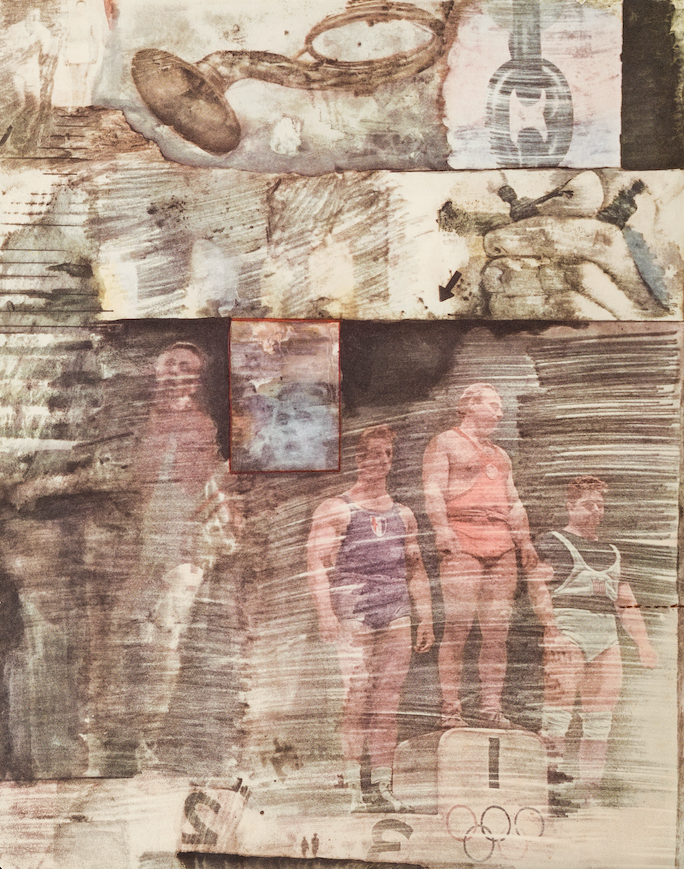
Robert Rauschenberg. Canto XXXI. The central pit of Malebolge: the giants. Offset lithograph. From the portfolio drawings for Dante's Inferno. Edizioni Macorini. Milan, 1965. Copy 186/250. © 2026 Robert Rauschenberg Foundation / Licensed by VAGA at Artists Rights Society (ARS), NY / VEGAP, Madrid.
Rauschenberg starts from a completely different place. When he confronts the same text in the 20th century, the confidence in a stable representation of the world has vanished. His Dante belongs to an era marked by wars, mass media, mass culture, and the incessant proliferation of images. Photographs, stains, lines, fragments, and figures coexist in compositions that defy a single interpretation. If Doré illustrates Inferno , Rauschenberg seems to be asking what it means to continue speaking of hell in the contemporary world.
The exhibition brings together the 76 woodcuts associated with Doré's celebrated edition—75 illustrations of the Inferno and a portrait of Dante—and the 35 offset lithographs by Rauschenberg—34 corresponding to the various cantos and one cover. In the case of Doré, the exhibition features the Parisian edition published by Hachette in 1862, its second printing, especially valued by specialists and bibliophiles for the quality of its prints. The engravings were executed by Héliodore Pisan based on Doré's compositions.
Beyond their artistic value, these examples allow us to recover an essential dimension of the exhibition: the relationship between art and the book. The Divine Comedy is not merely an illustrated text here, but the starting point for two graphic projects in which literature becomes visual material. The book ceases to be a simple medium and transforms into a space for interpretation.
The journey begins, like the poem, with Dante lost in a dark wood. It is the night of Holy Thursday in the year 1300, and the poet is 35 years old, "midway through life's journey." The wood represents the loss of moral and existential orientation. The panther, the lion, and the she-wolf prevent him from advancing until Virgil appears, sent by Beatrice. The Latin poet becomes his guide and leads Dante through a descent that is simultaneously physical, moral, and intellectual.
From that point on, the visitor traverses the nine circles of Hell , from Limbo to the circle of traitors. The exhibition's structure allows us to contemplate how Doré and Rauschenberg approach the same episodes from virtually opposite visual perspectives. One seeks to construct a coherent and recognizable universe; the other introduces fragmentation, association, and uncertainty.
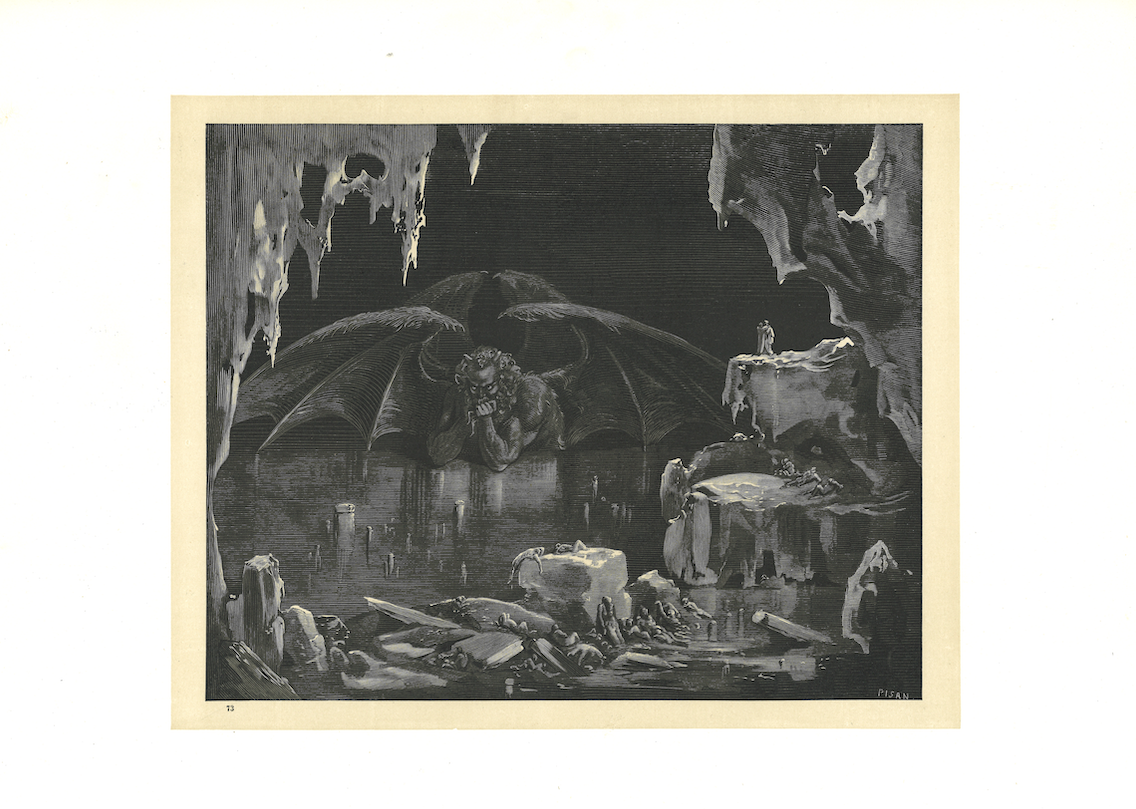
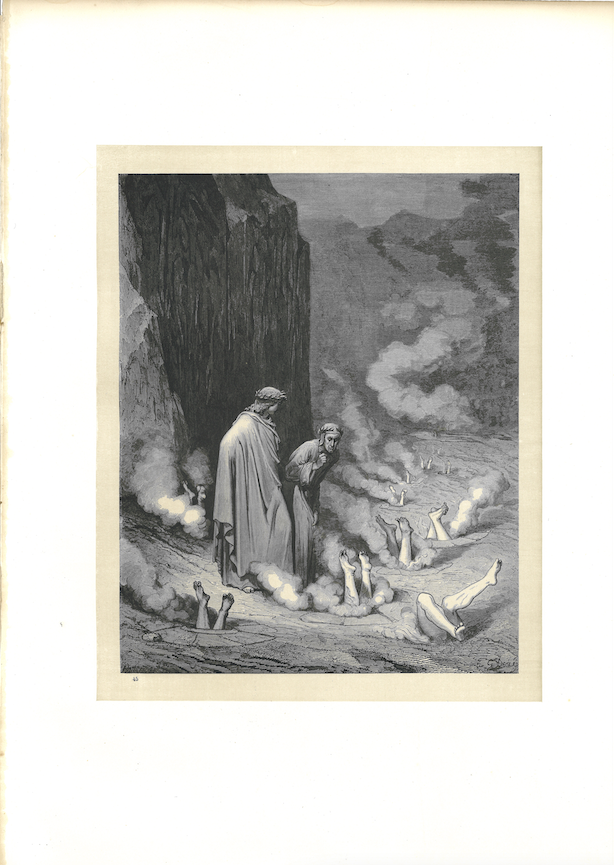
Gustave Doré. Canto XXXIV. The Judeca. Woodcut. From the series Illustrations for Hell by Dante Alighieri. Published in La Divine Comédie, Hachette et Cie. Paris, 1862 (2nd ed.). Engraving by Héliore Pisan.
In Doré's work, perspective, chiaroscuro, and monumentality produce an image of hell as a sublime spectacle. His figures appear subjugated by an overwhelming nature, trapped in settings that amplify their condemnation. There is something theatrical in these images, but also a desire to make visible what Dante's text describes in words. The artist does not question the possibility of representing hell: he constructs it before our eyes.
Rauschenberg, on the other hand, shatters that certainty. His images do not aim to literally reconstruct Dante's scenes, but rather to provoke a collision between the medieval poem and the visual culture of his own time. Photographs, signs, stains, and fragments generate a deliberately unstable iconography. The narrative ceases to be linear, and the viewer must reconstruct meaning from partial associations.
Therein lies one of the exhibition's greatest strengths. It's not simply a matter of contrasting figuration and abstraction, nor of establishing a competition between a 19th-century artist and a 20th-century one. The true dialogue occurs between two ways of understanding the relationship between image and reality. Doré still believes in the narrative power of representation; Rauschenberg is suspicious of it and uses fragmentation to reveal an equally fragmented world.
The relationship with time also changes. Doré views Dante from the 19th century and transforms the Middle Ages into a universe of shadows, monsters, and sublime landscapes. Rauschenberg, on the other hand, introduces the present into the poem and eliminates any comfortable distance from the past. His images suggest that Dante's monsters have not disappeared: they have simply changed their appearance.
The Divine Comedy was able to synthesize theology, philosophy, science, and medieval spiritual worldview, while exploring human passions with extraordinary depth. Written in the vernacular rather than Latin, it also contributed decisively to the shaping of modern Italian and anticipated some of the intellectual shifts that would culminate in Humanism and the Renaissance. This ability to transcend eras largely explains its remarkable cultural enduring influence.

You may be
interested
...