Opinion
Kiefer: collapse and seed
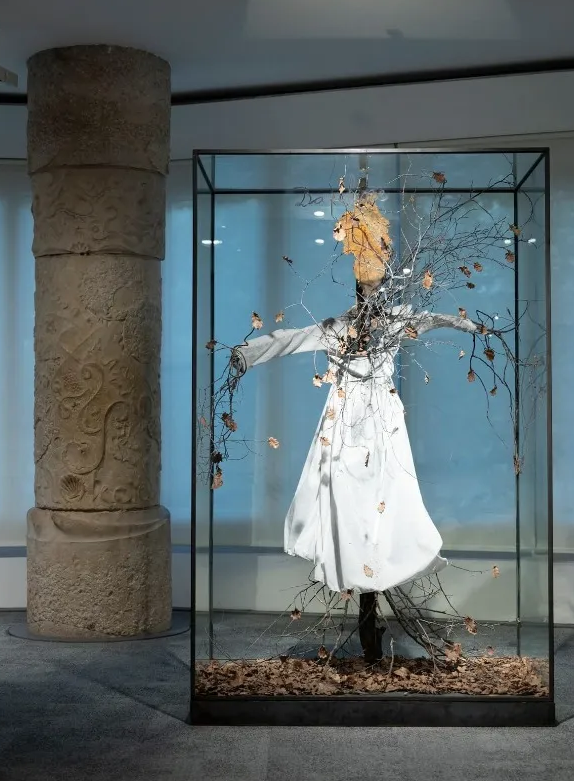
"Art does not collapse for nothing," Joseph Beuys
Finally, Kiefer arrives in Barcelona: one of the great living artists, whom the city has not been able to enjoy for too many decades. The last time I saw his work was in Milan: at the Hangar Bicocca, the sumptuous 7 palazzi celesti (2005). Anyone who has not seen this colossal installation has missed one of the wonders of contemporary art: seven large cement towers of more than twenty meters gravitate in the middle of the space of an old railway hangar, in which the artist evoked —with that language that is both intense and disjointed— seven great spiritual principles of the Jewish Kabbalah (without being Jewish himself: only paying homage to the mystical current of that people disemboweled by the German Nazis).
The exhibition at La Pedrera raised doubts in me because of the way in which Vicent Todolí —director of Hangar Bicocca— allowed the seven palaces of Milan to be filled with Kiefer's most colossal contemporary painting, atomizing all the original strength of the piece, and showing a drift of the German painter into an effectual one sold to big capital. And no: an intimate and measured exhibition of the elderly and wise Kiefer, 82 years old, who is returning from art, and who, even in a post-plastic world like ours, is capable, with his plasticity, of transmitting to us great lessons in art, culture and thought.
Kiefer, like all the wise men of art, expresses himself from indifference: to languages, to politics, to the novelty of the world; and on the other hand, expressing himself from a universal and spontaneous perspective, he speaks, at the same time, of everything: of the centrality of women, of the collapse of the planet, of human progress, of suffering nature, of the cosmos, of matter, of the spirit. When an artist goes back, he creates freely, flowing through the great nuclear concepts of humanity without a desire for novelty or nostalgic drama; he neither speaks from smallness nor from grandiloquence. He speaks from you to you: everything is there and nothing is missing.
Kiefer speaks of the world after man: after the fall of the great Enlightenment ideals and the impossibility of putting them into practice without being able to stop the advance of time and nature, always directed towards decomposition and entropy. He belongs to this tradition of European art, with Benjamin ( Angelus Novus ), Eliot ( Wasted Land ), and so many post-war existentialists and expressionists of the eighties, who watch the world as an irrepressible wasteland, where only ash remains in the inability of human beings to know how to build and care for their home in balance with their environment. But he brings the hope of the wise, thanks to the artist's genuine interest in modern Kabbalah, mythology and poetry. In the texts he loved, it is related that all the spirit, all the hope, all the light, which once dominated the sky, have today been relegated to the interior of dry matter, which is also a seed disseminated potentially active through fertile artistic action.

You may be
interested
...