Exhibitions
Mia Goldstein paints art when it ceases to be art
What happens to a work of art when it leaves the gallery? Much of the history that shapes the art world has focused on its origins: the artist, the creative process, the studio, the emergence of a new work, and its arrival in the exhibition space. Mia Goldstein shifts her gaze to the opposite extreme. She is interested in what happens once the work has been acquired and begins its other life, far from the museum and the gallery, on the walls and in the private spaces of those who collect it.
This seemingly secondary territory becomes the focus of this young American artist's painting practice, who finds in collectors' interiors a narrative material with enormous potential. Her first solo exhibition, Handle With Care , presented at The Journal Gallery in New York from September 9 to October 3, 2026, takes this investigation a step further: instead of simply depicting the works installed in their final destinations, Goldstein is interested in the journey, in that moment when the pieces are still in transit and can appear wrapped, suspended, transported, or even displaced in the least solemn ways imaginable.
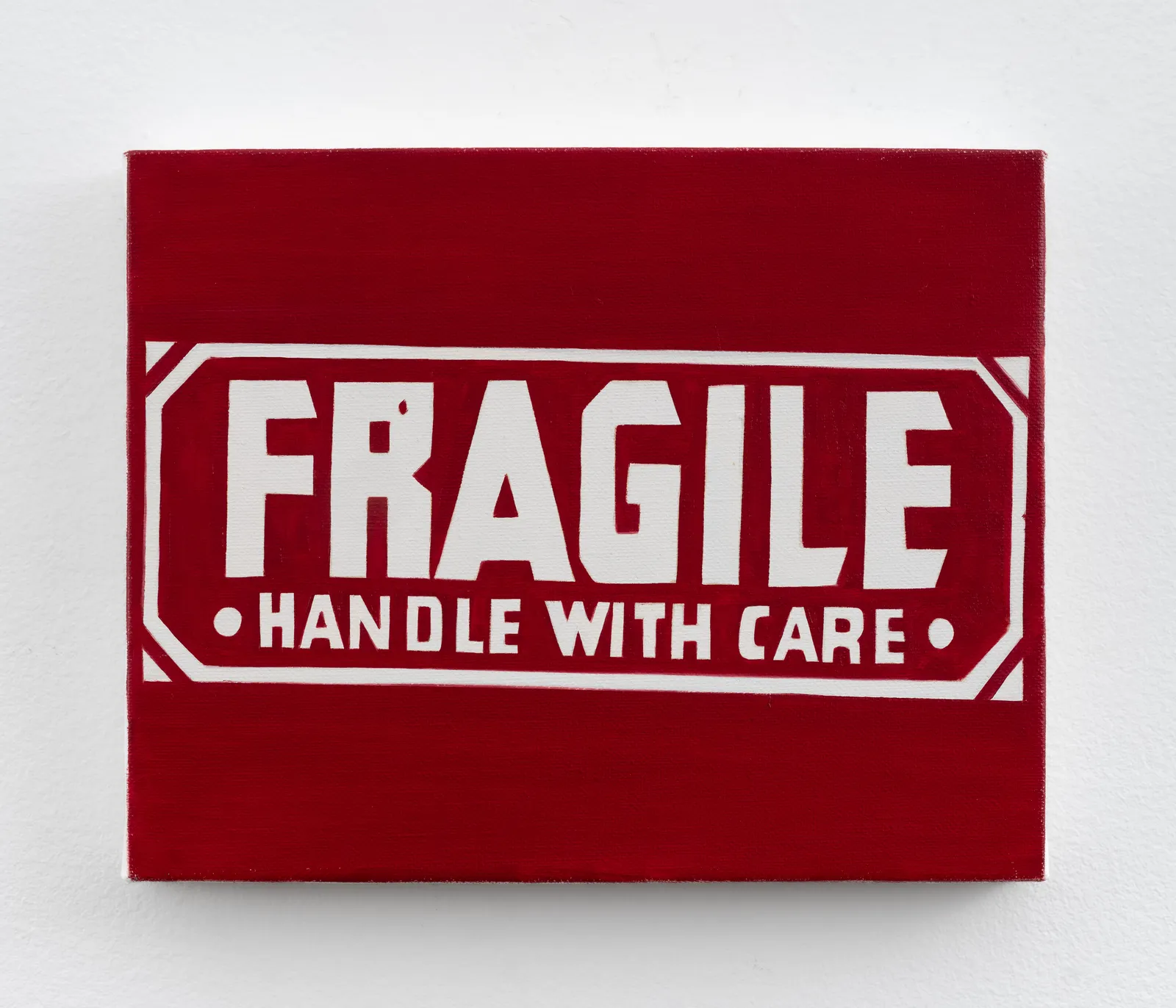
Mia Goldstein, Fragile, 2026, Copyright The Artist.
Her connection to this world goes back a long way. Goldstein grew up in Los Angeles in a family involved in the fashion industry and deeply interested in art and design. Her parents were collectors and encouraged her interest in painting from a very young age. When she arrived at New York University in 2020, she planned to study Art History, but her curiosity gradually shifted toward artistic practice, eventually leading her to change her major and focus on studio art.
Painting his subjects as he found them in their domestic context emerged almost naturally. His early works consisted of depicting rooms in his family home in Los Angeles, incorporating into his paintings elements that were part of his everyday landscape: works of art, furniture, and various interior details. Subsequent commissions from collectors, interested in having him paint their own living rooms, reinforced an intuition that would eventually become the central focus of his work.
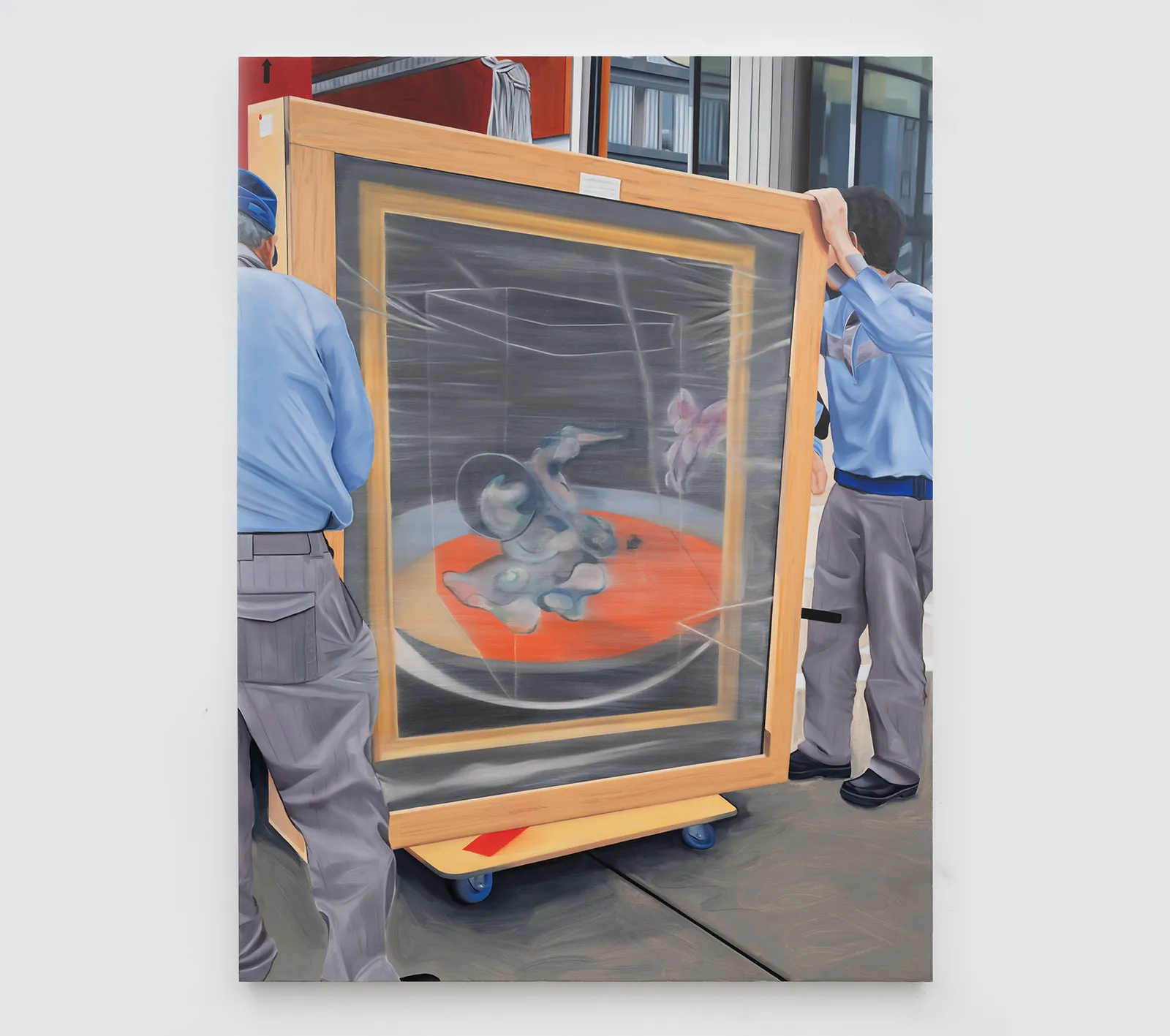
Mia Goldstein, Coming Through, 2026, Copyright The Artist.
Goldstein began to progressively alter these scenes. She started with rooms she knew, but substituted certain paintings, furniture, or objects with others that reflected her own tastes. The collector's interior thus ceased to be a purely documentary space and became a kind of personal aesthetic laboratory. In her paintings, the artist simultaneously assumed the roles of decorator and curator, reorganizing the visual universe of wealthy collectors and using it as a stage to explore the relationships between art, desire, taste, and representation.
Handle With Care , however, introduces a new dimension. Goldstein no longer simply observes the works once they are installed, but focuses his attention on the moments preceding their arrival. The title functions almost as a logistical instruction, but also as an ironic statement about the fragility and symbolic value that accompany certain artistic objects. Moving a piece can be a meticulous and sophisticated process, but also a succession of strange, awkward, or even comical situations.
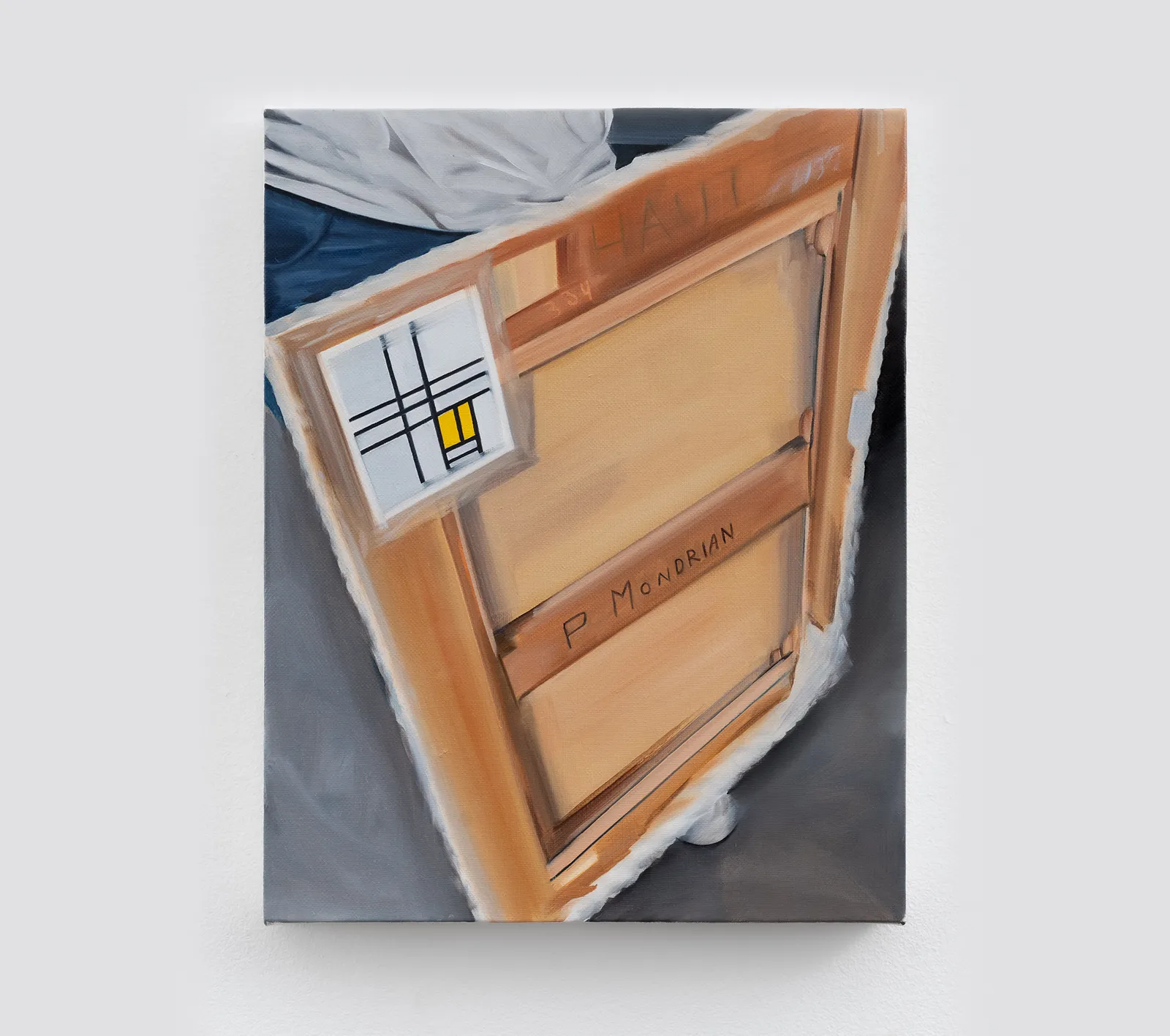
Mia Goldstein, For Release, 2026, Copyright The Artist.
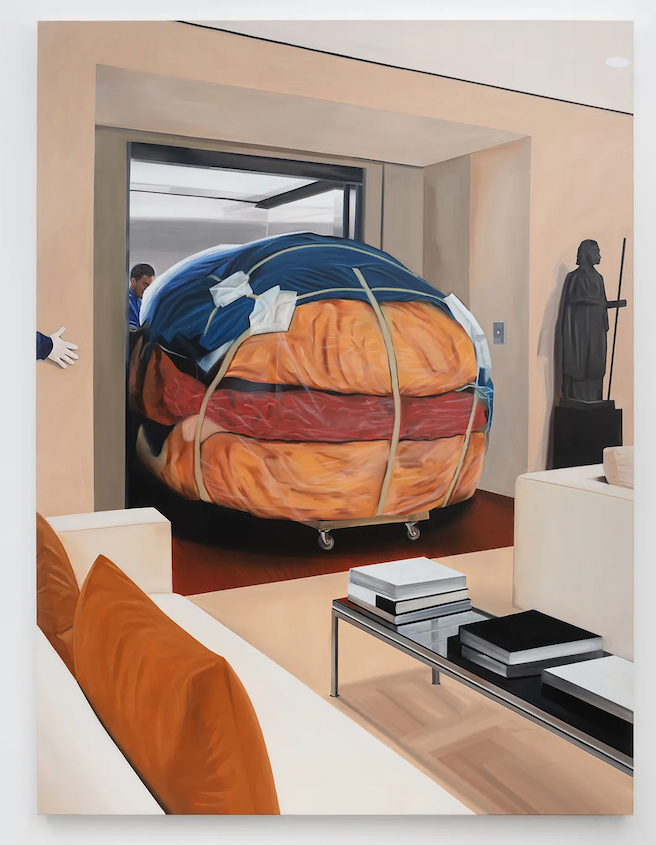
In one of the paintings, an iconic work by Francis Bacon is shown protected by plastic during transport, introducing an unexpected layer of sfumato to the image. In another, a blue resin hippopotamus by Lalanne is lifted by a crane into a luxury apartment. Another scene shows an enormous hamburger by Claes Oldenburg, carefully packaged, being removed from a designer elevator whose dimensions seem barely sufficient to allow the piece to pass through.
Transportation thus becomes a kind of improvised theater in which the usual solemnity of contemporary art encounters the physical difficulties of its own materiality. The works that appear in an exhibition hall imbued with authority and prestige regain for a few moments an almost domestic dimension: they are heavy, they take up space, they don't fit through a door, they need protection, and they require technical solutions to reach the place where they will be viewed.
One of the exhibition's scenes, featuring a René Magritte painting placed in the back of an SUV, stems from a real experience Goldstein had while working at a top gallery. A collector wanted to see how a painting valued at several million dollars would fare inside his own home. The solution was as simple as it was unusual: transport it in the trunk of a car to see firsthand if the artwork fit in that space.
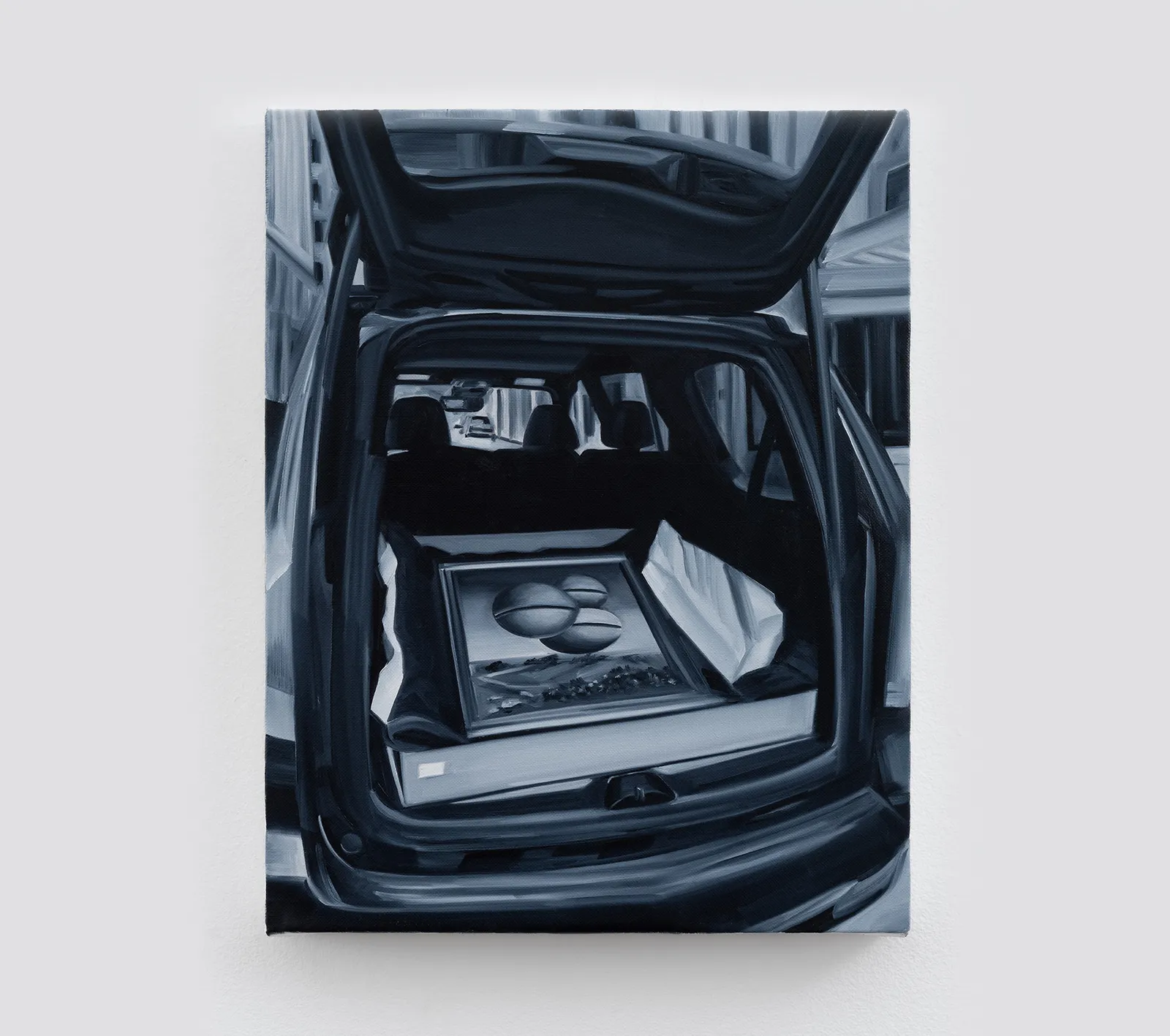
Mia Goldstein, Trunk Show, 2026, Copyright The Artist.
Much of the interest in Goldstein's painting lies in these kinds of episodes. The artist doesn't need grand gestures to question the art system. It's enough for her to observe it when it leaves its usual settings and confronts concrete situations. The masterpiece ceases to be merely an image, an investment, or an object of contemplation, becoming instead something that must also be packed, transported, protected, and displayed.
Goldstein finds fertile ground for painting precisely in that distance between the aura of the work and its material dimension. His interiors and scenes of transit speak of collecting, but also of how art acquires new meanings when it enters private space. Handle With Care makes these displacements the protagonists and poses, with a touch of irony, a question about the true destiny of artworks: not only where they end up, but everything that happens before they finally find their place on a wall.



You may be
interested
...