Exhibitions
Fabián Romero celebrates indigenous roots in Cúcuta
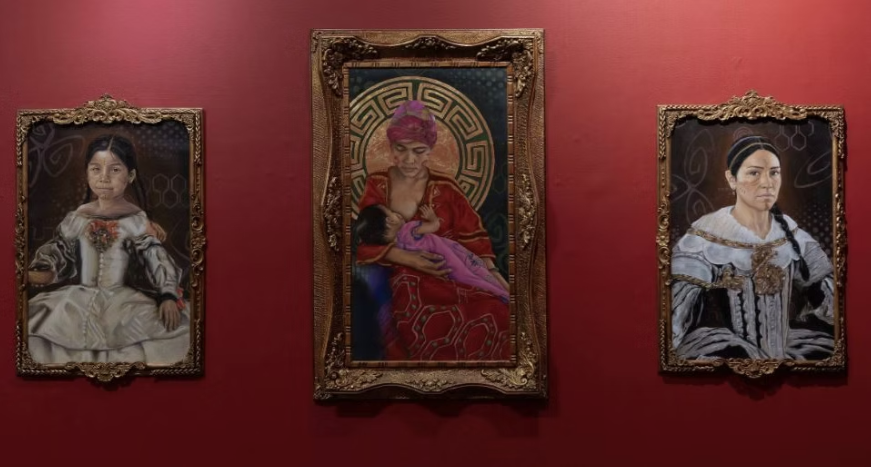
Recognizing one's own roots to question an identity constructed over centuries under the European gaze. This is one of the ideas running through Barroco Mestizo , the new exhibition by Colombian artist Fabián Romero, which presents more than fifteen works at the Museo Norte de Santander in Cúcuta. The project takes mestizaje (racial and cultural mixing) as a space of tension and, at the same time, of possibility, and brings into dialogue references to the European Baroque, popular culture, pop art, and Wayúu indigenous iconography.
For Romero, this combination is not merely a formal matter. Barroco Mestizo proposes a re-examination of indigenous culture and the ways in which its traces have been assimilated, transformed, or rendered invisible throughout the centuries. The artist thus advocates a perspective on mestizaje (racial and cultural mixing) that does not necessarily involve the assimilation of European models, but rather the recognition of a unique and complex identity.
“This critique is aimed at recognizing ourselves as mestizos, urging us to stop trying to do everything like Europeans and instead acknowledge our roots,” Romero explains. His proposal stems precisely from this contradiction: a culture built on multiple influences, yet one that often continues to seek its sources of legitimacy outside itself.
Among the pieces included in the exhibition are Migrants, a Path to Invisibility , winner of the 18th Regional Salon of Visual and Plastic Arts of the Chamber of Commerce, and Resilient Truth , recognized by the Truth Commission. These two works offer insight into a career marked by an interest in social tensions, memory, and the identities that inhabit the margins.
In this visual universe, historical references coexist with concepts from contemporary thought. Romero takes as his starting point, among others, Diego Velázquez and especially Las Meninas , but also the sociologist Silvia Rivera Cusicanqui and her concept of Ch'ixi , understood as a coexistence of differences that do not necessarily have to merge into a single identity. To this constellation of references is added the philosopher Enrique Dussel and his idea of transmodernity, linked to the need to overcome a modernity conceived from a single cultural center.
This dialogue between eras, languages, and traditions is also evident in the very frames of the works. Crafted by the artist himself and inspired by Rococo aesthetics, they establish a deliberate contrast with the images they contain. The ornamental sophistication of European tradition thus becomes the structure that frames narratives linked to indigenous memory, mestizaje (racial and cultural mixing), and Latin American identity.
The feminine dimension also occupies a central place in his work. Romero explains that the figures appearing in his paintings express an admiration for the presence of women and their struggles. This perspective also has a personal dimension, linked to the role of his mother and to the recognition of Indigenous women who, according to the artist, sustain their communities in particularly adverse contexts. The female figure thus appears not only as a represented subject, but also as a symbol of resistance and permanence.
Barroco Mestizo is, in this sense, both an art exhibition and a space for reflection and learning about indigenous culture. The project aims to encourage viewers not only to recognize visual references, but also to question the origins of the imagery that defines their own identity and which voices have been left out of official narratives.
The exhibition's presentation in Cúcuta also holds special significance for the artist. "It's a great benefit for me and a joy to be able to present my work in Cúcuta," Romero states. The exhibition is supported by the Lucho Brahim Grants for Creation 2025 initiative and the Pilar de Brahim Cultural Center Foundation – El Pilar, entities that promote the participation and circulation of artistic and cultural projects in the city.

You may be
interested
...