Exhibitions
The memory of the land
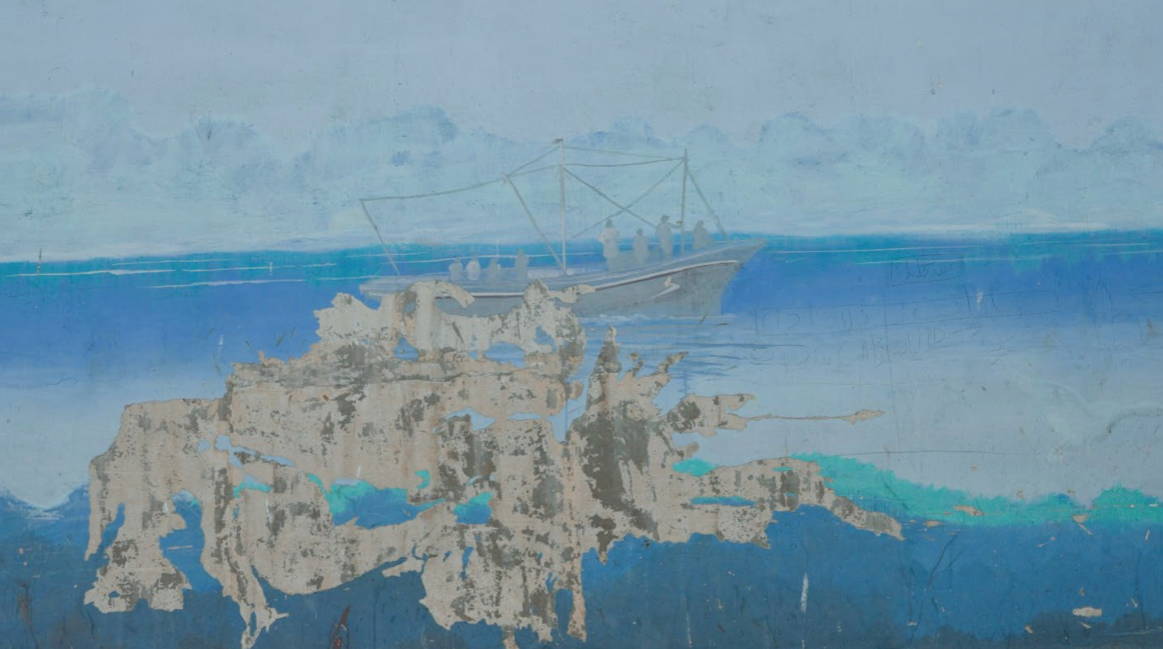
The Ishara Art Foundation presents The sky held it, the earth remembered , an exhibition organized in collaboration with the Han Nefkens Foundation that brings together works by Shahana Rajani, Rohini Devasher and Sarker Protick, three artists from Pakistan, India and Bangladesh whose practices converge on the same concern: understanding the territory as a living archive capable of preserving the traces of memory, ecological transformation and history.
The exhibition, which will be open from September 11 to December 15, 2026, offers a critical perspective on the relationship between humanity and nature and challenges the anthropocentric view associated with the Anthropocene. The Earth ceases to appear as a passive stage upon which history unfolds, becoming instead a body that records its consequences. Water, vegetation, urban infrastructure, and even celestial phenomena function as repositories of information that reveal processes of environmental destruction, displacement, and violence in the territory.
The works gathered here aim to focus precisely on what often remains outside our immediate perception. The layers of soil, the traces of vegetation lost beneath urban growth, the transformed banks of rivers, and the signs emanating from the cosmos shape a material memory that transcends generations and borders.
In Lines That World a River , Shahana Rajani addresses the Indus River as a space of extraction, disappearance, and contested memory. Her three-channel audiovisual installation follows the experiences of displaced communities in the delta, whose ancestral villages were submerged as a result of the construction of dams and other hydraulic infrastructure. Faced with this loss, the inhabitants reconstruct their territories through murals and paintings depicting houses, canals, boats, and dargahs —shrines dedicated to Islamic saints. Representation thus becomes a form of resistance against ecological destruction and institutional neglect.
At the heart of the installation, an enclosure inspired by a dargah recalls those structures that, in many cases, remain standing even after settlements have been flooded. The space functions as a metaphor for presence and absence: the sanctuaries physically survive in the delta landscape, but those who were displaced can no longer access them. Within the exhibition, this void is temporarily transformed into a space for encounter and remembrance.
The cosmic dimension appears in Rohini Devasher's Latent Fields , an installation consisting of three large habotai silk panels suspended from the ceiling, each measuring three by 5.5 meters. Images inspired by sunspots and other solar phenomena appear on the surfaces, represented at different scales, from the microscopic to the atmospheric. The result offers a visual immersion that seems to lead the viewer into the interior of a star.
Devasher works from the perspective of the artist as astronomer, linking his practice to research conducted during residencies at scientific institutions such as CERN. For these pieces, he uses technologies designed to observe distant stars and subatomic particles. The images were initially created on thin copper sheets using drawing, acid etching, printing, and fumage techniques, and were subsequently photographed, scanned, and digitally printed onto silk. The various visual layers transform the installation into a kind of palimpsest of cosmic time.
Sarker Protick, for his part, presents a selection from Dhaka 1217 , a recent series comprised of 135 black and white photographs. Taken between 2011 and 2026, the images document the transformation of an area of approximately one square mile around the Dhaka neighborhood where the artist was born and continues to live. The project will also be published in the fall of 2026 in a book of the same title, co-published by Nokta Books and Protick himself.
In this work, memory often emerges precisely through what has disappeared. The city's growth encroaches upon parks, lakes, and green spaces: a railway line under construction almost erases the foliage from the horizon, while palm trees survive on the other side of the fences of a city in constant transformation. Protick turns these changes into a reflection on loss and on the way in which the urban landscape progressively absorbs what once existed.
The ecological dimension coexists here with an intimate memory marked by small traces: hair fallen on the ground, a woman portrayed in an old photograph inside a stained envelope, or a dusty stack of books. Alongside these images appear the protesters of the 2024 Monsoon Revolution, who protested the loss of their livelihoods. Dhaka thus presents itself as a contested territory where social, ecological, and personal histories converge.
Through these three perspectives, The Sky Held It, the Earth Remembered constructs a geography of shared memories between Pakistan, India, and Bangladesh. Rivers, cities, landscapes, and skies reveal transformations that transcend national borders and connect common experiences of environmental degradation, displacement, and resistance.


You may be
interested
...