Exhibitions
A sentimental museum, where collecting is also remembering
There are objects that don't seem to deserve a place in a museum: stones, roots, masks, photographs, toys, found artifacts, everyday utensils, papers, small rarities, or seemingly insignificant pieces. However, when someone decides to preserve them, bring them together, and establish a relationship between them, they cease to be mere things and become fragments of a story. This seemingly simple shift is the starting point of Musée sentimental , an exhibition co-organized by the Musée des Beaux-Arts de Lyon and the Centre Pompidou, which explores one of the most fertile and least innocent practices in 20th- and 21st-century art: collecting as a tool for creation.
The exhibition, presented at the Musée des Beaux-Arts de Lyon in collaboration with the Pôle des musées d'art de Lyon—the Musée des Beaux-Arts and the Musée d'art contemporain—and the Centre Pompidou, brings together works from all three public institutions and constructs a narrative around the unique ways in which nearly sixty artists and collectives have collected, accumulated, classified, and presented objects. The exhibition explores the history of the emotional relationships we establish with things and how these relationships can transform our way of seeing.
Because collecting is never a completely neutral act. Every collection implies a choice, an exclusion, and a particular way of ordering the world. An isolated object may be insignificant; gathered with others, it acquires a new biography. In this process, the museum ceases to be merely a place of preservation and becomes a space of memory, imagination, and even desire. Musée sentimental situates itself precisely in this ambiguous territory where the document can become a fetish, memory can become artistic material, and the everyday can become a form of poetry.
The exhibition's title itself alludes to a dual genealogy. Two introductory rooms present the visitor with two seemingly disparate antecedents, united by a shared desire to replace purely rational knowledge with an experience based on emotion. On one hand, there is Alexandre Lenoir, the curator responsible, from 1791, for the collection housed in the Petits-Augustins convent, where he gathered religious sculptures confiscated during the French Revolution and created the Musée des monuments français. His project introduced a sentimental dimension to the conception of the museum, grounding it not only in study but also in the evocative power of objects.
The second reference point is much closer to modern and contemporary art: the Musée sentimental, conceived by Daniel Spoerri and first presented in 1977 at the Centre Pompidou. In contrast to the museum understood as a space of classification and authority, Spoerri envisioned a place built upon free association, emotion, and imagination. Objects could be chosen for personal, anecdotal, or emotional reasons, and, when brought together, generated new narratives. The museum thus became a kind of autobiography made of things.
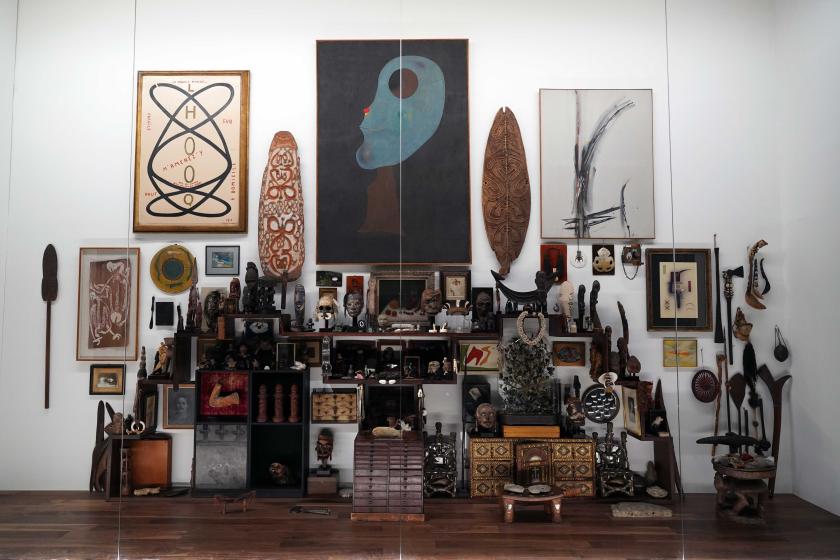
André Breton, Mur de l'atelier d'André Breton, 1922-1966, ©ADAGP, Paris, 2026. Image © Lyon MBA - Photo Antoine Guerrier.
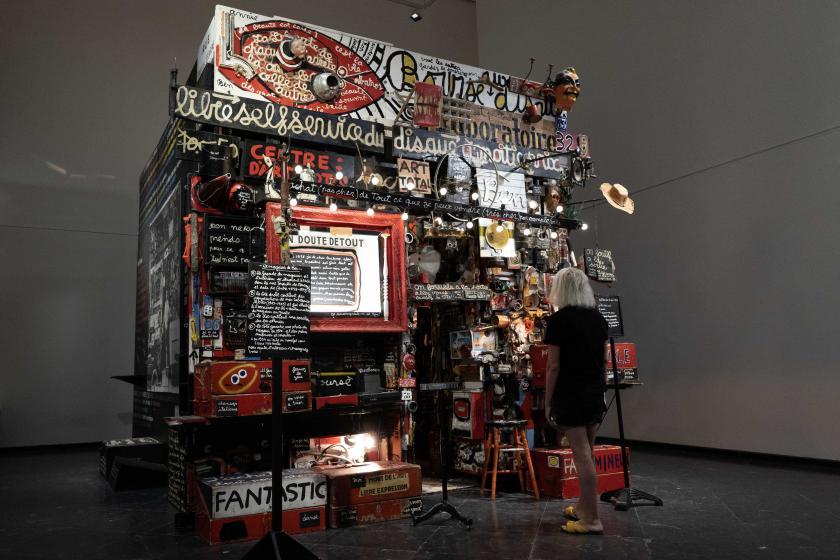
This idea permeates the entire exhibition. One of the most significant contributions comes precisely from the Centre Pompidou collection, which allows visitors to view pieces that are difficult to loan and of special historical importance. Among them is Le Magasin de Ben (1958-1973), conceived by Ben as a veritable space of accumulation where writing and objects coexist, forming a kind of total and mutable sculpture. The work challenges the traditional boundaries between installation, archive, shop, collection, and everyday life: everything can enter it because everything can become artistic material.
Also of central importance is the celebrated Mur de l'atelier d'André Breton (1922-1966), a faithful reconstruction of the wall in the surrealist poet's studio. Oceanic and pre-Columbian objects, masks, stones, roots, and folk art coexisted in that domestic universe transformed into a constellation. Breton didn't seem to be ordering the world; rather, he established correspondences between seemingly unrelated elements. His collection was, in reality, a form of surrealist thought. In contrast to scientific classification, he proposed poetic association.
At the Musée d'art contemporain de Lyon, the exhibition incorporates other equally unique approaches. Henri Ughetto's Impure Mannequins , conceived since the 1970s, stem from an almost paradoxical concern: to construct substitute bodies capable of escaping organic decay. In this case, the collection and accumulation are linked to the fragility of the body and to the desire to preserve that which is inevitably destined to disappear.
Sylvie Selig's Weird Family (2015-2026) introduces another dimension. Her sculpture-characters are born from objects found and acquired in various places, constructing a universe populated by creatures that blend autobiography, memory, and references to children's stories. What might seem like an arbitrary collection of objects transforms into an imaginary family. The artist turns accumulation into narrative and the found object into a character.
From the collections of the Musée des Beaux-Arts de Lyon comes Hotel Andromeda (1954) by Joseph Cornell, one of the small boxes the artist conceived as veritable "theaters of memory." His works, reminiscent of old cabinets of curiosities, contain worlds compressed into a few centimeters. Photographs, fragments, images, and objects find a new poetic quality within the box. Cornell demonstrates that a collection doesn't need to be monumental to be infinite: it is enough that each element triggers a memory or a narrative possibility.
The exhibition also includes some twenty sculptures by Étienne-Martin that engage in dialogue with Mur du temps (1963-1995), a reconstruction of part of his studio wall presented here for the first time. The studio thus appears not as a mere workspace, but as a repository of an artistic existence. Time adheres to the objects, the materials, and the traces of a practice that transforms personal space into an archive.
The tour brings together names as diverse as Art&Language, Delphine Balley, Ben, Christian Boltanski, George Brecht, André Breton, Marcel Broodthaers, Mark Brusse, Joseph Cornell, Erik Dietman, Philippe Droguet, Marcel Duchamp, Étienne-Martin, Hans-Peter Feldmann, André Félix, Hervé Fischer, Christian Jaccard, Géraldine Kosiak, Laura Lamiel, La «S» Grand Atelier, André Masson, Annette Messager, Jean-Luc Moulène, Gabriel Orozco, Jean-Luc Parant, Jean-Pierre Raynaud, Pierre Révoil, Fleury Richard, Sarkis, Max Schoendorff, Sylvie Selig, Daniel Spoerri and Henri Ughetto.
The breadth of this list reveals that art collecting doesn't adhere to a single tradition. It can be surrealist, conceptual, autobiographical, anthropological, obsessive, humorous, or even therapeutic. It can stem from the desire to preserve what has been lost or, conversely, to transform what has been found into something new. In all cases, there is a common impulse: to rescue certain fragments from the undifferentiated flow of reality and grant them a second life.
Therein lies much of the appeal of Musée sentimental . The exhibition doesn't simply showcase artists who collect objects; it prompts us to consider what happens when someone decides that something deserves to be preserved. In this seemingly minor gesture lies one of the museum's roots, but also one of the fundamental operations of contemporary art: to look at what normally goes unnoticed and discover that, behind every object, a story may be hidden.
The result is a museum within a museum, but also something more intimate: a cartography of affections constructed with objects. In contrast to the solemnity of the institutional collection, Musée sentimental champions the possibility of collecting from memory, chance, and desire. Display cases, boxes, bags, accumulations, and assemblages cease to be mere presentation devices and become spaces where objects seem to retain the echo of the lives that touched them.
The project is jointly curated by Sophie Duplaix, chief curator of contemporary collections at the Centre Pompidou-Musée national d'art moderne; Sylvie Ramond, general director of the Pôle des musées d'art MBA I macLYON and director of the Musée des Beaux-Arts de Lyon, as well as chief curator of Heritage; and Isabelle Bertolotti, director of the Musée d'art contemporain de Lyon and chief curator of Heritage.
Ultimately, Musée sentimental poses a question as simple as it is profound: why do we keep the things we keep? Perhaps because some objects are capable of resisting oblivion. Perhaps because a part of us remains within them. Art, by bringing them together, only intensifies that capacity for memory.

You may be
interested
...