
Exhibitions
Isamu Noguchi's sculpture returning to the water
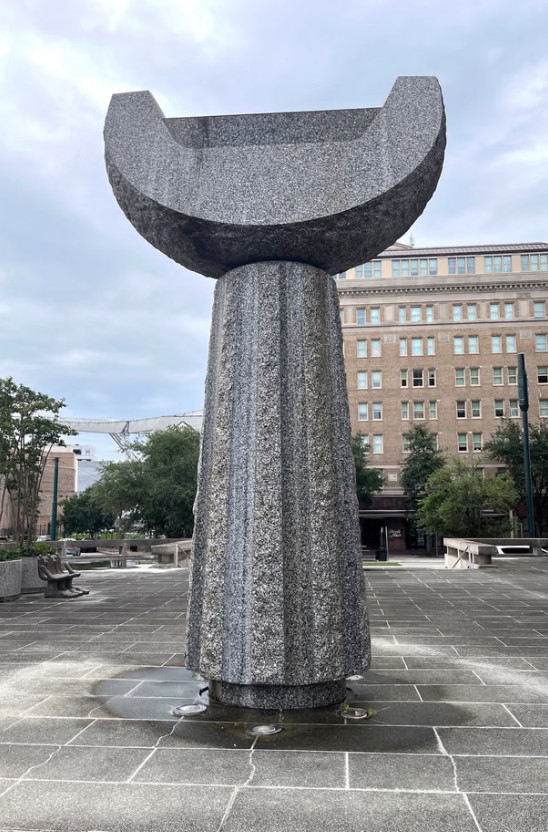
One of Isamu Noguchi's most unique monumental sculptures will embark on a new journey through New Orleans this fall. Mississippi Fountain , also known as The Mississippi (1961-1962), will be moved from the city's financial district to the New Orleans Museum of Art (NOMA), where it will occupy the Beaux Arts entrance and regain one of its essential characteristics: water.
The operation will require a complex engineering maneuver. The piece, made of granite and weighing approximately 40 tons, will be lifted about twelve meters by a crane, protected in a metal structure specifically designed for the move, and transported on a large truck to City Park, where the museum is located.
The building was originally conceived to welcome visitors to the headquarters of the John Hancock Mutual Life Insurance Company, located in Harmony Circle in downtown New Orleans. Noguchi designed it as part of his long-standing collaboration with architect Gordon Bunshaft of the firm Skidmore, Owings & Merrill, with whom he worked for nearly two decades on various architectural projects.
Between 1951 and 1968, Noguchi and Bunshaft explored the possibilities of integrating sculpture, architecture, landscape, and public space. This collaboration resulted in projects such as The Garden (Pyramid, Sun, and Cube) (1960-1964), at the Beinecke Library at Yale University, and Sunken Garden (1964), at the building located at 28 Liberty Street in Manhattan.
Mississippi Fountain encapsulates many of those concerns. The sculpture consists of a large granite column crowned by a curved, crescent-shaped element, a minimalist composition whose relationship with water is fundamental. Its very title establishes a direct link with the Mississippi River, a geographical and cultural element inseparable from the history of New Orleans.
The piece changed hands when the K&B (Katz & Besthoff) pharmacy chain acquired John Hancock's building and made it its headquarters. Decades later, the Besthoff family decided to donate the sculpture to the museum in honor of Sydney Besthoff III, who, along with his wife Walda, was instrumental in creating the renowned sculpture garden that bears his name at NOMA.
The new location, however, represents a significant change from the context for which Noguchi created the work. Throughout his career, the artist championed the close relationship between his sculptures and the spaces that housed them. For Noguchi, separating a piece from its architecture or original surroundings could profoundly alter its meaning.
One of the clearest examples was Shinto (1974-1975), a work that was removed from the Bank of Tokyo in 1980. Noguchi even considered that, once separated from its context, it had lost its purpose. The work would end up being destroyed that same year.
In the case of Mississippi Fountain , the move to NOMA presents a different situation. Although the original connection with the Bunshaft building has been lost, the new installation will allow the sculpture to be preserved and, above all, restore the functionality of its water system, which had been out of use for years.
“In its new home, Mississippi Fountain will be reactivated as Noguchi intended,” said Amy Hau, director of the Noguchi Museum. The restoration of the water will allow for the reinstatement of an essential dimension of the work and offer the public an experience closer to the artist’s original vision.



You may be
interested
...