Exhibitions
Zachary Armstrong brings American childhood to the Weston Art Gallery
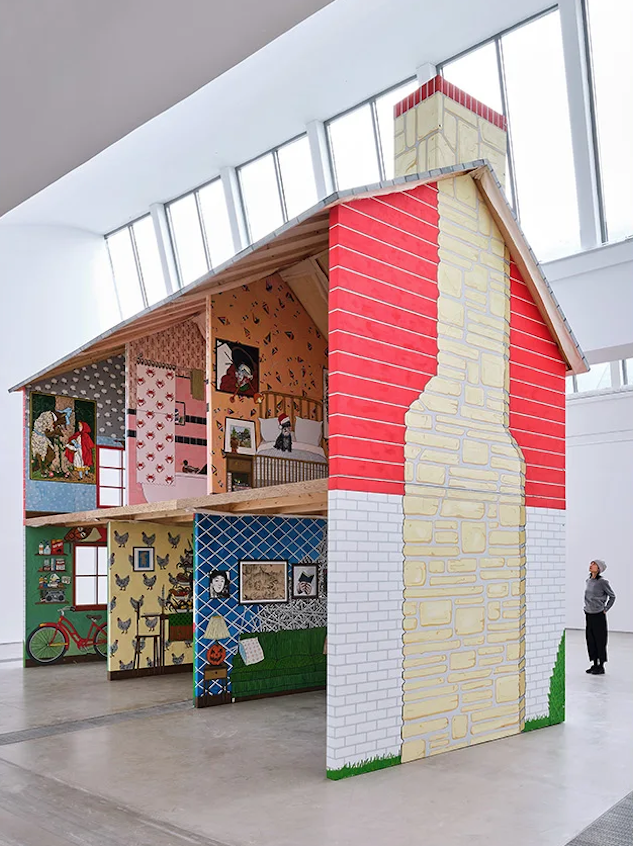
The Weston Art Gallery in Cincinnati presents Zachary Armstrong: Encaustic House , an immersive installation in which the American artist explores childhood, memory, and the idea of home through architecture constructed entirely of paint, running until August 30, 2026. The exhibition occupies the gallery's Street-Level Gallery and invites visitors to literally enter Armstrong's personal universe.
At the heart of the project is Encaustic House , a life-size house whose walls, roof, and floor are constructed from large encaustic paintings assembled with bolts. From the outside, the installation reproduces in three dimensions a dollhouse that had a discreet yet constant presence during the artist's childhood. That small structure is now transformed into a monumental architecture capable of containing memories, fantasies, and cultural references.
The interior offers a very different experience. In contrast to the recognizable and domestic appearance of the exterior, the walls are filled with complex and seemingly chaotic images that blend references to art history, personal memories, collective imagery, and elements of American popular culture. Armstrong thus combines the intimate and the familiar with a perspective imbued with humor, strangeness, and a certain darkness.
The encaustic technique plays a fundamental role in this work. Armstrong works with layers of beeswax mixed with pigments, a process that allows him to create dense, tactile surfaces. Once cooled, the wax can be cut, engraved, stamped, and sculpted, giving the painting an almost sculptural dimension. The artist began working with encaustic in his mid-twenties and has made this technique one of the defining elements of his practice.
The story of Encaustic House is closely linked to Armstrong's own life. The idea originated from a dollhouse he received from an old friend, which made him think about his childhood and the concept of home. For approximately fifteen years, the artist imagined how he could bring that small structure to its full potential until he decided to scale it up to a human size.
The Weston exhibition is complemented by an extensive shelving installation that spans the entire width of the gallery. It houses over 200 objects, including lamps, ceramics, paintings, and drawings. The display functions as a kind of mural portrait of Armstrong's artistic practice: each image or object relates to one of the works in the exhibition or alludes to other pieces by the artist.
This accumulation of objects also connects with one of the central aspects of her work: collecting as a way of constructing memory. In previous projects, Armstrong has used candles, ceramics, drawings, sculptures, and references from popular culture to create visual universes in which personal memories blend with art history and the American imagination.
Born in 1984 in Dayton, Ohio, Zachary Armstrong lives and works in his hometown. His work encompasses painting, sculpture, and installation, though encaustic holds a particularly prominent place in his artistic career. His art frequently draws on childhood memories, children's drawings, scenes from everyday life, and elements of Midwestern American culture, which he combines with references to natural history and art history.
Over the past few years, Armstrong has presented solo exhibitions in venues across the United States and Europe, as well as international projects such as Bag of Candles , presented at Faurschou Beijing in 2021-2022. Her work is characterized by the coexistence of painting and object, memory and popular culture, childlike naiveté and a more unsettling view of contemporary society.
With Encaustic House , the artist takes this investigation a step further. The house ceases to be merely a representation and becomes a space that can be physically explored. The visitor enters a childhood reconstructed through wax, paint, and objects, but also a reflection on how memories are formed and how domestic spaces end up becoming repositories of experiences, desires, and fears.

You may be
interested
...