
Exhibitions
Alfredo Jaar turns the number 11 into an open wound
The number eleven might seem like just another number. For Alfredo Jaar, it became an obsession. In 1974, a year after the coup that overthrew Chilean President Salvador Allende, the young artist began repeatedly writing the number 11, filling pages with thousands of repetitions and altering calendars to symbolically stop the passage of time. This numerical insistence stemmed from a specific date: September 11, 1973, the day a military coup ended Allende's democratically elected government and ushered in one of the darkest periods in Chile's recent history, marked by seventeen years of military dictatorship.
This relationship between memory, political violence, and representation runs through O lado oscuro da lua (The Dark Side of the Moon) , the exhibition that Alfredo Jaar presents at the Luisa Strina gallery from August 8 to September 19. The show brings together works and projects in which the artist analyzes how an image, a date, or a word can become a device for remembering what history risks erasing.
In some of the more direct pieces in the series, such as September 11 (Yellow) , September 11 (White) , and September 11 (Blue) , Jaar arranges row upon row of the number eleven on lined paper of different colors. The repetition takes on an almost compulsive dimension. Thousands of digits seem to try to pierce the very meaning of the number in search of an answer that never arrives.
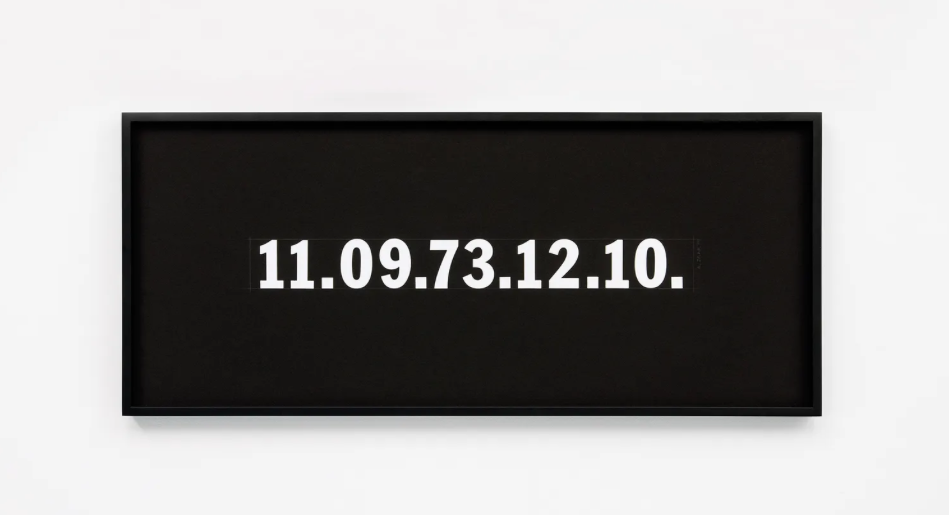
11.09.73.12.10, 1974 © artist [the artist].
The strategy is repeated in September 11, 1973 (Black) , where the calendars are constructed using white and red characters on a black background. The dates advance until they reach September 11, 1973, and from that point on, time seems to be suspended. The phrase "Only eleven after the eleven" encapsulates this operation: the number ceases to function as a simple temporal reference and becomes a marker of rupture.
Jaar introduces this alteration even into seemingly innocent images. In some advertising calendars, couples appear enjoying idyllic green landscapes, accompanied by messages that convey happiness, unity, and tranquility, and by the recognizable Coca-Cola logo. The advertising, designed to sell an image of well-being, thus coexists with an almost imperceptible intervention by the artist.
This is precisely where part of the power of these works lies. At first glance, the numbers might go unnoticed because the original object was conceived as advertising, not as a historical document. But, little by little, the elevens begin to infiltrate the image and generate a disquiet that completely transforms its interpretation. The viewer is then faced with a seemingly simple question: why have the dates been altered?
It could be a printing error, a minor anomaly, or an arbitrary decision. But it could also be the trace of a political event that irreversibly changed the lives of millions. The shifted dates thus transform an everyday object into a repository of memory.
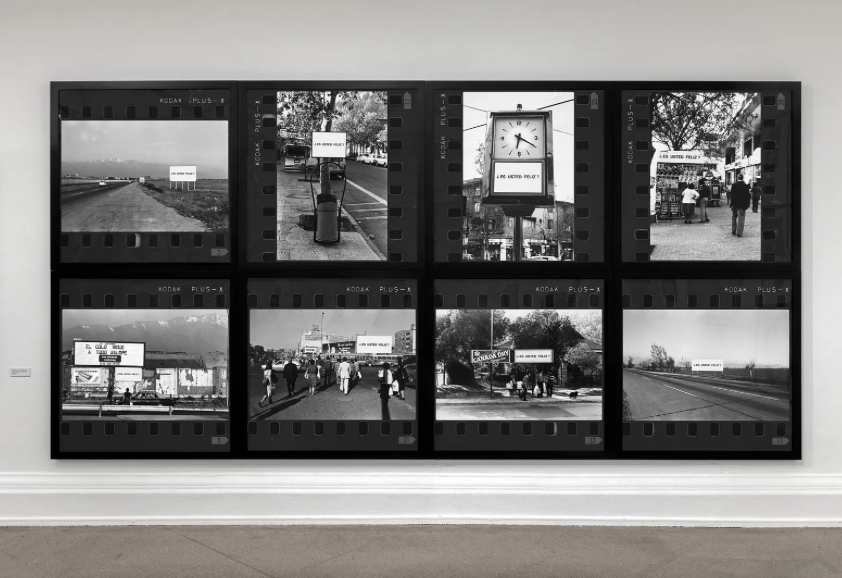
This tension between the intimate and the historical also appears in Studies on Happiness , one of Jaar's fundamental projects. The work invited different people to talk about happiness in public and private spaces, individually, in groups, or in front of a video camera. In the context of Chile during those years, when testimonies about political violence and the existence of detainees and disappeared persons were beginning to emerge, speaking took on a dimension that went far beyond everyday conversation.
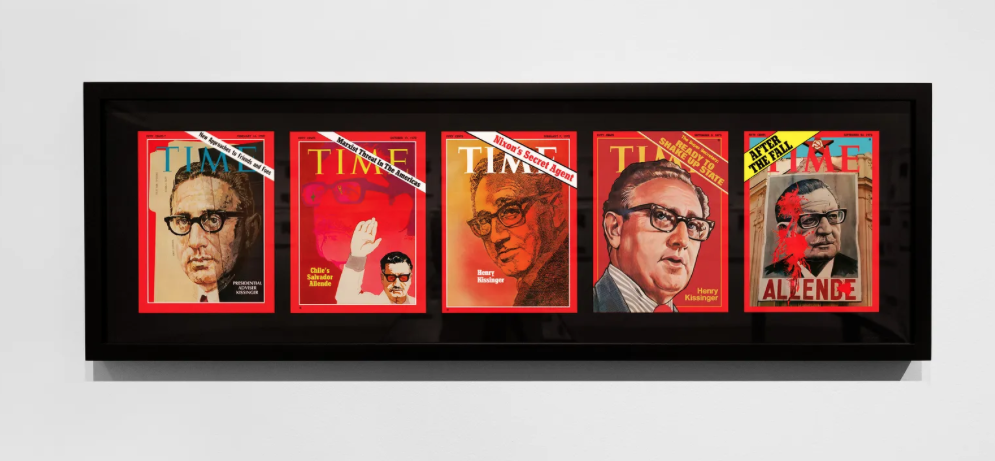
KISSINGER, ALLENDE, KISSINGER, KISSINGER, ALLENDE, 1985 © artist [the artist].
Through its various phases, Studies on Happiness was built as an open and iterative process. Each new conversation created a space for other voices to be heard and for strangers to share experiences and opinions. In contrast to the tendency to reduce historical events to figures and statistics, Jaar sought to recover the individual dimension of those who had lived through them.
The project thus raises a central question in the artist's practice: how to represent what has happened without reducing it to a single, fixed image. Instead of offering a single interpretation, Jaar constructs situations in which words, silence, repetition, and memory allow the viewer to participate in the construction of meaning.
In this sense, O lado oscuro da lua is not only an exhibition about Chile's past. It is also a reflection on the mechanisms by which we remember, on what images reveal and conceal, and on art's capacity to restore a human dimension to events that, with the passage of time, risk becoming mere historical facts.


You may be
interested
...