interviews
Jonàs Forchini: mapping what disappears underwater
bonart talks to Jonàs Forchini about 'Tèrbol. Territory and underwater visions', the exhibition he is presenting at the Museum of Archaeology of Catalonia.
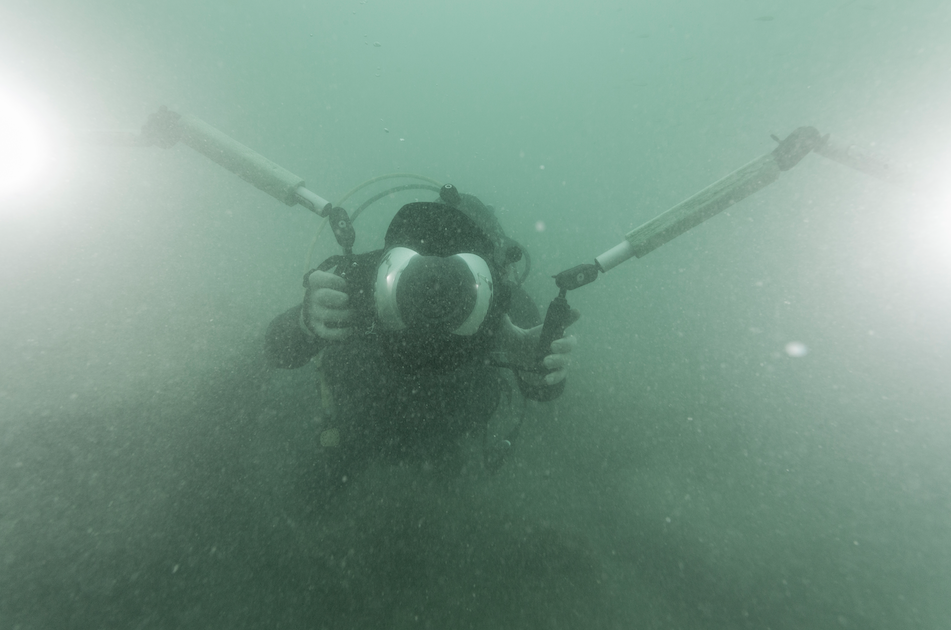
There are landscapes that cannot be observed clearly. Spaces where the gaze is conditioned by matter, light, time and even by the body's own ability to orient itself. In these territories, photography ceases to be solely an instrument of representation to become a tool of discovery. This is the premise of Tèrbol. Territori i visions submarines , the project by Jonàs Forchini presented by the Museum of Archaeology of Catalonia, an artistic investigation that takes as its starting point the submerged remains of the old lighthouse of the island of Buda, in the Ebro delta, to construct a reflection on memory, heritage, landscape and disappearance.
The exhibition revolves around an almost forgotten element. The Buda lighthouse, inaugurated in the 19th century to facilitate navigation at the mouth of the Ebro, ended up succumbing to the changes in the coastline until it disappeared under the waters. Today its remains remain submerged, converted into a contemporary archaeological site that speaks both of the country's industrial history and the constant transformation of the landscapes.
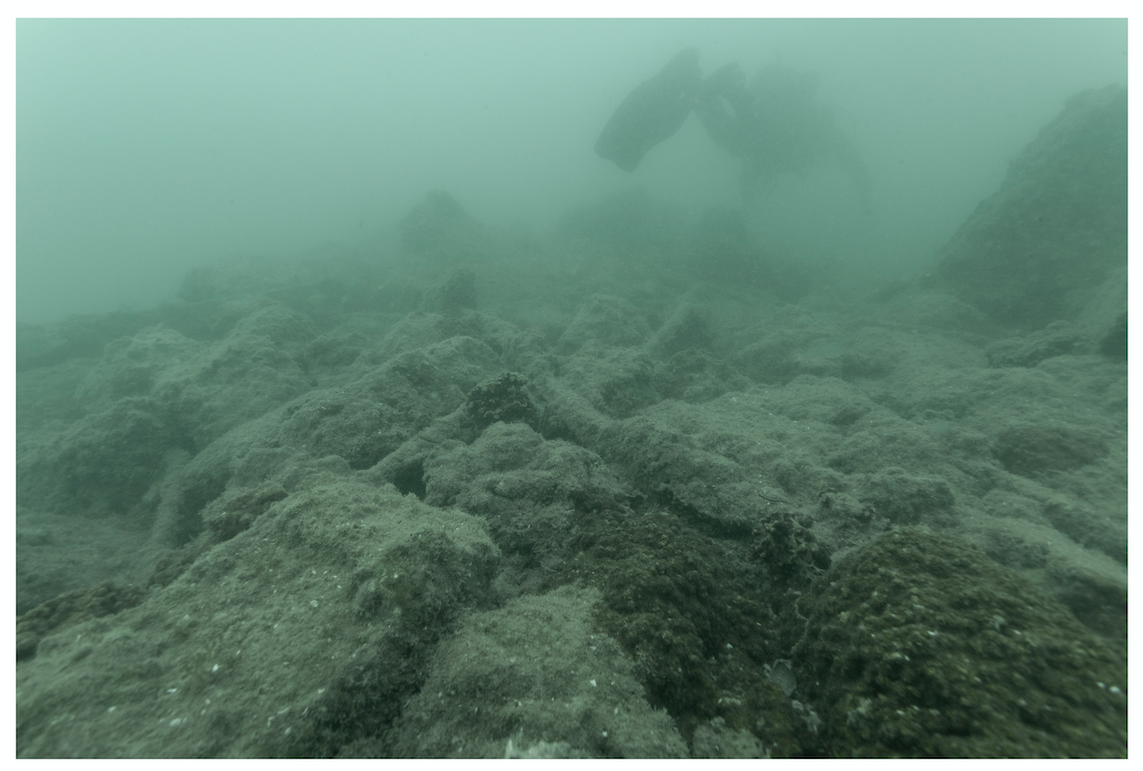
But Forchini does not arrive at this vestige solely from historical interest. His project is born from a double condition: that of a visual artist and that of a diver operator linked to the Center for Underwater Archaeology of Catalonia (CASC). This direct relationship with scientific work has ended up defining a good part of his way of understanding photography.
"This project arises from an artistic residency focused on underwater photography on the Tarragona coast and in Terres de l'Ebre. At the same time, I work with the Underwater Archaeology Center as an operating diver. This dual link allowed us to establish a very natural collaboration between artistic and scientific research."
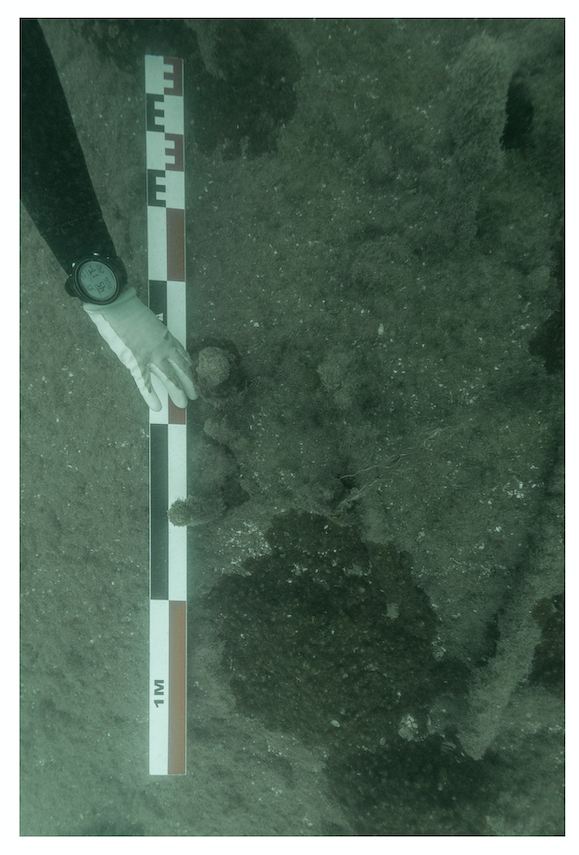
This complicity gave rise to an expedition with a very specific objective: to locate the remains of the Buda lighthouse. The paradox is that, despite being part of Catalan heritage, no one knew its precise location. "The CASC archives documented the collapse of the lighthouse, but there was very little information. There was practically no photographic documentation and the location was very imprecise. When we started the search we didn't know exactly where it was."
The search ended up becoming a shared experience between archaeologists and artist. "From this artistic initiative we involved the scientific teams. Finally we located it, an express dating was done underwater and we generated a whole visual documentation that today constitutes a very important part of the exhibition."
This origin already defines a good part of the project. Térbol is not a historical reconstruction nor a conventional documentary report. It is an investigation where art and archaeology share methodology, doubts and discoveries.
The lighthouse as a metaphor
For Forchini, the Buda Lighthouse is much more than a vanished piece of architecture. Its symbolic value is as important as its heritage value. "That a lighthouse built to rise above the landscape, to illuminate the horizon and represent an idea of progress is now underwater seems deeply revealing to me. It is almost a metaphor for the decline of modernity."
The artist observes this displacement with a critical eye. "When you consult the historical documentation you discover that this lighthouse became a technological symbol. A replica was even exhibited at the Universal Exhibition in Paris. Comparing that triumphant iconography with today's reality inevitably invites us to reflect on the obsolescence of certain technologies but also on the way the West has understood progress."
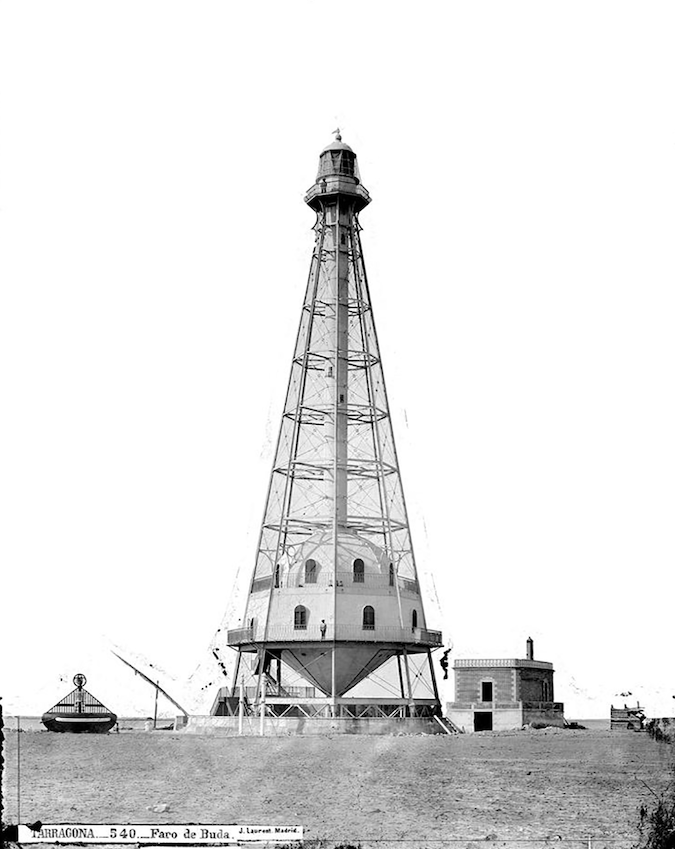
The structure, designed to dominate the landscape from the heights, ends up becoming an archaeological fragment hidden under the sea. "It's like a lighthouse that has gone out twice: first it stopped illuminating navigators and then it also almost disappeared from collective memory. Only the people of the territory retain a living memory of it."
This displacement is precisely what interests Forchini. More than recovering a monument, what he seeks is to activate a reflection on what disappears without making a sound.
Learning to look from uncertainty
The title of the exhibition encapsulates a whole way of understanding artistic practice. The term turbid describes the physical condition of sediment-laden waters, but also a perceptual experience. "The first meaning of turbid is technical. It has to do with the difficulty of seeing underwater. But this difficulty ends up becoming a much deeper experience."
For the artist, the first lesson of diving in these environments is frustration. "I always say that turbidity is a learning experience of frustration. You have to accept that many times you won't be able to see what you're looking for. Weather conditions, currents, sediments... everything conditions your gaze."
This learning ends up transforming the way we inhabit the landscape. "Uncertainty ceases to be a technical problem and becomes almost a philosophical question. You learn to position your body, your gaze and your camera in a space that has practically no horizon."
Forchini argues that these limitations do not reduce creative possibilities, but rather amplify them. "It is a very limited space visually, but precisely within this limitation other ways of seeing appear. This is the potential that I am interested in exploring."
When the camera sees more than the photographer
One of the most suggestive aspects of the project is the reflection on photography itself. In Tèrbol , the camera does not act solely as a recording device. "Here photography functions almost as a prosthesis of the gaze."
The artist explains that digital technology is capable of capturing information that the brain cannot process during the dive. "When you dive in such opaque waters you are not fully aware of what you are seeing. It is when you review the images that you truly understand the space you were in. Photography surpasses my own perception."
Current cameras allow hundreds of images to be generated in a single dive. "The new sensitivities of digital sensors interpret the turbidity better than we do. The images end up constructing a topography that the body had been unable to perceive."
Photography thus becomes a tool for shared knowledge between artist and archaeologists. "These images allow us to better understand the configuration of the underwater floor and reconstruct a reality that, during the dive, had gone practically unnoticed."
The body also photographs
Working underwater is determined by very different factors than those that condition terrestrial photography. The immersion time is limited. The available air determines every decision. "The first conditioning factor is always time. Each photograph is also a constant management of the air you carry."
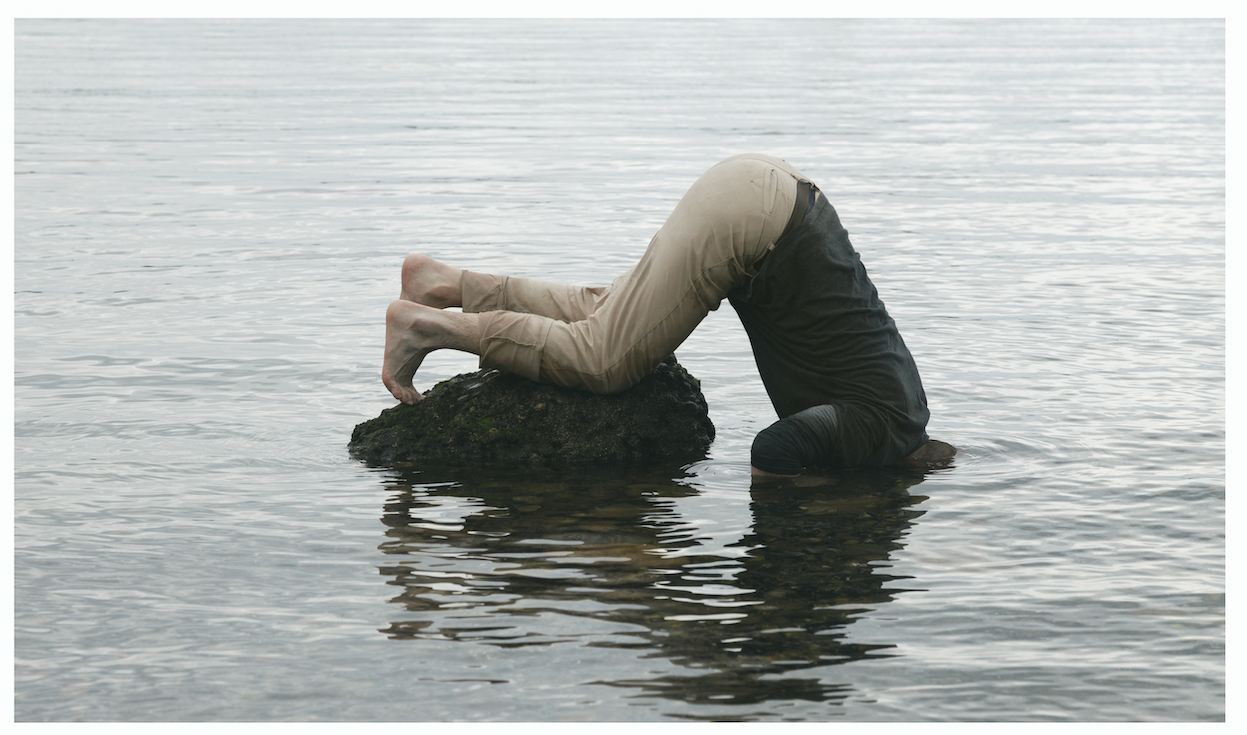
But there is another, even deeper limitation: the loss of spatial references. "We spend a lot of time trying to understand space because, simply, we are lost." In these conditions, the body becomes as important a tool of perception as the camera. "You have to learn to move almost anticipating the landscape. Many times you get to know it first by touch than by sight."
Photography incorporates this physical experience. "There's a lot of chance. I'm often not aware of what I'm photographing. Sometimes I separate the camera from my face and continue making images without looking at them directly. It's an extension of the body rather than the gaze." This bodily component radically distances the project from the traditional codes of documentary photography.
New imaginaries of the underwater world
Forchini also questions the visual imaginaries that have dominated underwater photography for decades. "Most of the images we consume continue to reproduce a very aesthetic idea of the sea: transparent waters, coral reefs, exotic fish... It's a very consolidated imaginary."
According to the artist, this iconography comes from both the tourist industry and the first great audiovisual stories about the underwater world. "Art and science are today practically the only fields that are generating new imaginaries. It is no longer just about showing beauty, but about explaining other landscapes and other experiences."
In this sense, Têrbol reclaims seemingly innocuous spaces. "Contemporary terrestrial photography has been working on the ordinary for many years. On the other hand, underwater photography is still beginning this path. I am interested precisely in directing our gaze towards these places that no one considers spectacular."
Heritage in the face of climate change
The project also connects with an increasingly urgent issue: the fragility of underwater heritage. Catalonia preserves hundreds of archaeological sites under the sea, many of which are affected by storms, coastal regression or the effects of climate change. "Extreme episodes bring new sites to the surface, but at the same time accelerate their degradation."
For Forchini, this situation forces us to rethink the role of documentation. "It is impossible to preserve everything. Many things will be lost. The great challenge is to document them so that this memory can continue to exist even if the landscape disappears."
Here art reconnects with science. "Documentation not only has a heritage value. It also allows us to construct critical discourses on the disappearance of landscapes, on the loss of territories and on the transformations that the coastline is experiencing."
The Buddha Lighthouse is, in this sense, a paradigmatic example. "These remains tell us about a cartography that no longer exists. The current landscape is different, but the images allow us to understand what was there before and what we have lost." Far from proposing a nostalgic look, Forchini defends that this acceptance of disappearance is part of the creative process. "In the end, everything comes back to the same idea: the acceptance of loss. Not only the loss of objects, but also of landscapes, of memories and even of ways of looking."
With the temporary exhibition Tèrbol. Territory and Underwater Visions at the MAC, presented in parallel with the installation of the Showcase at the Abelló Museum in Mollet del Vallès a few months ago, Jonàs Forchini invites the visitor to question the way we observe the landscape, but also what remains outside our field of vision. In this process, photography becomes a fundamental tool of exploration, capable of revealing realities that often remain hidden from view.
You may be
interested
...