Exhibitions
Delcy Morelos, the land as a language of resistance in Bozar
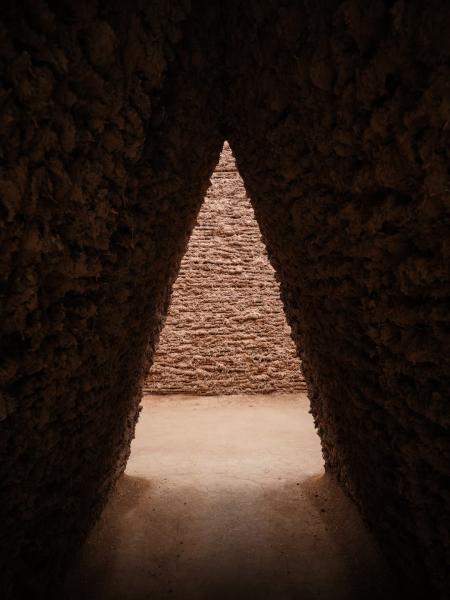
Heading to Bozar in Brussels, where Colombian artist Delcy Morelos presents one of the most ambitious interventions of her European career. The monumental installation, open until August 30, 2026, reaffirms one of the fundamental lines of Morelos's practice, which for decades has explored the relationship between the body, the landscape, and indigenous knowledge, positioning nature as an active subject and not as a mere resource at the service of humankind.
Internationally recognized for her immersive installations made with earth, clay, plant fibers, seeds, and natural pigments, Morelos has created a body of work that challenges the separation between art, ecology, and spirituality. Born in Tierralta, in the Colombian department of Córdoba, her work is deeply connected to the ancestral knowledge of Indigenous and Afro-descendant peoples of Latin America, whose understanding of the land becomes the conceptual core of her art. In contrast to the extractive logic that has defined much of Western modernity, the artist advocates for alternative ways of inhabiting the world based on care, reciprocity, and interdependence.
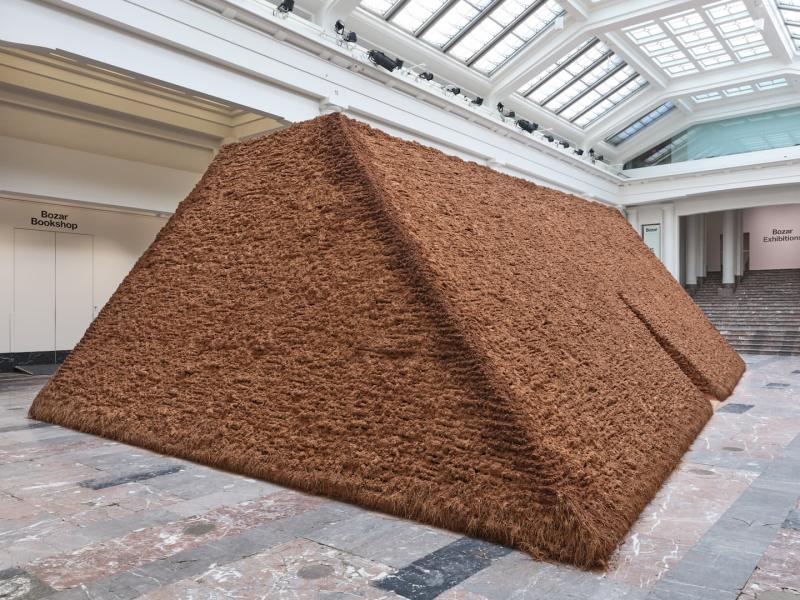
The intervention conceived for Bozar establishes a dialogue between traditional South American construction techniques and certain forms of European vernacular architecture. To achieve this, Morelos employs local, biological materials—earth, clay, and natural fibers—underscoring the importance of local resources and manual processes in contrast to the industrialization of contemporary construction. The collaboration with Belgian architect Jasper van der Linden broadens the project's scope by introducing a shared investigation into the sustainability and architectural possibilities of these materials within a European context.
The visitor passes through a space dominated by texture, the scent of damp earth, temperature variations, and the almost organic presence of matter. The work eschews technological spectacle to recover a sensory dimension that compels one to slow down and establish a different relationship with the surroundings. In this sense, the monumentality of the proposal lies not only in its dimensions but also in the intensity with which it alters the perception of the architectural space designed by Victor Horta.
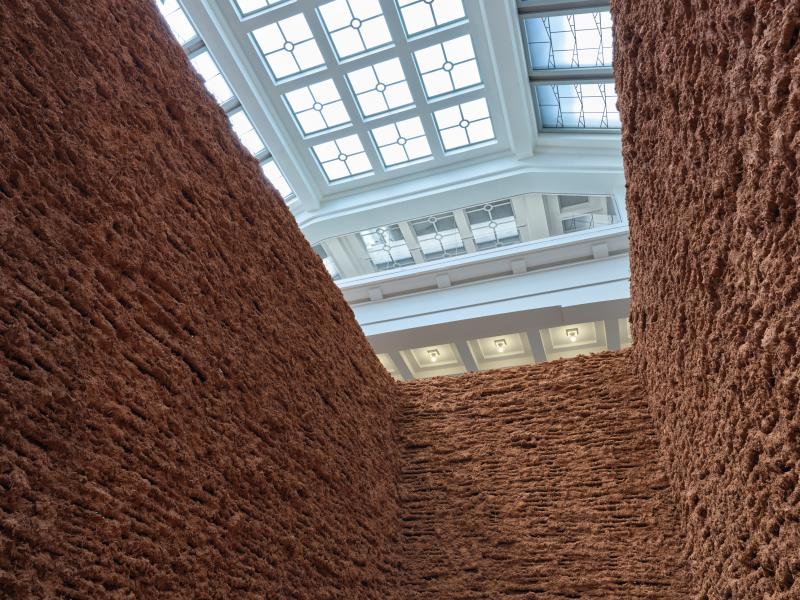
From a critical perspective, Morelos's work is situated within one of the most relevant debates in contemporary art: the incorporation of Indigenous epistemologies as tools capable of questioning dominant models of cultural and economic production. Without resorting to illustrative or propagandistic discourses, his installations propose an experience in which matter itself becomes a political language. The earth appears as an archive of collective memories, but also as evidence of the fragility of ecosystems and the need to rebuild an ethical relationship with the planet.
This reflection connects with Delcy Morelos's growing presence on the international art scene. In recent years, her work has been featured in major exhibitions and biennials, solidifying a practice that has resonated particularly strongly in Europe thanks to its ability to address environmental issues from a profoundly poetic and decolonial perspective. Her language avoids both didacticism and literal representation: it is the materials themselves—their weight, their scent, and their transformation—that construct the discourse.

You may be
interested
...