reports
Xavier Corberó: the total work of art
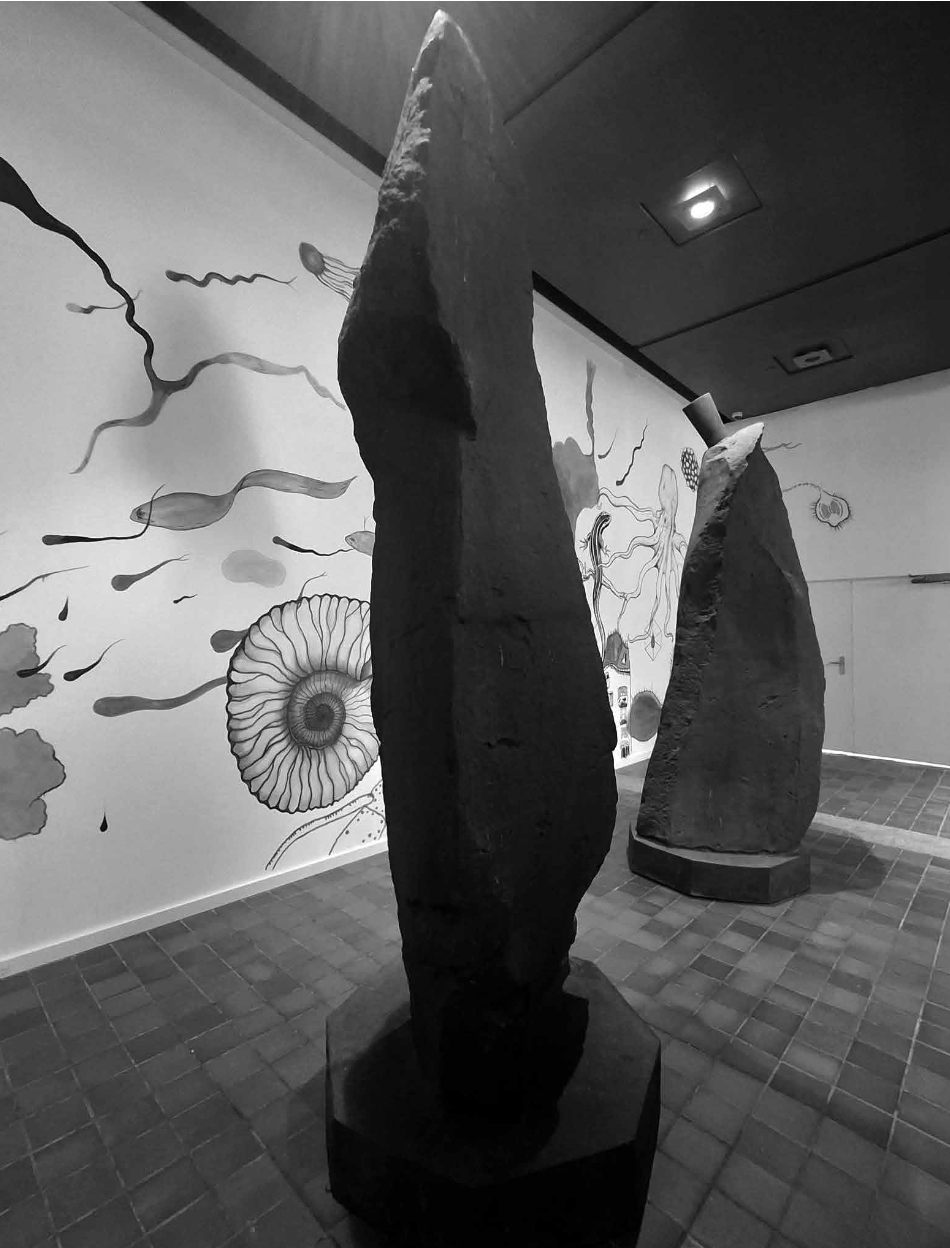
While with the arrival of democracy Barcelona projects an image of a global and avant-garde metropolis, an entire generation of Catalan artists from the second half of the 20th century was trapped in a kind of “historiographic limbo”. Recovering these creators is not only an act of poetic justice but an urgent need to understand the true genealogy of contemporary art in Catalonia. They make up the diversity and complexity of this moment that for a long time seemed dominated by certain names. It is urgent to review and reread the contribution of the artists who acted in this stage and to make a “repair of history”. The reconstruction of the long post-war period is still in process and the canon continues to be discussed. In these years, art in Catalonia is moving from opposition and isolation to critical response and positioning within the international context. It is necessary to reexamine the hierarchies that have been drawn and to put order into an era with new perspectives and readings. In this sense, it is necessary to recover those figures to whom history and criticism did not give enough consideration despite making significant personal contributions. Hence, intense work is currently being carried out to reposition many authors who were left in a certain oblivion, far from the spotlight of the great icons, such as Picasso, Miró, Dalí and Tàpies.
The Second Avant-garde: The rescued link of modernity
The historiography of art in Catalonia has often operated under a logic of major stages and has overlooked some very significant periods, such as the Second Avant-garde, developed approximately between 1940 and 1970; a generation that fought in silence. Emerging after the trauma of 1939, it was not a unitary movement, but a constellation of resistances that allowed the flame of modernity not to be extinguished. Names that explored informalism, geometric abstraction, critical pop art or new figuration were left on the margins and who did not always count on the favor of official exhibition channels. As J. Corredor-Matheos says: «All these artists are among the generations that formed the avant-garde and those that have put it in crisis. In the middle of both, this generation "of the middle", as the master of Catalan criticism Alexandre Cirici called it, has participated in the hopes and despairs of both, and is also faced with a multiplicity of challenges, when the personality of its components is already defined and their art is recognized.
The map of Catalan art will remain incomplete as long as these creators continue to be footnotes. It is time to complete the intellectual whole with the “missing links” of artists who kept the critical spirit alive in the darkest moments of Francoism. There is a whole heritage at risk, since many of these legacies are in the hands of families who cannot manage them or remain in warehouses without being catalogued. Without institutional and academic intervention we run the risk of them dispersing or disappearing.
Recovering and relocating names like Xavier Corberó (Barcelona, 1935 – Esplugues de Llobregat, 2017) is understanding that Catalan modernity was multifaceted. Claiming these artists is not an exercise in nostalgia, but rather in cultural sovereignty. Many were relegated and their careers little recognized. Corberó occupies a unique and strategic place within the framework of the Second Catalan Avant-garde. Unlike others who were dazzled by informalist research, dominated by matter, darkness and gesturality, with Tàpies at the forefront, Corberó introduced technical perfection and an almost jeweler's precision. His work claimed elegance, geometry and a polished finish that contrasted with the prevailing aesthetics, which were more abrupt and existentialist in nature.
On the other hand, Corberó was one of the most international figures of his generation. His time at the Central School of Arts and Crafts in London and his close friendship with luminaries such as Salvador Dalí and Marcel Duchamp allowed him to act as a connecting node. He defined himself as a great friend of Dalí, whom he considered his "first patron". Although Corberó distanced himself from Dalí's figurative surrealism, he inherited his ambition for the total work of art and his taste for the oneiric. They shared a vision of the artist as a character who builds his own universe. Dalí admired Corberó's technique, who went so far as to supervise projects based on notes from the genius of Figueres, such as the controversial monolith projected for Barcelona.
In short, Xavier Corberó was not a "relegated" artist in the strict sense, but an atypical personality who, thanks to his international success and his management skills, avoided the oblivion suffered by other colleagues of his generation, becoming one of the greatest aesthetic promoters of modern Barcelona.
The promoter of public space (Barcelona'92)
Within the framework of the Cultural Olympiad and in the context of the recovery of the city of Barcelona, Corberó's role was fundamental as a manager and dynamizer, advising the mayor Pasqual Maragall. That metamorphosis involved a reorganization of the urban landscape in which art played a strategic role. Hence, in 1992, more than fifty sculptures were placed, in addition to another fifty installed since the city was nominated as the host of the XXV Olympic Games. Corberó was the advisor who convinced world-class artists such as Richard Serra, Fernando Botero, Anthony Caro, Claes Oldenburg and Roy Lichtenstein to donate or install monumental sculptures in Barcelona, redesigning the urban landscape of the Olympic city. Beyond their artistic value, these performances in public space become transforming elements of the environment and the behavior of citizens, becoming authentic urban emblems. In addition, he himself was the designer of the Barcelona '92 Olympic medals.
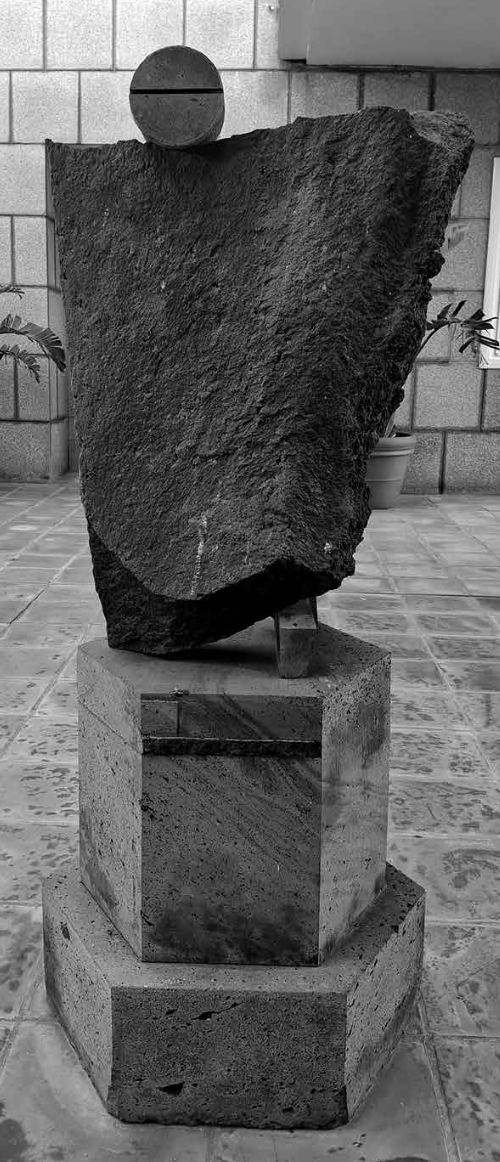
Corberó's premise was based on integration. He did not accept that sculpture was an object simply attached to the ground, but that it had to be contextualized with the urban environment. He wanted the sculptures to be part of the landscape, enriching it without imposing itself on it. Artistic interventions in the public domain had to confer a feeling of community, of collective belonging and identity. This is demonstrated by works such as A Nicolau Maria Rubió i Tudurí (1983, gardens of Vil·la Amèlia), Homenatge a ses Illes (1983, plaça de Sóller), one of the most iconic, formed by a series of marble blocks that dialogue with water and architectural space; L'ou com balla. Homage to the artists of Poble-sec (1987), Terminus Columns (1988, Plaça John F. Kennedy), a tribute to the American president conceived as a modern reinterpretation of the old terminus crosses; or the monoliths SM el Rei and SM la Reina (1988), belonging to the MACBA collection and located in front of the Faculty of Translation and Interpretation of the Universitat Autònoma de Barcelona. Despite their monumentality and a certain anthropomorphism, they seem to have been naturally detached from the block of stone.
Also particularly significant are The Traveler (1992), in front of the Palau de Congressos on Avinguda Diagonal; To Josep Tarradellas. Stone on Stone (1998), on the avenue that bears the president's name; the sculptural ensemble Ejecutores y ejecutados (1973), for the Fundació Juan March in Santa Cruz de Tenerife, an allegory on repression; the works of Cala Rajada, integrated into the Sculpture Garden of the Fundació March in Sa Torre Cega; and The Family (2003), in Esplugues de Llobregat, a set of anthropomorphic basalt figures that preside over the entrance to the city and announce the Espai Corberó.
He was also a highly regarded artist internationally. The Broad Family, located in the Broadgate complex in London, near Liverpool Street station, is a basalt sculptural ensemble that has become one of the landmarks of the City. His success in the United States was also notable. The Metropolitan Museum of Art and the Museum of Modern Art in New York incorporated his works into their collections, while he also installed sculptures in universities and corporate spaces in Chicago and Washington, consolidating his image as a sculptor of "classical modernity". His work is also present in the Stedelijk Museum in Amsterdam and the Victoria and Albert Museum in London. At the same time, he stood out as a jewelry designer, creating pieces with diverse materials and an unmistakable sculptural language.
Hotel Arts: a shared collection
Designed by the famous architect Bruce Graham, the Hotel Arts is a glass tower surrounded by a white steel structure, whose gardens rest under the shade of Frank Gehry's goldfish. Inaugurated in 1994, it is one of the great icons of contemporary architecture in Barcelona and also one of the private spaces with the most outstanding collection of Spanish art and functions as a true art gallery. The monumental sculptures of Xavier Corberó stand out, made mainly in marble and basalt, materials that he mastered with a great sensitivity to light and volume.
At the main entrance is one of the most emblematic pieces of the collection, The King and The Queen (1988), two basalt sculptures over three and a half metres high that welcome visitors and establish a dialogue between contemporary architecture and the nobility of carved stone. Around the terraces and gardens, other large totems rise, integrated into the landscape, where Corberó develops his characteristic language of columnar and anthropomorphic forms that seem to silently guard the space. His sculptures seek extreme simplicity, often resolved with just a few incisions that confer identity and expressiveness to the block of stone. Most of these works were direct commissions carried out during the construction of the hotel for the 1992 Barcelona Olympic Games, making the Hotel Arts one of the most relevant testimonies of the integration between architecture, public space and contemporary sculpture that Xavier Corberó defended throughout his career.
The creator of habitable utopias
In the old heart of Esplugues de Llobregat, in 1968, Xavier Corberó began building what would be the great creation of his life. A living manifesto that is not just a gigantic bastion located on a 4,000 square meter plot that currently encompasses nine buildings, but a habitable sculpture that functioned as a center for artistic activities and a refuge for other creators, embodying the idea that art should not be confined to museums, but should be part of the living environment.
A labyrinth of arches, courtyards and basements functioned for decades as a center of intellectual activity. The project was born with the purchase of the Can Cargol farmhouse as a place to live and work and, over the course of five decades, eight more buildings were added, with labyrinthine rooms and staircases reminiscent of MC Escher's impossible architectures. In 1972, he expanded the functions of the workshop by founding the Center for Artistic Activities and Research (CAIAC), conceived as a residence for artists.
Corberó invested all the resources he obtained from his work there and, even when he died at the age of eighty-one, he continued to be obsessed with this total work that remained almost secret for a long time. In recent years, however, the space has become the setting for filming, events and films such as Vicky Cristina Barcelona , by Woody Allen. The artist mortgaged himself on numerous occasions to make that colossal dream a reality that, despite leaving it unfinished, he defined as "a miracle".
He used concrete and stone to construct a set of buildings with courtyards, gardens and ponds. It is a surprising and intricate space where the hundreds of concrete arches that overlap on different levels and stairs make the visitor feel as if they are inside a painting by Giorgio de Chirico or a surrealist dream, where monumental basalt sculptures coexist in perfect harmony with nature and trees. The arches do not fulfill a conventional structural function, but serve to frame the light and generate an infinite play of perspectives and shadows that varies depending on the time of day.
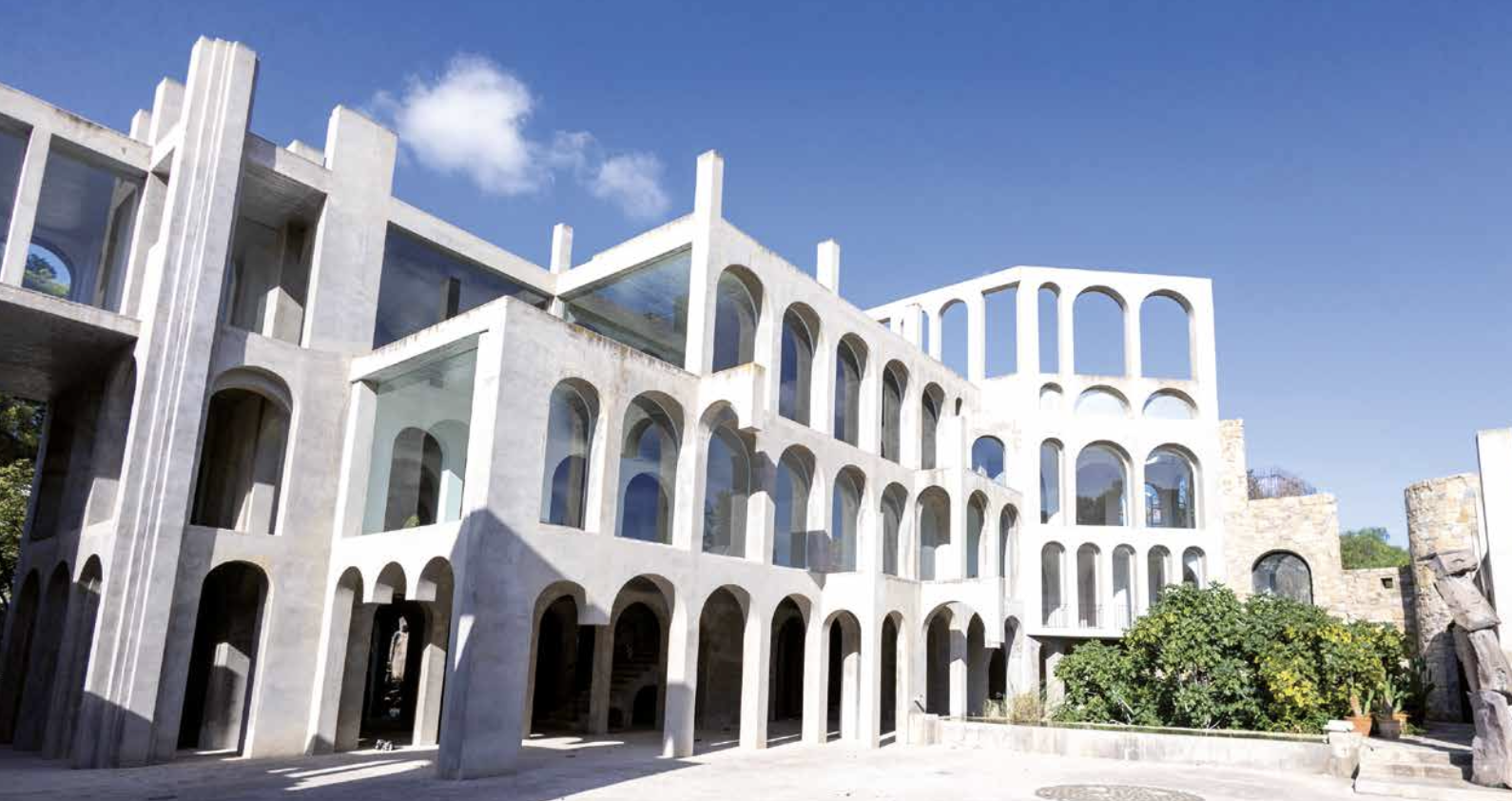
Another essential characteristic is the constant relationship between interior and exterior through patios, zenithal openings and open spaces. Corberó managed to make the garden and the sky part of the rooms, breaking the hierarchy of traditional walls. For this reason, the Espai Corberó should not be understood as a building, but as a large walkable sculpture; probably his great posthumous work. A metaphysical space where light and emptiness are as important as solid matter. Everything is conceived to be explored with the senses, where the touch of materials and the echo of the echo are as relevant as the gaze.
Future of the Corberó complex
In mid-2022, the Esplugues de Llobregat City Council acquired from the family, for three million euros, part of the site, the Espai Corberó, a large three-storey structure of cement arches with the aim of preserving it as heritage and opening it to the public on specific days, consolidating it as one of the great architectural jewels of the metropolitan area.
The acquired space is mainly made up of a lateral body built on the ground floor that runs the entire length of the property, several courtyards, water ponds and a second building. The built complex totals 1,995 m² on a plot of 2,055 m², with several buildings and open spaces. In the basement there is an auditorium with a capacity for between 250 and 300 people. Inside the property, between two courtyards, another construction is built consisting of reinforced concrete slabs, semicircular arches and stairs that make up a set of open or semi-closed rooms and terraces, distributed between the ground floor and three floors, some enclosed with glass and others completely open to the landscape.
With this acquisition, the council not only incorporates a new cultural facility, but also vindicates the artist's legacy, deeply linked to Esplugues. It is currently working on a use plan to define the future of the site as a center for cultural activities and artistic research.
At the same time, between July 2025 and July 2026, the City Council is commemorating the ninetieth anniversary of Xavier Corberó's birth with a special program aimed at disseminating his public heritage. Every first Sunday of the month, guided tours are organized through the municipal museums and conferences dedicated to architecture and art are also planned with the participation of prestigious architects, coinciding with Barcelona's World Capital of Architecture. A new stage that aims to definitively place Corberó's legacy at the forefront of contemporary creation.
Biographical profile
Descendant of a family of goldsmiths and metalworkers, Xavier Corberó was a creator endowed with extraordinary charisma. He began drawing and working with metals in the family workshop and later began his studies at the Escola Massana, an institution of which his father had been one of the founders. This origin deeply marked his defense of the trade and the permanent vindication of artisanal work.
After a first step in Paris and Sweden, he settled in London, where he discovered the sculpture of Henry Moore, while cultivating painting. Between the end of 1955 and 1959 he studied at the Central School of Arts and Crafts, where he met David Hockney —who years later would visit the Espai Corberó—, and also at the Royal College of Art.
In 1955 he participated in the Hispano-American Biennial of Barcelona, where Salvador Dalí acquired all the works he presented there, beginning a friendship that would be decisive. In 1959 he exhibited individually in Lausanne, a city where he spent a fundamental period of training working in the Medici foundry. He later participated in numerous European collective exhibitions and in the Salons de Maig in Barcelona, where he won the Manolo Hugué (1960) and Ramon Rogent (1961) awards.
After these recognitions he moved to New York, at a time when Op Art was attracting great international interest. Critics considered him one of the representatives of that language based on geometric shapes and optical illusions. Two years later he exhibited in Munich, where he received the Gold Medal of the State of Bavaria. From there he continued to show his work in Pittsburgh, New York and Japan, while being invited to give lectures and workshops in the United States, a country where he would reside on numerous occasions.
Upon his return to Catalonia, he permanently established his residence in Esplugues de Llobregat, where in 1972 he founded the Centre d'Activitats i Recerca Artístiques de Catalunya. In Cadaqués he formed part of Marcel Duchamp's circle, a friendship that, together with other international contacts, opened many doors for him in the United States.
Among the main recognitions received are the Bavarian Gold Medal (1963), the Cross of Sant Jordi (1992) and his appointment, in 2000, as a full member of the Royal Catalan Academy of Fine Arts of Sant Jordi, an institution of which he would later become a supernumerary member.
The cut versus the shaping
Stone, despite being one of the oldest materials used by humanity, played a fundamental role in the evolution of modern sculpture. During the first third of the 20th century, numerous sculptors recovered direct carving, working with stone without intermediaries. Instead of modeling pieces in clay or plaster to be later executed by specialized technicians, they directly assumed the sculptural process as a modern and radical attitude.
Unlike other sculptors who preferred modeling, Xavier Corberó defined himself as a carver. He believed that the sculptor had to disappear so that the stone could speak. While other artists aspired to master the material, he sought to "find what the stone wanted to be", following an attitude close to that of Michelangelo: excavating the block, eliminating what was left and discovering the form that was already latent there.
After an initial period dedicated to metals, characterized by an abstract and structured language, he turned to sculpture in marble and stone, achieving an extraordinary formal purification. During the 1970s and 1980s, his work evolved towards an organic and biomorphic abstraction, inheriting the approaches of Jean Arp. Especially in the 1980s and 1990s, he worked with black, white and pink marble to create sensual, fluid and refined forms, far removed from the geometric severity of his beginnings.
He never gave up experimenting with other materials, such as wood, esparto grass or iron, establishing dialogues between the nobility of marble and humbler textures to generate unexpected visual tensions. He later incorporated combinations of marble with bronze, steel or granite.
Corberó established a particularly intense relationship with basalt, a material that would become the protagonist of his production from the 1990s onwards. This dark, compact volcanic rock allowed him to express his connection with the earth. He left some parts in their natural, rough state, while polishing others until they became shiny surfaces like black mirrors or liquid transparencies.
With basalt he managed to make the heavy seem light, elegant and almost fluid. Although many of his sculptures exceed two hundred tons, he endowed them with a surprising humanity. The figures adopt ironic and affable attitudes and are conceived as "families" or groups of friends who permanently inhabit the spaces, becoming silent guardians of the landscape. By constantly playing with weight and weightlessness, he creates monumental compositions that seem to float or fit together with almost impossible precision.
Daniel Giralt-Miracle, a friend of the artist and one of his main scholars, wrote on the occasion of Corberó's exhibition at the Cap Roig Botanical Garden (2003): "Having combined these two worlds, that of forcefulness and strength with that of intimacy and poetry, gives the exhibition a dimension of someone who has deliberately and conceptually wanted to be a sculptor rather than a painter or goldsmith."
Xavier Corberó's career unfolds between two extremes—the macro and the micro—with an open and uncomplicated reading. Perhaps that is why critics have seen in him, at the same time, a profound classical sense of permanence and a visionary romanticism that, added to his mastery of the craft, his transversal view and his way of thinking like a master builder, make him one of the great contemporary classics.
His is one of the most unique and poetic trajectories of 20th century sculpture. An evolution that does not follow a straight line, but rather a journey from the mastery of the material to the construction of habitable worlds. With Xavier Corberó, the boundary between sculpture and architecture dissolves definitively.
You may be
interested
...