News
Figueres revisits the beginning of the Spanish Civil War through the eyes of Agustí Centelles
Ricard Martínez stars in a talk commemorating the 90th anniversary of the coup d'état of July 1936 and vindicating photography as a tool for understanding memory, conflict and the visual construction of history
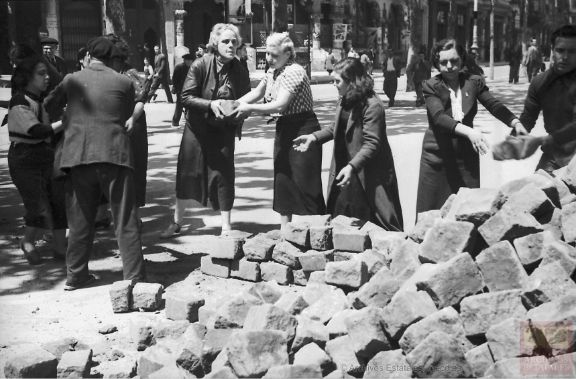
Next Thursday, July 16, Figueres will host the talk "Seeing a War Begin. Agustí Centelles and the Visual Construction of a Conflict ," by photographer, visual artist and researcher Ricard Martínez Teruel. The proposal is part of the commemoration of the 90th anniversary of the outbreak of the Spanish Civil War, a key episode for understanding the contemporary history of the Spanish State and, also, of 20th-century Europe.
This July marks the 90th anniversary of the 1936 coup d'état, the military uprising that precipitated the beginning of a conflict that would profoundly mark the political, social and cultural life of the country. The partial failure of that coup—promoted by the military with the support of a civilian plot—led to open war between the two sides in dispute. Resistance on the streets of Barcelona from the early hours of July 19 played a decisive role in this outcome.
In the Catalan capital, the so-called national uprising resulted in an armed confrontation in which the popular classes, with the support of police forces loyal to the Republic, managed to defeat the military rebellion that had arisen from the barracks. The Republican victory in Barcelona was decisive: it gave impetus and legitimacy to other cities such as Madrid or Valencia, which also remained faithful to Republican legality.
Those turbulent hours were captured by the lens of several photojournalists, who turned the urban battle of Barcelona into one of the first great visual accounts of the war. The images published in the national and international press not only documented the events: they also contributed to building the narrative of a conflict that had just erupted. Photographers such as Sagarra, Pérez de Rozas and Agustí Centelles followed those events closely, but it was Centelles —the youngest of them all at the time— who most clearly sensed the historical significance of what was happening.
Centelles thus became the reporter who took the most photographs during those decisive hours. Among them, some have become iconic, such as the one of the assault guards parapeted behind a barricade of dead horses, an image that over time has become one of the most powerful and recognizable representations of the Civil War.
The Figueres conference proposes to approach the events of July 1936 from the perspective of photography and, especially, its capacity to shape collective memory. To do so, it will feature the presence of Ricard Martínez Teruel, visual artist, photographer, historian, teacher and founder of the Arqueologia del Punt de Vista project.
Martínez focuses much of his work on rephotography, a discipline that relates two or more images taken from the same point of view at different moments in time, often separated by decades. Beyond the formal exercise, this practice becomes a critical tool for analyzing the relationship between image, memory and territory, and for understanding how photographs of the past condition our view of the present.
Through projects that combine historical research and visual creation, Martínez has investigated how certain images end up shaping cultural landscapes and the way a society remembers its most traumatic episodes. On this occasion, his intervention will focus on the report that Agustí Centelles made on July 19, 1936 in Barcelona, a set of images that is fundamental to understanding not only the outbreak of war, but also the visual construction of that foundational moment of the conflict.
You may be
interested
...