Exhibitions
Sweet revenge: Felix Gonzalez-Torres' most intimate return to Madrid
The Reina Sofía Museum revisits the work of the Cuban-American artist in an exhibition that transforms memory, fragility, and contradiction into a profoundly contemporary political language.
"In the end, above all else, it's about leaving a mark that I have lived: I have been here. I have been hungry. I have been defeated. I have been happy. I have been unhappy. I have been in love. I have been afraid. I have had hope. I have had ideas and good intentions, and that is why I have made works of art," Felix Gonzalez-Torres.
The echo of an absence can fill an entire room. So can a handful of crystal-blue candies, a curtain of beads that compels the visitor to walk through it, or a mountain of papers destined to slowly disappear into the hands of the public. The exhibition Sweet Revenge , dedicated to Felix Gonzalez-Torres at the Reina Sofía Museum, transforms this fragility into a powerful form of aesthetic and political resistance.
The exhibition marks the first major presentation in Madrid of the work of the artist, who died in 1996, and whose practice remains uncomfortably relevant. His work, developed during the darkest years of the AIDS crisis and in an American context dominated by political conservatism, articulated a deliberately unstable, intimate, and participatory visual language. It is art where the viewer does not merely contemplate the work: they transform it.
Madrid occupies a crucial—and emotionally complex—place in Gonzalez-Torres's biography. In 1971, he arrived in the capital with his sister Gloria as part of a program that relocated minors from Cuba. For a brief period, they were placed in an orphanage before being sent to Puerto Rico to live with relatives. "They sent us, like someone shipping a package," the artist would recall years later. That experience of uprooting would profoundly mark a body of work permeated by loss, displacement, and identity.
Two decades later, she returned to Madrid to participate in a group exhibition. There, she presented for the first time Untitled (Revenge) , an installation composed of translucent blue candies. Recalling that return, she wrote a phrase that now gives the retrospective its title: “I have returned to Madrid after almost twenty years: sweet revenge.”
The exhibition now reclaims that piece as the symbolic axis of the entire journey. More than a title, “sweet revenge” functions as a method of interpretation for understanding Gonzalez-Torres's work: a practice built on seemingly irreconcilable tensions. Beauty and pain. Intimacy and politics. Permanence and disappearance. Control and freedom.
In her famous piles of candy and stacks of paper, the public can take fragments of the artwork, constantly altering its original form. The pieces are designed to be replenished indefinitely, making wear and tear, loss, and participation essential parts of their meaning. The same is true of her beaded curtains, her light garlands, and her billboards: structures open to contingency, change, and reinterpretation.
Gonzalez-Torres's refined aesthetic economy also conceals a sophisticated system of emotional and political references. Many of his titles incorporate words in parentheses—"revenge," "blood," "lovers," "death"—that shift the meaning of the works into ambiguous and profoundly human territories. The explicit rarely appears in the image; rather, it occurs in the emotional experience of the viewer.
Curator Nancy Spector notes that the artist decided to remove the accent marks from his surnames and join them with a hyphen because he wanted to be perceived as “fully American,” avoiding being reduced to identity categories such as “Cuban artist,” “gay artist,” or “activist.” This refusal to be pigeonholed permeates his entire body of work: a body of work that shuns rigid definitions and resists being fixed in a single interpretation.
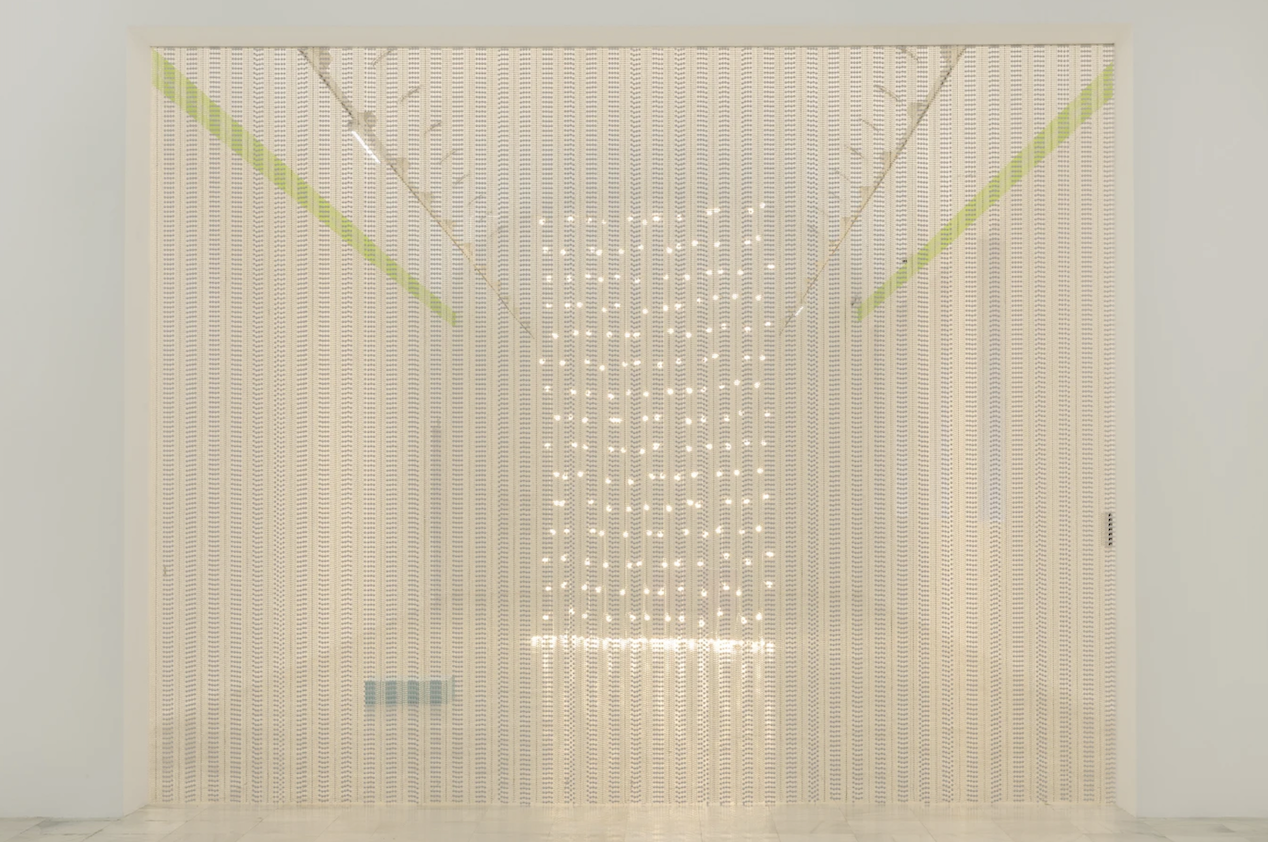
Among the most striking pieces in the exhibition are the curtains of crystal beads that visitors must physically pass through. Some display biomedical data related to the body and disease, functioning simultaneously as a threshold, a barrier, and a sensory experience. Crossing them means entering another state: physical, emotional, and political.
The exhibition also coincides with a symbolic date for the museum itself. Exactly forty years ago, on May 26, 1986, the then Reina Sofía Art Center was officially inaugurated by Queen Sofía and the Minister of Culture, Javier Solana. Two days later, it opened its doors to the public. During the exhibition's presentation, the museum's director, Manuel Segade, emphasized the metaphorical significance of the new windows opened in the exhibition halls, expressing his hope that they would remain open "for many years to come."

You may be
interested
...