Opinion
Salvador Espriu and Saint George's Day: the word that flourishes among books and roses
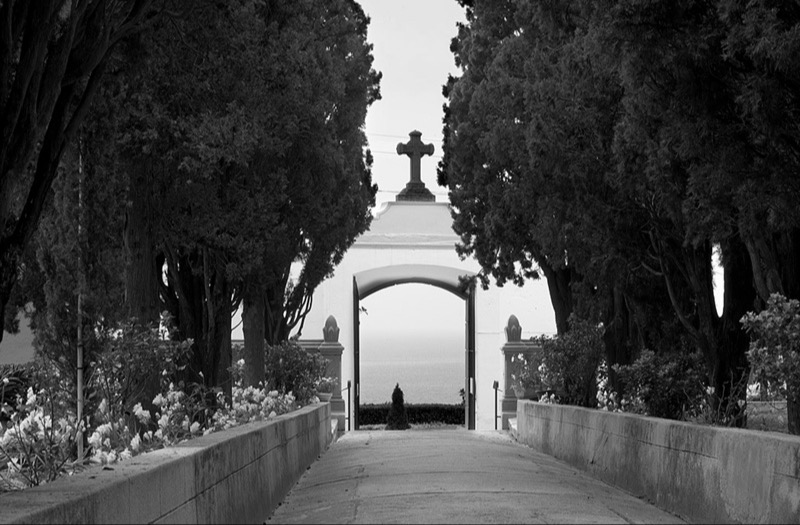
Deeply immersed in clay, in bronze, I raise the clarity of idea, through the darkest roots to the great explosion of the dream. ('Forms and words')
Salvador Espriu was a man of vast culture, of splendid narrative, creator of magnificent theatre and excellent poetry. All added to a clear, sarcastic and ironic intelligence; a rational, intellectual and existential man. Everything was always channelled through reason. Linked to the world of art, Espriu considered that art has a reason for being if it has a thought behind it, never left to chance, where the content is in full re-actualisation. Encyclopedic curiosity. Starting from the premise that he had an encyclopedic curiosity towards any kind of art derived from the tradition of liberal humanism, it must be said that Espriu and the world of visual arts always had a circumstantial relationship; however, without disregarding the plastic and musical contributions or the historical legacy or contemporary testimony.
The poet of La pell de brau had a certain prejudice against contemporary art, he was suspicious of spontaneous gestures, instinct, rationalism, the new spirit of forms and impulse. He examined color, stain, line and signs in search of the definition of the essence of art. He had a library full of art books and catalogs of the moment, also of classic figures such as Velázquez, Goya, Patinir and above all Pieter Brueghel and his direct connection with Haikus, in which exhibitions held in Barcelona stood out, with a key role in the Sala Gaspar, since we must not forget that Espriu had a friendship from a very young age with Elvira Farreras (they studied together at the German Institute of Barcelona) and later with Joan Gaspar, from here there will be the relationship with a key artist in Espriu's life, Joan Pere Viladecans, or Joan Miró.
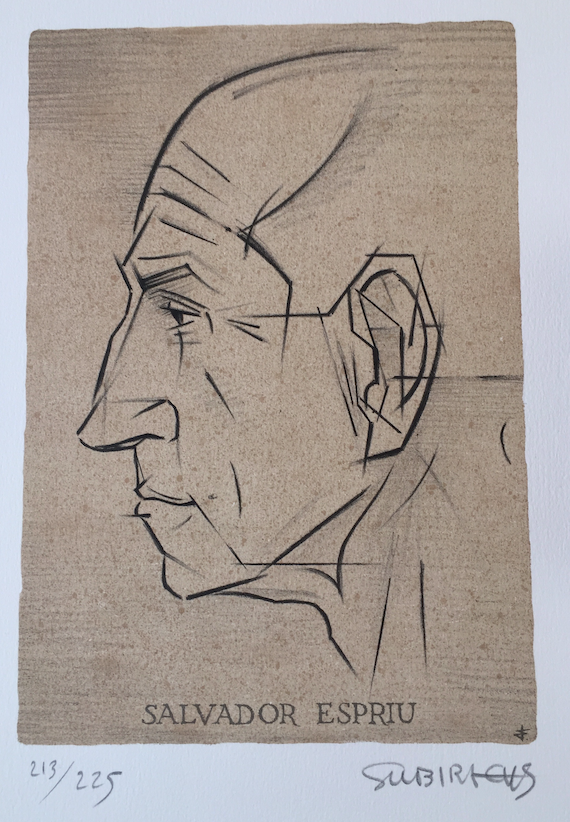
Art understood as a skill acquired with selfless application. Subtle and sharp irony, together with a very personal ability that characterized Espriu, saw art understood as a skill acquired with selfless application. “Art follows three very clear paths: the path of knowledge, the path of communication, the path of research. If all three paths can be taken at the same time, then you have made a total domino.” With Manel Cusachs, the sculptor from Mataró, in the many moments that they lived together, especially from the sculptural interpretation of the book of poems El caminant i el mur, he considered: “The process of a sculpture is laborious, from clay to plaster, from plaster to bronze or stone. I know that now everything is more direct, but I must say that most sculptors today do not know about the craft, and this, like language, should never be lost.” Far from descriptive gloss, the author explored the pretext, in the comprehensive contemplation of the artist's work, finding new impulses and stimuli to broaden the spiral of his literary creations.
This communication in Espriu has nothing to do with vulgarizing paternalism, rather he seeks to intertwine with the reader small intimate truths of the artists with whom he has had the most relationship over the years, in which the figure of Joan Pere Viladecans stands out (along with Raimon, he considered them the children he never had) or the aforementioned Cusachs, Pla Narbona, Antoni Miró, Ramon Calsina or Josep Beulas. These, along with Miró, Amèlia Riera or Freixanet, were awarded the category of cosmocrats, since they are artists appreciated by Espriu.
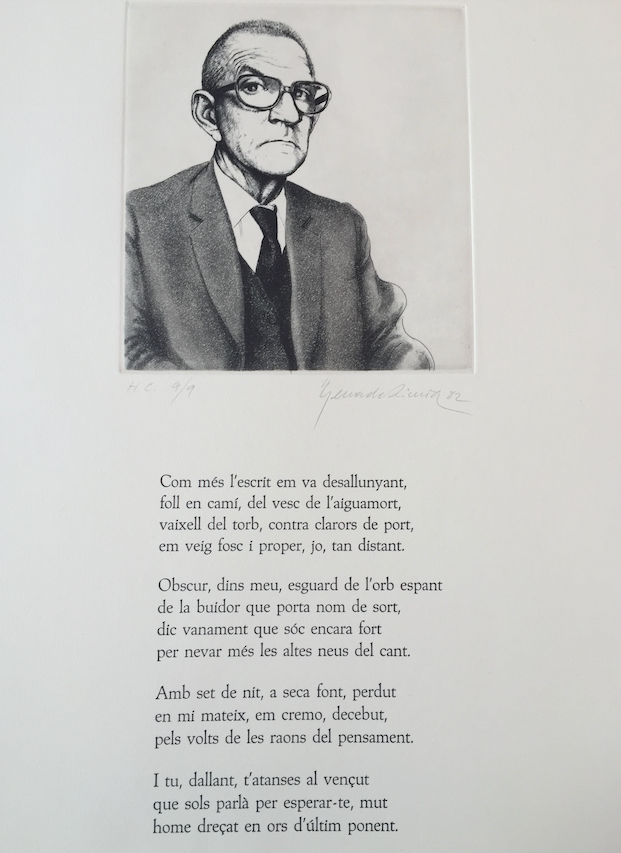
If there is a common phenomenon in much of the literature and art of different moments of the 20th century, it is the displacement of external reality in favor of the analysis of the internal mechanisms of creation. Here would enter two key figures such as Apel·les Fenosa (his dear teacher friend) and Josep Maria Subirachs. Of the first, following the exhibition at the Palau de la Virreina in 1983, he considers: “The work of art results from the combination of three factors: intelligence, vision and the hand, and all three, changing without stopping, evolve and remain at the same time. And this is quite natural.” Fenosa considered him a man open to all artistic concerns and a man who has not touched anything without embellishing it. Endurance of contemplative forms full of beauty in the form of three-dimensional figures. In Formes i paraules he glossed 40 cantos of 21 sculptures by Fenosa.
De Subirachs shows us that Espriu had an assiduity for relationships with figures linked to plastic arts, creating a binomial of inspiration and reciprocal resonance. Image and word were combined with both, as could be the case in the book Aproximació a tres esculturas de Subirachs i altres texts, a direct manipulation of matter to tear out forms and give human coherence to nature, a direct thread with the works Salm, Tekel or Món de Subirachs, leaving words such as “how much authentic humility there is in perfection, the landing of an implacable learning, of the mastery of a craft, of a trade, which is the indispensable starting point of the creative impulse!”. With Subirachs, he transported him to a Mediterranean, expressionist, abstract and neofigurative world. Madola and Joan Pere Viladecans.
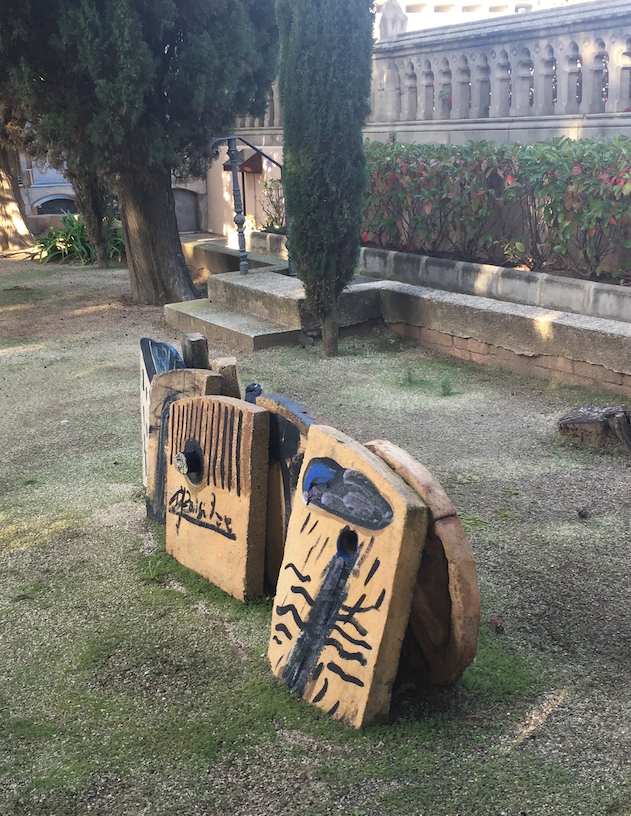
This giving shape to the word is represented with Madola in 1967, when the young ceramist knocked on Salvador Espriu's door to ask him for the prologue to her first exhibition in Barcelona. The artist admired the poet, especially from Cançons de la Roda del Temps , which Espriu made together with Raimon and with a cover by Joan Miró. At that time, Madola wanted to meet the author and ask him to visit his workshop. Espriu agreed and, after explaining what he wanted to express, he made a great presentation of the exhibition. Espriu had a great fondness for archaeological remains.
In this way of linking Espriu to different artists, the figure of Joan Pere Viladecans stands out. A beginning that transports us to the sixties, with a very young Viladecans who was starting to exhibit in Barcelona, going through the different covers he made for Llibres del Mall where each book/cover was an emblem with geometric figures, vectors, numbers and letters and an end that marks him Sinera (Espriu's mythical universe), the great piece created in 2013 by Enciclopèdia Catalana following the Year of Espriu, where Espriu is reread again from the images, but which always takes us to the characteristic blue of Arenys and the sea with its permanent renewal. Art, a long fear of the road, the door to the cold silence that you become, when things are the sea of your shipwreck.
You may be
interested
...