interviews
Oriol Castro, Eduard Xatruch and Mateu Casañas Chefs of the restaurants Disfrutar i Compartir
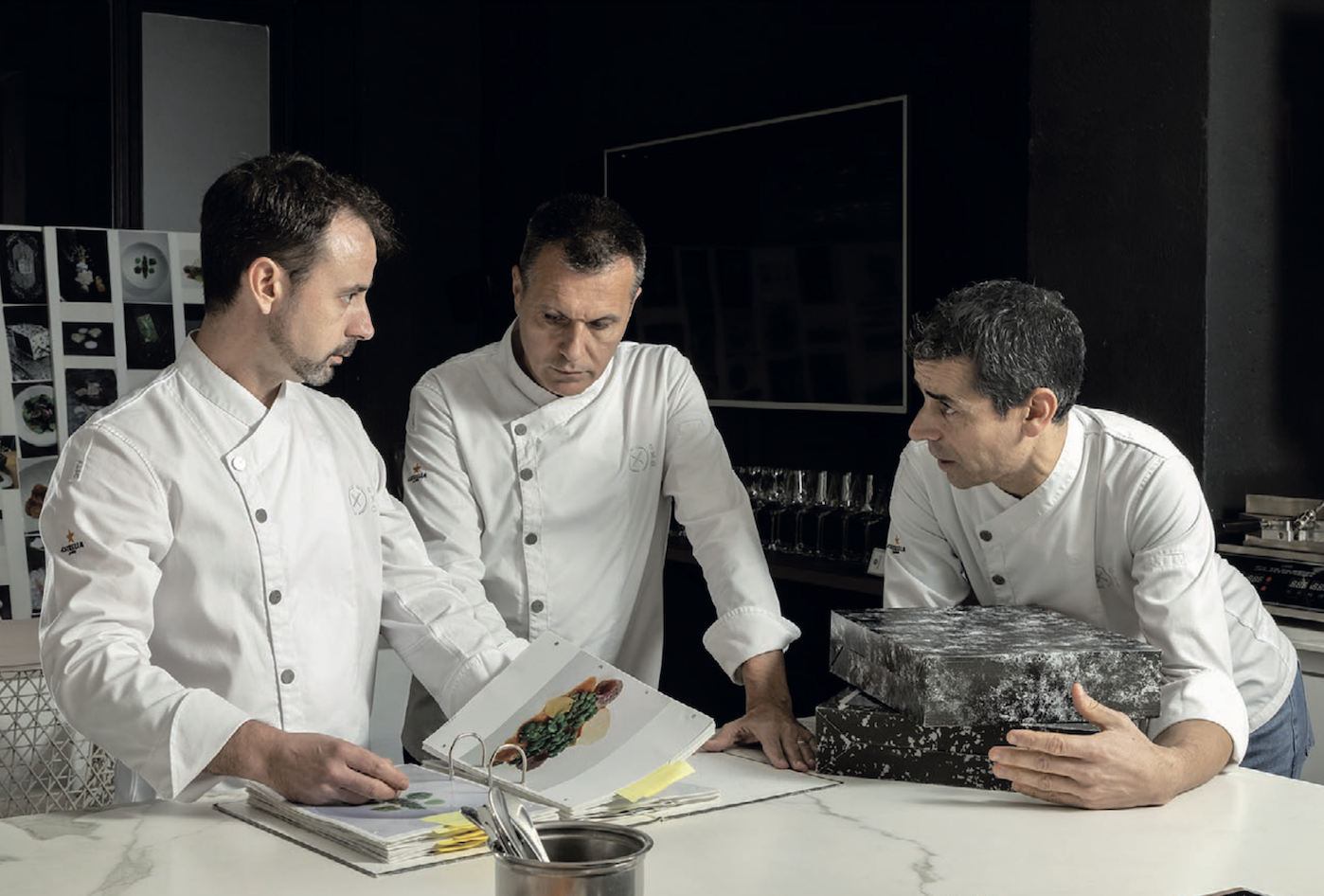
Oriol Castro, Eduard Xatruch and Mateu Casañas met in the kitchens of elBulli, where, during the nineties, they forged a solid professional partnership. In 2012 they set out on their own path with the opening of Compartir, in Cadaqués, and in 2014 they inaugurated Disfrutar, in Barcelona. In 2024, the latter obtained its third Michelin star and was distinguished as the best restaurant in the world, which consolidated them as indisputable references in creative and avant-garde cuisine.
What motivates them and how do they begin to conceptualize their creations?
The most important thing is to have a methodology. We come from a legacy and a way of doing things that we lived at elBulli, but we have adapted them to our model and this has allowed us to have our own personality. In the end, it is about methodology, work, rigor and perseverance. We have a section dedicated exclusively to creativity, which is the backbone of Disfrutar. We believe that creativity is the engine of everything: if we do new things, we can communicate them and, therefore, grow in the kitchen.
We organize our work in a structured way every week, with a global vision of the annual work. From there, we create dishes that are included in a catalog, then we develop the recipes and take photographs and videos of the techniques, which we share at conferences to explain the creative work we do.
What are they based on more: artistic dynamics, sustainability, zero kilometer or health? How do they see and implement these trends?
Creatively, the goal is to look for new techniques and concepts. There are many restaurants, and everyone makes dishes, but Disfrutar has distinguished itself, has gotten where it has and has the professional respect it has because we have developed new techniques and concepts. With the creative team, we work on ten different lines, because we are aware that probably seven of the latter will not come to fruition, but three will. Within this methodology, we create “thematic” sections: we take a product, a concept or a technology and work on them intensely for a period of time to see what we can get out of it. When it comes to health, at both Disfrutar and Compartir, we are chefs and have an ethical responsibility. When we make a dish, we look for the best product and treat it with respect, but our mission is not to make a “healthy” dish.
Do you see gastronomy as art?
Gastronomy encompasses many possibilities and different ways of understanding and experiencing it and, in addition, it is directly linked to people's basic nutrition, which makes it different from other artistic disciplines. When a person expresses themselves through painting, photography, literature or dance, they can do so without having the responsibility of having to cover a vital need. On the other hand, gastronomy has this responsibility, as do the issues of health or ethics. Gastronomy, obviously, is culture. When we ate at home, when we saw what our grandmother or our parents cooked, we received all this cultural baggage, which has shaped our character, has conditioned who we are and how we interpret reality and has given us broad and diverse starting points. When we archive everything we do —books and documents—, we do it from a professional perspective, not because we want to be artists.
What vectors would stand out as being what differentiates them from other creative-gastronomic proposals?
When we talk to people who visit us and people interested in gastronomy, what they value most is that our proposal touches many registers and that our menus provoke very diverse emotions. They see that in the culinary field there is a technical-conceptual creativity that is difficult to find elsewhere. The goal is to awaken the sensitive fiber and excite, whether with a "dish" that makes you reflect, with another that reminds you of childhood or even toasting with two glasses and feeling a sense of joy. The combination of a playful touch within a certain seriousness allows that, despite the pillar of everything being culinary creativity, there are intimate and naked moments. We have realized that human value and the ability to awaken feelings in the client are what often make them, when leaving our spaces, say: "It's different".
Books, memory... How do they approach photographs? They have the advantage of having worked with Francesc Guillamet for many years.
The relationship with Met is one of friendship, and his work is a work of craftsmanship. There is a very intimate feeling that goes beyond the profession: we all know what we think and what we want. A photo of Met tries to capture the whole of the creation.
The result of this is the books, which when people see them, they are amazed. He has a camera, a device that captures the light that is reflected in it, and he needs little else. He has become a reference in the profession and you have to be very honest and serious when talking about a person who has a legacy like his. There is no photographer in the gastronomic world today who can afford the luxury of saying that he has photographed what he has done. From the eighties, starting with the elBulli stage, to today. Perhaps this more artistic side that he has — of traveling the territory, of looking for key moments of light, of waiting for hours in a specific place to photograph the Albera in one way or another, longing for those rays of light — also makes it so precise, so clean and so neat when it comes to photography.
And, finally, what plans do you have for the future in the creative, gastronomic, personal and international arenas?
Regarding the project, we all have a very set and clear path. In the end, the book is not just any book, it is a reasoned catalogue that continues a way of doing things that is very much ours since we started with the first volume. When we are told about new projects, we always lower the soufflé a little: maintaining this level is already a challenge in itself. It is about capturing the theoretical information, today that we are able to include a photographic element with the techniques, the QR codes of the videos that we develop and show the ins and outs of how we make the recipes for people... and, in the same way, interpreting Met's work, and he ours, in the most rigorous and serious way. For us, having built the structure so that this is viable in all aspects —personal, intellectual, human resources, IT— and that it can grow year after year without losing the most important part, which is freedom, that is, without having to ask anyone for money or causing the dream to falter, is already a great challenge.
You may be
interested
...