News
The “invisible paintings” of art take the stage at Romea
A scenic proposal that sheds light on the invisible mechanisms of art, from the curatorial office to the market, without forgetting the essential solitude of the creative gesture.
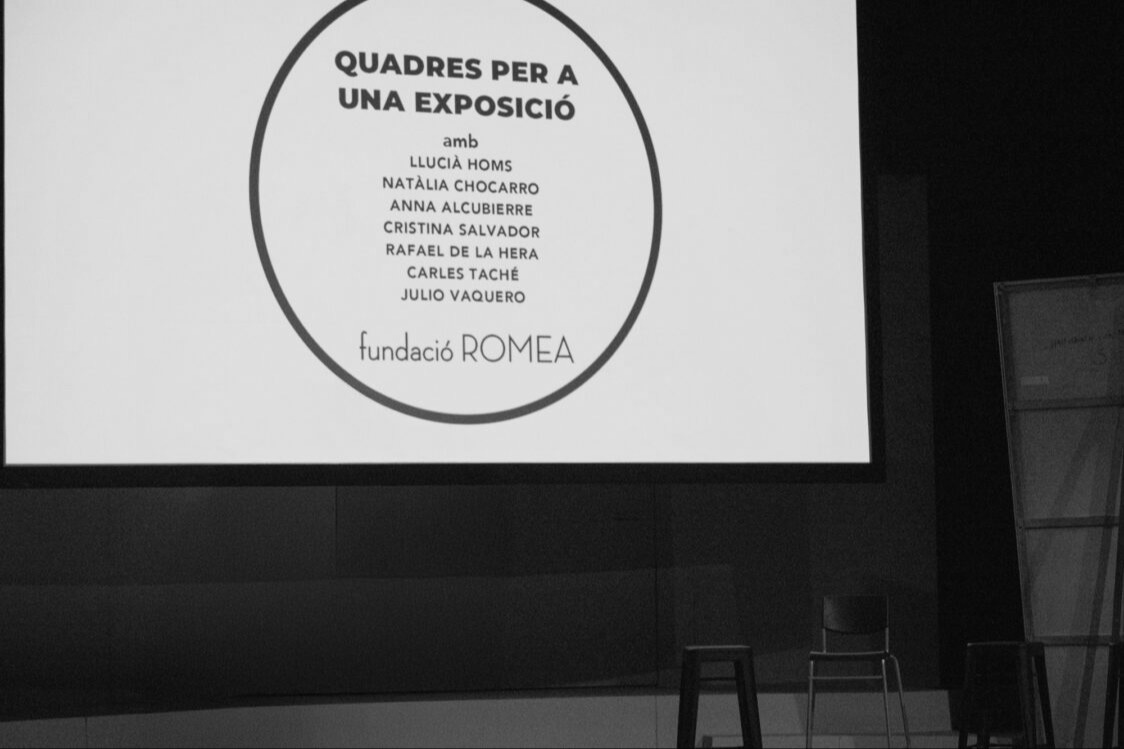
There are exhibitions that start long before the spotlights come on. And there are others—like yesterday's one at the Romea Theater—that decide to explain it precisely.
Pictures for an Exhibition , inspired by the itinerary suggested by Modest Mussorgsky, did not propose so much to look at paintings as to understand everything that sustains them. An immersion in this complex mechanism that goes from curation to design, from logistics to communication, from the market to space. Everything that is not seen — and that, nevertheless, makes it possible.
The event, presented by Fèlix Riera, director of the Romea Foundation, immediately gave way to Llucià Homs —cultural consultant, exhibition curator, art advisor and art market analyst—, who from the stage went through various questions for the guests, one by one, getting fully into the core of each profession.
From my practice as a curator, I tried to explain to what extent an exhibition is not just a sum of works, but a construction of meaning: a series of decisions—often invisible—that end up defining the gaze.
Meanwhile, there was a silent presence on stage. As if it were part of the spirit of the Reversos exhibition held at the Museo del Prado, where the focus was on the back of the paintings, Julio Vaquero's work showed only its reverse side: the hidden part, the skin behind, that side that is usually condemned to the anonymity of the wall. During the event, the painting remained suspended, like a discreet reminder that speaks to us in a low voice and reminds us that there is always another side to things.
Vaquero was the last to appear on stage, because, you will agree with me, he is undoubtedly the main protagonist of this performance. Only then, once the round of dialogues was over, was the piece revealed. Slowly, on a platform with wheels, the painting was displayed with a gesture that had something of a contained revelation.
After having talked about curating, design, insurance or communication, that painting appeared charged with a new density. It was no longer just a work, but the point of convergence of everything that had been explained.
Vaquero put into words an intuition that had run through the session: that the artist's work is, in essence, solitary. And what, at the same time, is increasingly conditioned. Without bombast, but with overwhelming clarity, he pointed out how the creator's function is often displaced, subjected to dynamics that have more to do with power structures, the market or external expectations than with the creation itself. After an hour talking about everything that makes an exhibition possible, that reminder acted almost as a necessary counterpoint.
Because yes: an exhibition is a complex, collective system, full of layers. As it unfolded with the interventions of Anna Alcubierre, Cristina Salvador, Rafael de la Hera and Carles Taché.
But before all this—and despite all this—there is someone alone in front of a work.
And perhaps this was, deep down, what Paintings for an Exhibition managed to make visible: not only the mechanisms behind the paintings, but also that hidden, less visible part, where everything begins.


You may be
interested
...