Exhibitions
Fe Blasco: black shoots
Black shoots and bright colors in the art of Fe Blasco that test acceptance and rejection in the contemporary world.
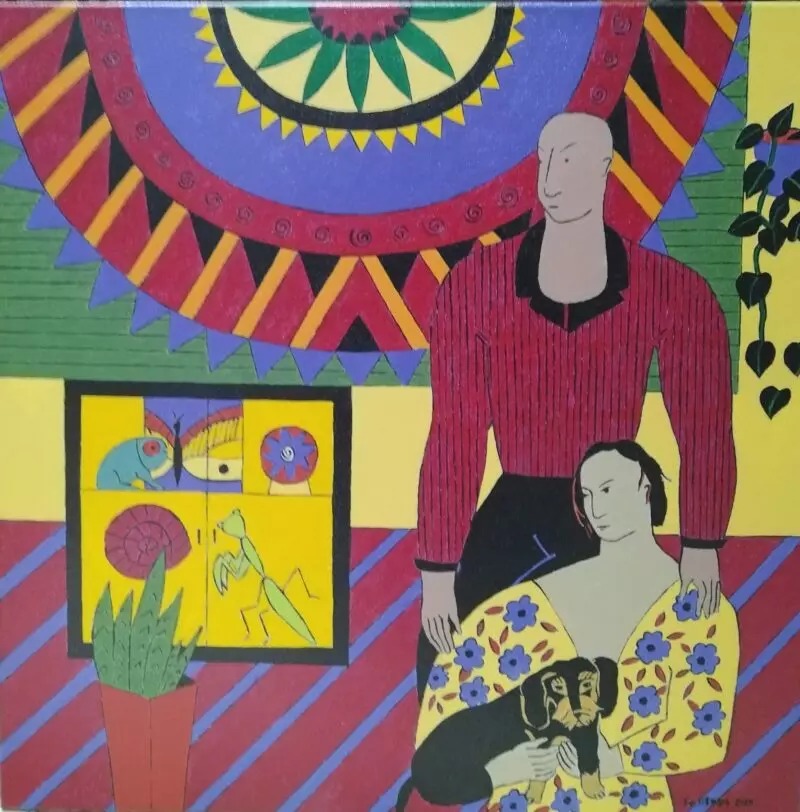
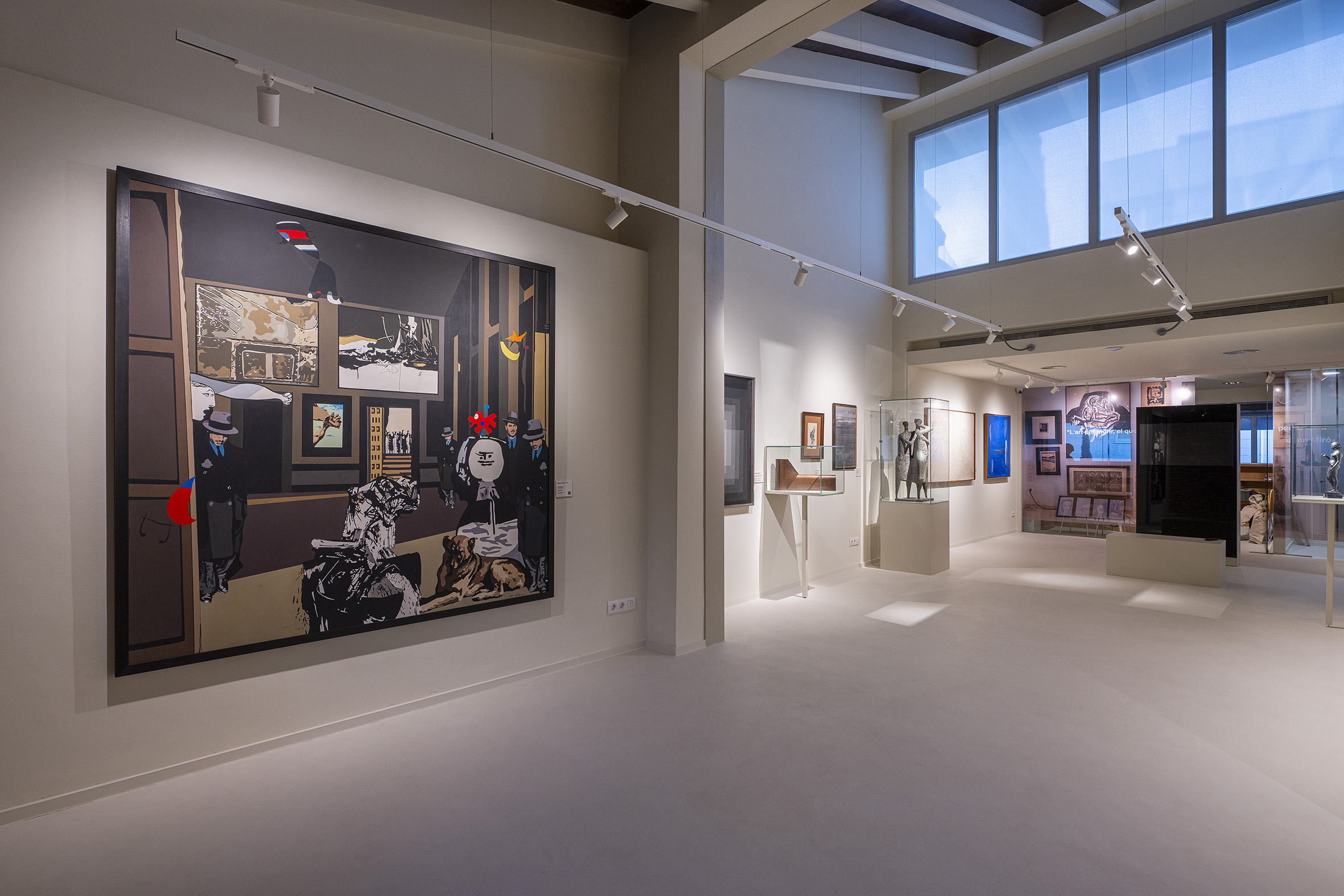
An exhibition by the painter Fe Blasco (Barcelona, 1952) was inaugurated at the Tarragona City Hall on March 27th and will remain open until April 15th. I didn't know her, I only knew that she had studied at the Escola Massana, in Eina and that someone had told me that she was a friend of Mariscal in the eighties. In her career there have been six exhibitions and a large anthological exhibition at the Torreón Fortea in Zaragoza, curated by Maria Luisa Grau and Antonio Ansón in May 2024, the year of her death. The exhibition is organized by those who were the painter's psychoanalysts since 1992, showing works related to the experience of her psychotic outbreaks.
The first impression is of a work with the figurative, colorful and pop stamp of the eighties, which I knew well in the postmodern boom and the return to figuration. In Madrid he exhibited at the Galeria La Kábala since 1989 and in those years he connected with a young audience, who in accordance with the era of the "movement" captured the meaning of his work, as he did with Ceesepe or Ouka Leele, Nazario, Max, Mariscal. As in them, the painting of Fe Blasco has a lot of illustration that in those years was an outstanding value, it must be thought that in 1984, Ceesepe, with a language very close to that of Fe Blasco, was the artist who sold the most at Arco 1984. This favorable circumstance, augured the conquest of Madrid, but it was not so, his rejection of which is social and his black shoots, and the constant changes of residence did not allow it.
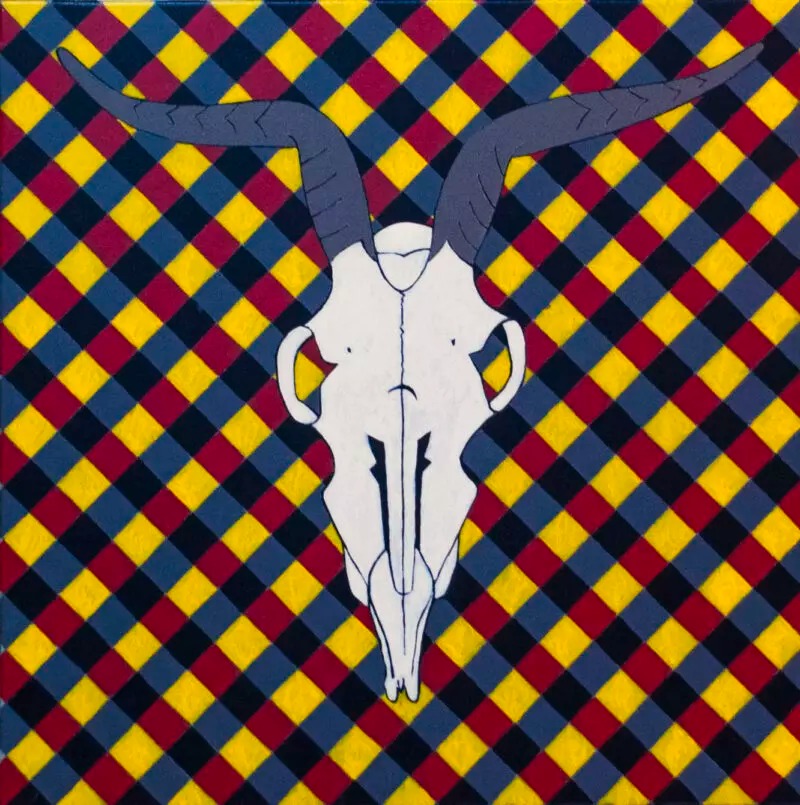
His images are delirious, the result of a state of maximum intensity, but they never cease to have a very rigorous constructive order, it is as if the rationalists Mondrian or Teo Van Doesburg had incorporated their nightmares into the order they were looking for. Everything is a structure of space and forms, developed in square formats of 60x60 which is the format of the most demanding restructurers of space along with the circle and the triangle. The measurements were extended to a meter or more or less depending on the various studies in which he painted, but always square. In some sketches there are even dimensions and proportions inside. His images are drawn with precision, so that in the language of the comic, which he feeds on, the clear line is called the “smooth” line of Crumb and others. His drawing is Apollonian, the line dominates the profile of everything, people, objects and hallucinations, which adds more intrigue to his working process. This desire for clarity is emphasized by the tendency to use clean and clear colors that he also orders by sizes and stripes, in his previous sketches: 1.3/2.6/0.6, /4, 8… but always intense colors. Domestic themes, without importance, become under his gaze in an extraordinary rarity. The figures and space are treated without perspective and the planimetry allows to create a symbolic hieratism typical of the Sumerian or Egyptian cultures that he admired so much. His obsession with goats may have to do with the “Sheep of the Bushes” from almost four thousand years ago that is exhibited in the Mesopotamia Gallery of the British Museum in London, where he lived.
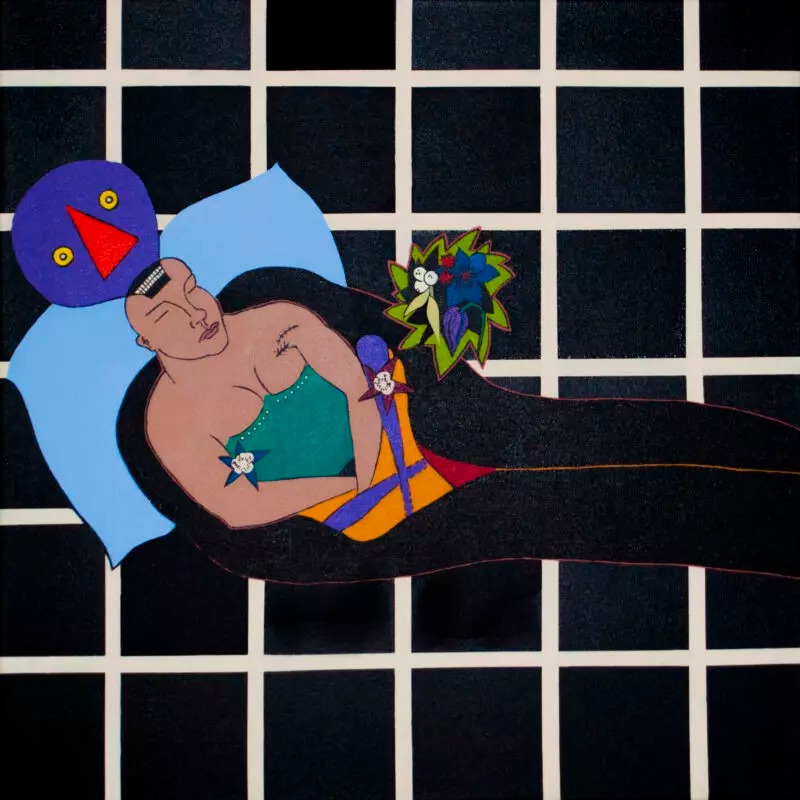
Everything is in its place, except her and her black shoots. In some cases she has painted or sketched under this altered state of consciousness, to return to it, once recovered from the crisis, repeating the work in an exact manner. A fascinating exercise in revision of the same delirium. Paradoxically, all this precision becomes a source of intangibility, because, in the words of Enrique Vila-Matas she is: “a painter of the unspeakable” and in the words of those who knew her best, her life partner the editor and writer Enrique Murillo is: “a secret painter”.
Figuration: acceptance or rejection
Enrique Murillo, his life partner, makes his aesthetic preferences in the visual arts very clear, as he also does in his book Personaje secundario. La oscura trastienda de la edición, a great success that in a few months is already in its third edition. From the first pages he makes it very clear that what he likes to find in a novel is what happens to the human being, his ups and downs, the joys and miseries narrated in an attractive way. He is not interested in speculation on language or excessive conceptualization. He usually emphasizes that publishers: do not publish in a vacuum but for a specific society. That is why he prefers narration, that is, the novel that is addressed to the human being and comes from the human being, against what he calls avant-garde literature represented by authors such as Juan Benet and others, although he saves Javier Marías. For this very reason, figurative painting would be narration and conceptual art would be equivalent to speculative literature. This preference for narrative, for the writing of human experience, led him to rule out the publication of Enrique Vila-Matas's initial works because, in his opinion, he wrote with too much veneration for avant-gardeism. It is true that those who accept and reject must sometimes apologize, as he did with Vila-Matas. No one in the gallery, institutional, or visual arts field has done anything similar to what Enrique Murillo has done. That is, to make clear what he prefers and what he does not. We need to find someone who dares to do it.
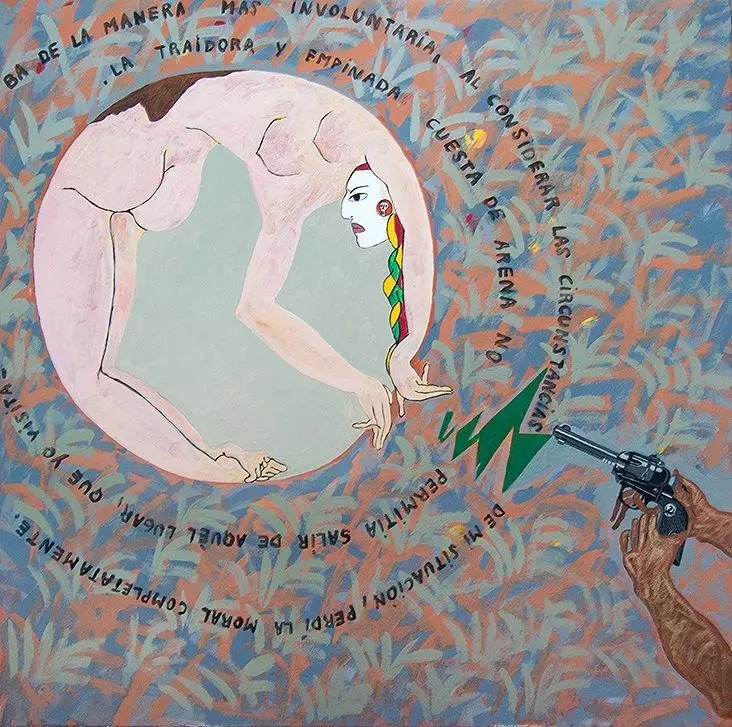
This declaration of intent by the editor or critic is very important, since it makes the acceptance or rejection obey coordinates that the candidate painter or writer should know so as not to waste time knocking on the wrong door, generating disappointment and frustration due to rejection. Specifying with what criteria it is decided what is published or exhibited and what is not exhibited and published. An editor or a critic who makes it very clear that what he likes is the narrative force, that the story that is told is what is main, makes things much easier. The editor with the writing and the art critic with the painting who declare that they are only interested in this or that other trend or more than anything else, figurative painting, tells the four winds that conceptual and abstract artists, don't waste your time with me.
In line with this criterion, his defense of figurative painting should not surprise us. But it is surprising that someone who has acted as an "influencer" of Spanish literature with a partial criterion and with clear preferences as an advisor to large publishing houses, is surprised that his art critic colleagues do something similar and do it with his wife. Here is the big knot, the big paradox. He laments the work of Fe Blasco, saying that figurative painting, which his wife practiced, has a place in the great institutions in Great Britain and other European countries, and not so much in Spain. It is true that on the Big Island there is a very clear tradition for drawing and the figure as demonstrated by the painting of Bacon, Freud or Hockney and that it continued with the project of the Saatchi & Saatchi brothers around 1970 who opened the doors to figuration even further, as a large multinational publishing house. Convinced that there is also a great interest in figurative painting in other European countries, the editor laments that, in Spain, with few exceptions, conceptual art dominates, installations... he says: "in Spain, civil servants, curators, gallery owners and critics are only aware of the latest fashion in installations, conceptualisms..., he also states: "no one seems to know what to say, or what to do, with people who only paint".
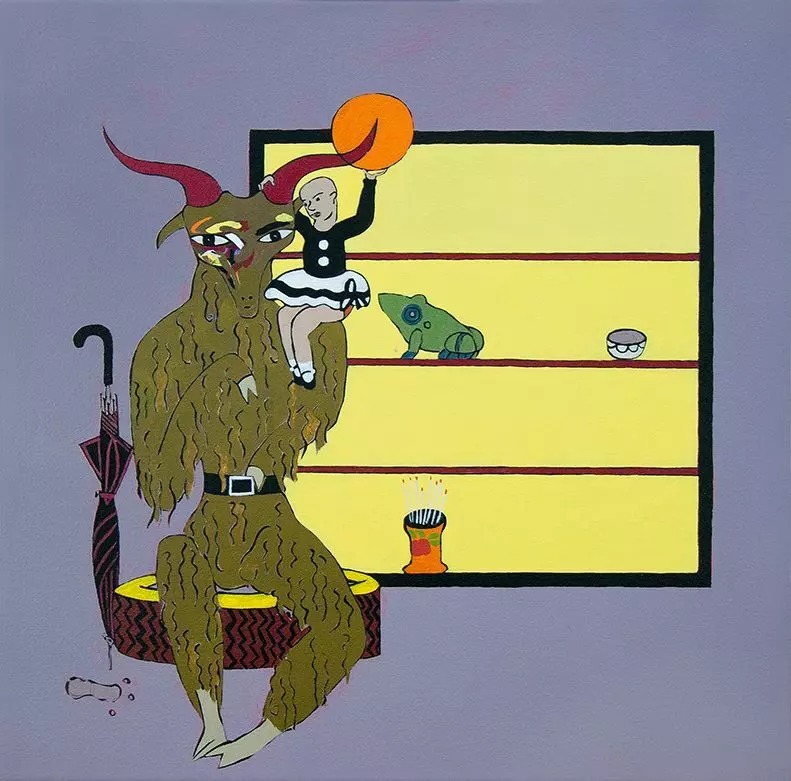
This predilection is projected in the work of Fe Blasco which began as abstract, and little by little, at Enrique's suggestion, she stands in front of the cinema screen and makes a version of Marilyn, then came: Frida, characters with masked faces, jugglers, little birds, animals, the goat and many others. In a work from 2008 she paints on a piece of paper this tendency towards narration with very significant painted letters: "Crónicas. América profunda. E. Murillo".
Black Sprouts
I have already used the expression black shoots twice. It is in the title of a devastating book published in 2022 by Eloi Fernández Porta: Los brotes negros: en los picos de ansiedad at the Anagrama publishing house. The same one where Enrique Murillo acted as the executive arm of literary projects generating this new narrative mentioned, but he was no longer there. By the whims of fate it was published by Jorge Herralde with whom he makes an adjustment of grievances and it is one of the most dramatic moments of Enrique Murillo's book about the publishing world.
Pain, restlessness, the pathologies sometimes listed by artists such as Camila Cañeque who was also of interest to Vila-Matas and about whom I wrote in bonart (18/11/2024) or Ortesia Cabrera (27/03/2026) who a few days ago at the Miró Foundation, at the presentation of the various issues of bonart paper , defined herself as a trans woman, or non-binary trans, neurodivergent and disabled, survivor of child sexual abuse and autistic. Signs of discomfort that Ortesia Cabrera uses as arguments to fight against the system. In this case, pain becomes the engine of artistic and social action. Discomfort in politics, or the politics of discomfort as demonstrated by the book by Alicia Valdés, political scientist and "Lacanian" psychoanalyst (Debate, 2024) but also includes in art, thought and literature, is a condition of transit between centuries. I wrote about it (ego surfing) in my book “Art and Transformation. A Look at the End of the Century” (2022).
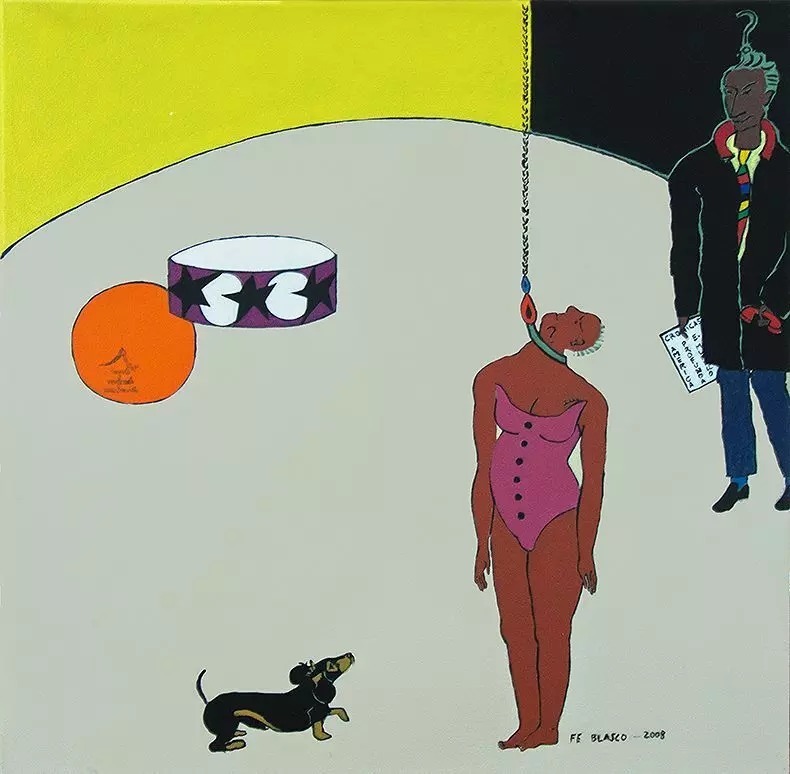
Eloi Fernández Porta writes: “What is left of a person when my boss is my enemy?” Fe Blasco is a painter who reflects at all times, corroborated by her life partner, psychic suffering and permanent anxiety, self-destructive ideas. Her painting is an autobiographical reflection of pain, but painted with bright colors, even with humor. The relationship between painting, mind and pain have been present in art since the moment the artist emancipated himself from the commission and began to abound in his inner monsters. This happened at the dawn of German Romanticism and still endures. The reality of restlessness and that discomfort exists, is the main axiom from which I start. Discomfort in contemporary art has meant the descent into the hells of neo-post-romanticism. We have seen the millenarian transit through nihilism and pessimism, the uncertainty of the moment, the true or false complexity of ideas and technologies, the dissolution of the border between what is true and what is false. Everything has been a conflict around art and life, with a good dose of pain since the 18th century when the wound opened, when the conflict between identity and difference was born. This is where I place the beginning of contemporary art.
In these painful conditions of current creativity. In this garden of black shoots, how can we dictate acceptance or rejection, to say yes and to say no? Perhaps aesthetic criteria and critical judgment itself are replaced by compassion and silence?
You may be
interested
...