Exhibitions
When the loom becomes an algorithm: the folded time of Marie-France Veyrat
The Contemporary Art Cycle at the Sala Fortuny presents an installation that connects origin and future through fabric, converted into a structure of thought and a radical metaphor for digital art.
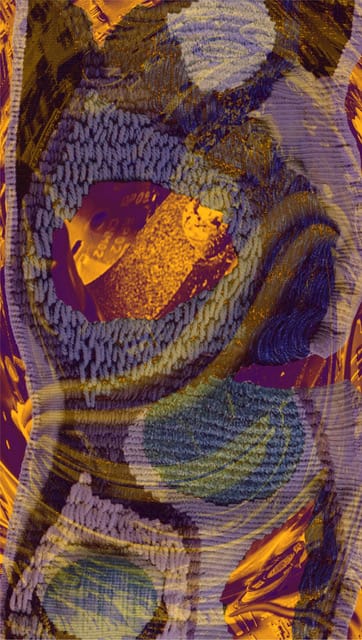
Marie-France Veyrat's work has been characterized, since its beginnings, by a sustained timelessness and a clear desire for universality. Her figures do not belong to any specific territory nor are they inscribed in a stable chronology; they appear as transversal, almost extradimensional presences, capable of articulating a common language between possible realities. In her visual universe, art does not simply inhabit time: it precedes it and, in a way, activates it.
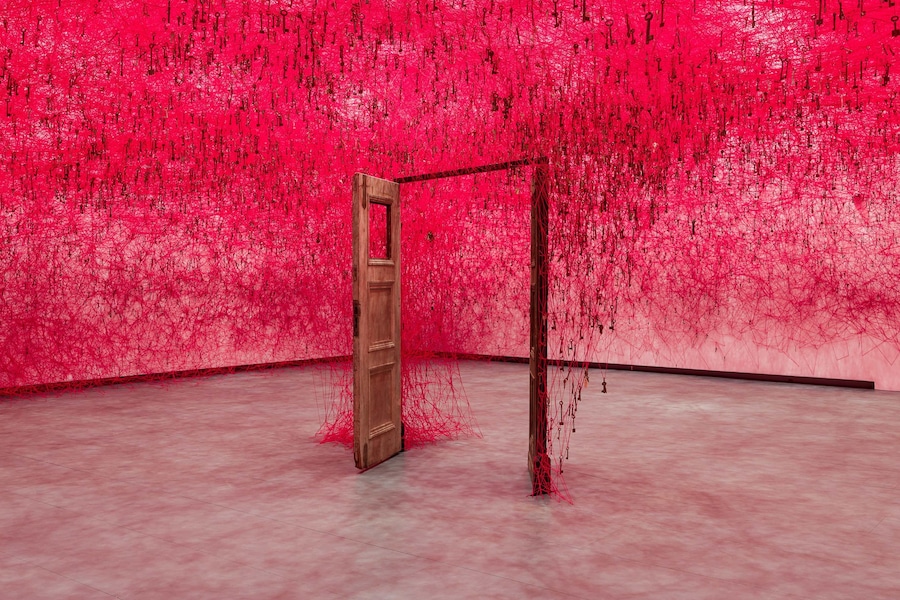
This perspective takes shape in the exhibition that can be visited until April 4th as part of the Contemporary Art Cycle at the Sala Fortuny, curated by Aureli Ruiz. Here, textiles emerge as the conceptual core of an investigation that connects origin and future in a single gesture. Fabric is not understood as a support or as an ornamental surface, but as a structure of thought. Weaving, in Veyrat's practice, is equivalent to coding; intertwining threads is to build systems. The loom ceases to be an ancestral tool to become a technology of knowledge.
The artist thus proposes a reading of textiles as a primordial device that anticipates the principles of contemporary computing. Weft and warp dialogue with circuit and screen; the pattern becomes a proto-algorithm. This correspondence questions the linear narrative of technical progress and instead proposes a folded temporality, where origin and future coexist in the same material operation.
The pieces are not presented as relics, but as active vestiges oriented towards tomorrow. They are artifacts that guard a paradoxical memory: not of what has already happened, but of what is yet to come. This idea connects with the notion of Vorerinnerung —the “pre-record”—, the unsettling intuition that the future can leave its mark on the present.
In line with Martin Heidegger's thought, time is not conceived as a line that advances towards a distant horizon, but as a structuring force that emerges from futurity. The work thus activates an expanded temporal experience in which memory and anticipation are confused, and the textile —understood as a system— becomes a metaphor and mechanism for rethinking digital art.
The installation is also part of Veyrat's sculptural research into the totemic form and the volume of brutalist roots. The totem does not appear as a folkloric symbol, but as a primary structure: a vertical body that concentrates matter, energy and memory on an axis of tension. The exhibition space is not displayed chronologically, but ontologically. The works share the same timeless dimension where the archaic, the technological and the speculative coexist without hierarchy.
The result is a corporal and immersive experience, almost ritualistic, that invites us to rethink the relationship between tradition and technology, between manual gesture and artificial intelligence, between ancestral past and digital imagination. More than a nostalgic look towards the origin, the proposal poses the origin as a latent territory: a space from which it is still possible to imagine the future.
You may be
interested
...