Opinion
Art as Spectacle: Chiharu Shiota at the Hayward Gallery
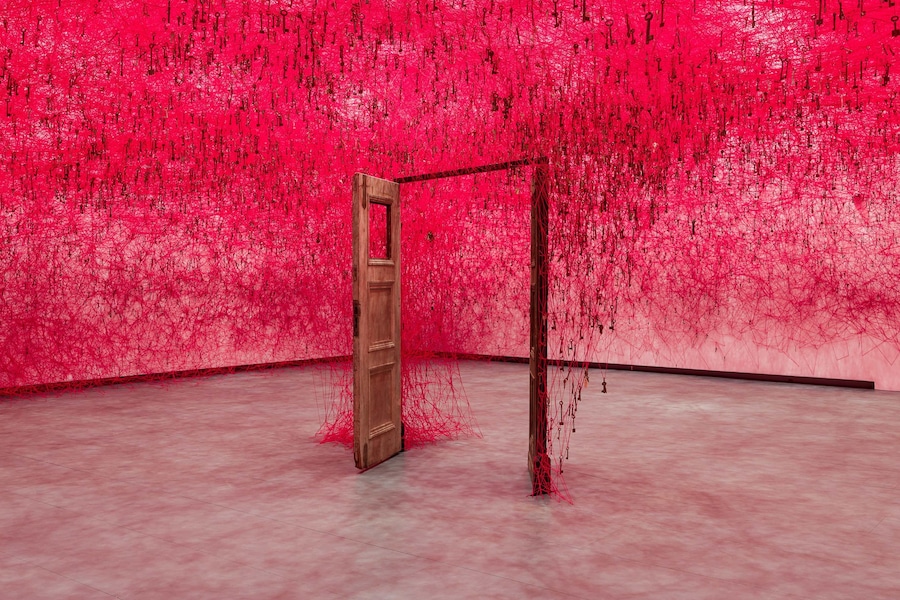
The talk of the town seems to centre on Chiharu Shiota’s Threads of Life, since its inauguration on February 17. On view until May at the Hayward Gallery, part of the Southbank Centre, the exhibition presents new iterations of Shiota’s monumental installations, including During Sleep (2026), which is activated by performances throughout the run of the show. The response has followed a familiar pattern, on the one side, scepticism from established critics; on the other, rapture across TikTok and Instagram, where the exhibition circulates less as an artwork than as an aesthetic event and a visual trend to be joined.
Shiota’s work is undoubtedly powerful in its sensory and poetic force, articulating physical metaphors of memory, life, and human connection. However, it is crucial to ask whether these installations truly transcend the visual to offer a genuinely critical or profound reflection. Upon visiting the exhibition, one is left with a curiously tiresome after-effect common to immersive art experiences. I found myself returning almost immediately to Guy Debord and his now-canonical critique in The Society of the Spectacle. Debord’s bleak claim that “all that once was directly lived has become mere representation” is often invoked today with a weary sigh, as though it were an outdated scolding. Yet inside this exhibition, it feels less moralising than diagnostic.
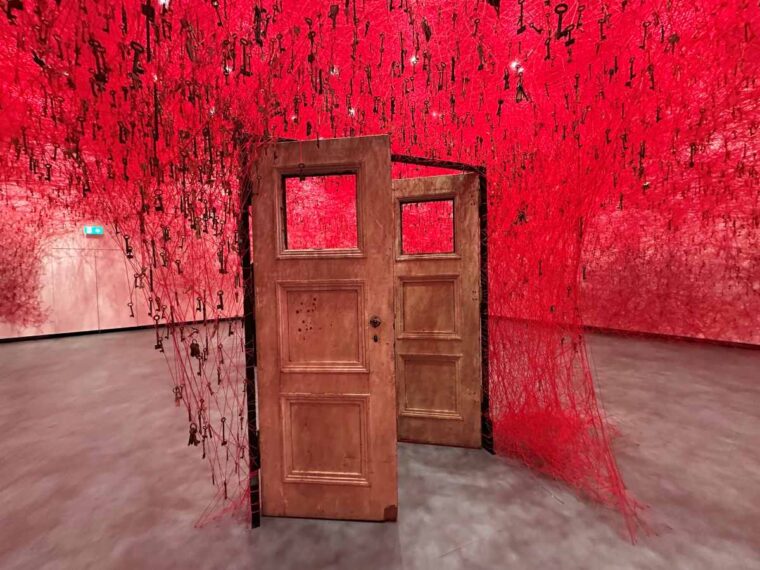
Threads of Life does not explicitly demand to be photographed; it simply assumes that it will be. At a time when visual culture leans heavily toward spectacle, the challenge for art is to recover its critical force beyond attractive imagery. Instead, the dense webs of infinite thread, evoking the Chinese mythology of the “red thread,” an invisible cord said to bind those destined to meet regardless of time, place, or circumstance, seem less to enclose objects than to frame them, preparing them for the perfect Instagrammable shot. These popular installations appear to anticipate their afterlife online rather than their present impact, if there is one. It seems time behaves strangely in this space. The installation gestures toward eternity while asking only for the brief engagement required to take a selfie. This is what Debord termed “pseudo-cyclical time”: a time of consumption and repetition, ultimately empty of consequence. You leave entangled in visions of red and black, lingering on the question that if these are indeed threads of memory and life, why do we depart devoid of any emotional or intellectual souvenir?
Timely, as I was delving into the behind-the-scenes thoughts of the exhibit, I happened to read Michelle Santiago Cortés’s recent article in ArtReview on the emergence of Moltbook, a social media platform designed for AI agent bots built by humans to post and interact with one another. Cortés writes that AI is nothing without its theatre, a line that struck me as painfully apt. Immersive installations, too, increasingly depend on theatricality not as a means of unsettling perception, but as a guarantee of circulation. At some point, inevitably, Plato intrudes. Where his prisoners mistook shadows for reality because they knew nothing else, our contemporary spectacle has refined this arrangement. We are no longer chained to the image but rewarded by it. The cave no longer conceals its artifice; it aestheticises it. It becomes a theatre, one in which we willingly perform, alternating between spectator and spectacle. In Shiota’s case, we are gently styled as puppets, threaded into a spiderweb, bedding the dreams of others.
These immersive art installations seem to simply exist to be activated by cameras, validated by metrics, and redeemed through repetition. It seems here that is the lineage that Threads of Life quietly enters. A place where Shiota’s materials, thread, personal objects and the residue of lives may still carry the ghosts of her earlier work, but the surrounding apparatus has changed. We are firmly within the blockbuster museum era, in which institutions have learned that immersion sells and seek to profit from the attention economy.
Upon leaving, one can do one of two things: announce, as is customary, where one has been, or enact the only remaining gesture of refusal. Not a refusal to enter, but a refusal to document. A refusal enacted by withholding the image, by resisting the need to prove that one was there.


You may be
interested
...