Exhibitions
Marta Mariño: Clippings from a pictorial life
Monday, July 28: A failed communication.
There are three days left until I fly to Las Palmas de Gran Canaria, but I have already packed my luggage four days ago. Even so, I have been feeling quite anxious about not being able to obtain information about the temporary exhibitions at the Centro Cultural de la Regenta in Las Palmas de Gran Canaria. There has been no way to have a clear telephone conversation with their staff, and even less so to obtain the precious press kit. It seemed that there was a Poltergeist behind the line who had put the voice of my interlocutor on it. There is nothing to be done, an in-person intervention on site is required.
Saturday, August 2: first reading.
On the first Saturday of August, with a cold, damp day that combined drizzle and periods of sunshine, I arrived at the Centro Cultural de La Regenta at 11 am on bus number 12. Once inside the cultural center, I met the aforementioned interlocutor in the flesh. She is Gina Solano, a patient and great professional who treated me with great kindness and helped me decide to write the art criticism review for the anthological exhibition entitled Los caminos de la pintura . An exhibition compendium dedicated to the Canarian artist Marta Mariño Casillas (Las Palmas de Gran Canaria, 1954), between July 11 and September 25, 2025, by the curator, teacher and writer Ángeles Alemán.

Wasp and quince. 2003. Naturam Series. Oil on canvas. Triptych. 116 x 244 cm.
A very realistic and luminous oil on canvas presided over the hall that gives access to the large multipurpose room on the ground floor. This still life; Wasp on a Quince ( Naturam series, 2003), is split in half by a wooden strip, thus forming a sui generis triptych that acted as a visual appeal and, at the same time, invited the viewer to delve into a particular history of painting that challenges the public to a more symbolic and prosaic reading, and, at the same time, to the discovery of the depths of Mariño's art, from different paths or ways of understanding, working and experiencing painting.
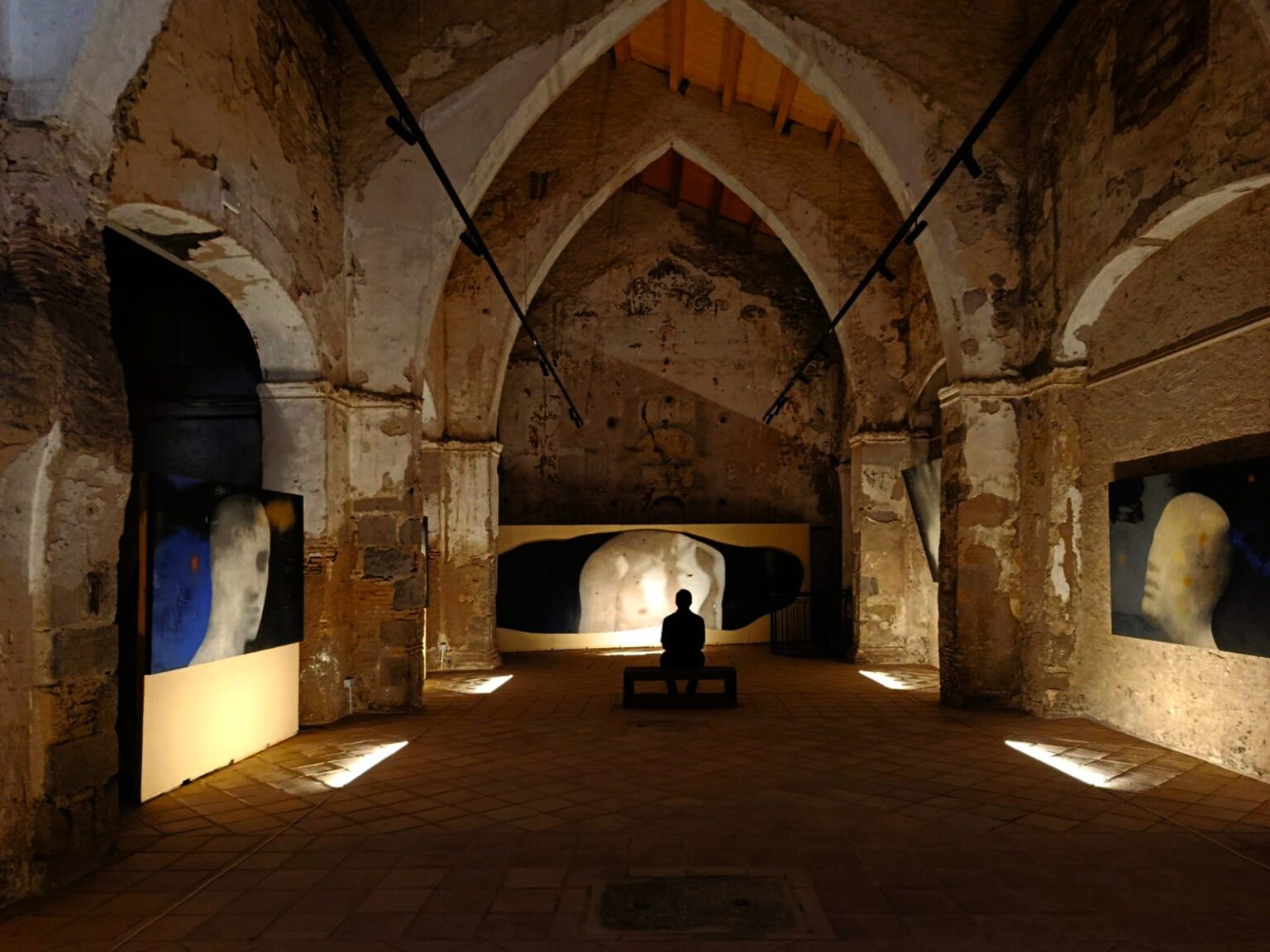
After crossing the threshold of the lobby, the audience begins a cathartic journey throughout all the rooms on the two floors where, despite the imposing omnipresent silence in this former tobacco factory from the 1940s (built by the architect Fernando Delgado), the works installed without a chronological logic dialogue harmoniously with the space, beat autonomously, tell stories and, ultimately, transmit an inexplicable complicity of rediscovered and reciprocal feelings with the viewer. From this background, Alaman, in her mission to study and make visible women artists from the Canary Islands in the face of the maelstrom of the masculine logo embodied in the institution of Art, has not hesitated to show La Regenta the prolific artistic career of Marta Mariño which, due to her personal research, has led her to experiment with different styles (colour field, informalism, neofiguration and hyperrealism), to work with various supports (contain, found wood, engraving plates, pallet...) and artistic techniques (acrylic on canvas or wood, profile drawing, drawing on paper, graphite, oil on canvas...), and, ultimately, to materialize them according to the formal conventions of the artistic genres (still lifes, urban and maritime landscapes, portraits, and interiors).
Thursday, August 7: second reading.
Thanks to the efforts of Gina Solano, I managed to contact the artist and arrange an interview at La Regenta on Thursday, August 7 at 5:30 p.m. That revealing and quite crucial discovery allowed me to delve into the depths of her artistic legacy that extends over almost five decades. From 1975 to the present, the author has distinguished herself with a prolific, careful and deeply emotional work, always linked to Canarian painting and culture, as demonstrated by the numerous individual and collective exhibitions held, mainly in the island territory. Mariño's work is located within a generation of resilient Canarian women artists, among whom Sira Ascanio (1947-2017), Pilar Rodiles (1947-2022) and Fabiola Ubani (1956) stand out. All these artists, in Mariño's words, are essential voices that must be preserved and vindicated to prevent them from falling into oblivion.
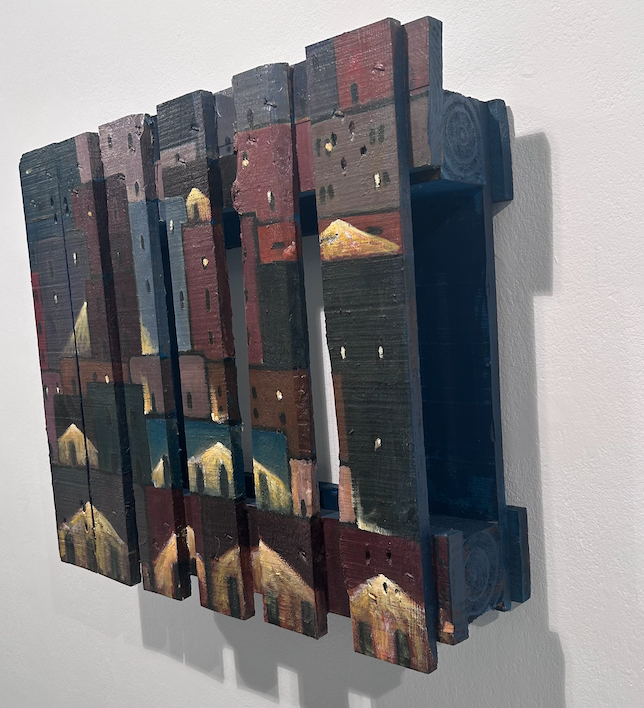
Risco. Oil on pallet, (Límit rodalies series), 2000, 58 x 68 cm.
Regarding the exhibition concept, curator Ángeles Alemán has selected representative works from various series created by the artist over the years, with the aim of rewriting Mariño's creative universe. A universe that, thanks to the genuine articulation of thematic areas -East-West, world of design and everyday objects, landscapes and identity signs, and atavistic spirituality-, manages to foster an intimate, sensorial and symbolic connection between the pieces and the space that hosts them. In the interview, the artist acknowledges the great work of his installation and admits that he feared that the industrial structure of the old tobacco factory itself would end up overshadowing his works.
August 12: dialogue and coexistence.
Despite the coexistence of works from different series and periods, the curator has opted to build an exhibition grammar based on thematic sections, chromatic fields, everyday and intimate elements, spatial rhythms, and, especially, multisensory sensations. It is a language of its own that, in the manner of the intarsia technique, has made the works dialogue, participate in a poetic understanding, and, ultimately, fit together from more respectful frameworks. This explains why on the ground floor she wanted to combine the Eastern and Western worlds without any kind of confrontation, nor any kind of trace of neocolonial sensationalism. On the contrary, it has been proposed to establish a framework of cordial and respectful coexistence between the hyperrealistic portraits of Japanese girls that respond with the titles of Mai , Sakura and Yuna ( Del naciente series, 2012), and several more abstract pieces of the colour field line, represented by the works Par 4 or Par 5 (Golf series, 1991) and Retrobament en roig and Retrobament en groc (Anastomosi series, 1993).
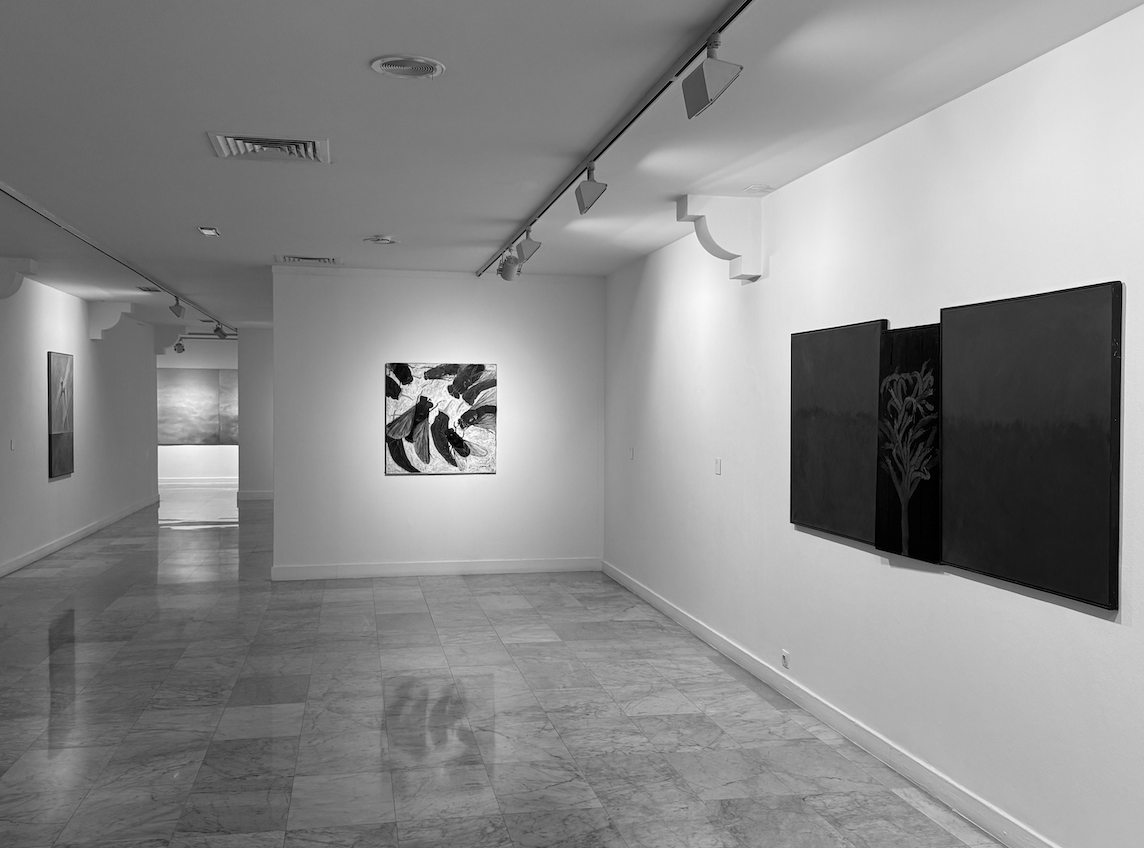
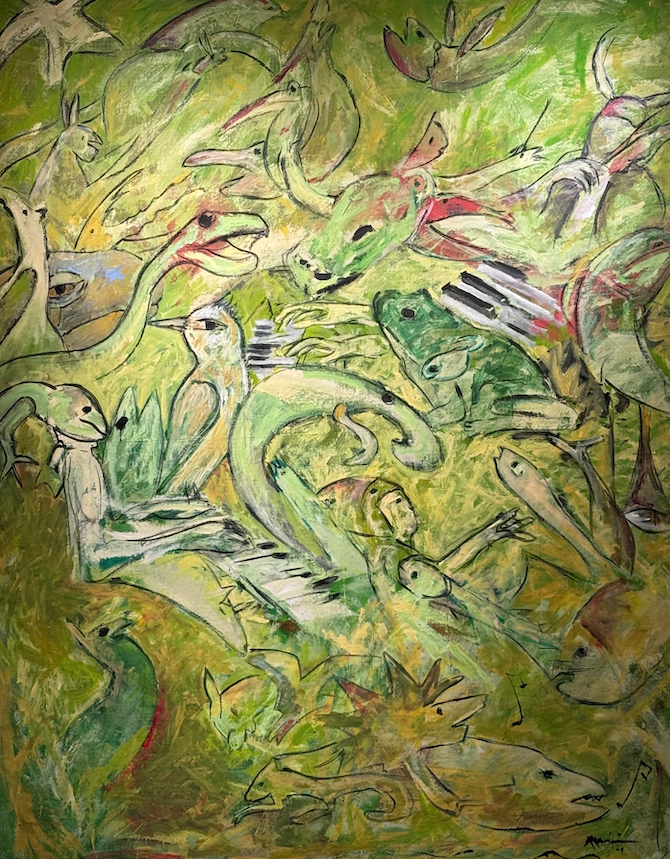
On the second floor, the tour unfolds in a series of thematic rooms that reflect on the identity of Canarian culture, through an intimate and magical exploration of the fauna, flora and orography of their island. From this background, it is necessary to echo the works of the Naturam series (2003) such as Mosquitos and peppers , Abella and raïm blanc, as well as the piece Manilla from the Plàtans series (1999). In addition, mention should be made of those oils that, in a symbolic way, represent the risks of Sant Nicolau and Sant Joan with their colorful and crowded houses ( Límits i rodalies series, 1999-2000), framing the city of Las Palmas. Other spaces evoke a naive paradisiacal landscape, populated by a fanciful bestiary - Opening of the Sinestèsia series, 2022 -, sublime skies of the Clouds series (1984) and poetic marine horizons of the Maresia series (1997). In between, there is a space dedicated to a nostalgic and sophisticated objectual world, represented by an old bed, belonging to the Intimista series (1989) and some designer lamps from the Síntesi series (1986). Finally, the exhibition reserves an area related to ancestral fears towards death and the end of the world, inspired by the Apocalypse described by John of Patmos (1st century AD). A hopeless universe with paintings such as in the triptych Relats del drogo (Hespèride series), L'ull del cavall , La mirada del xai ( Côdex series, 2007) and the triptych of L'Interior de la Catedral de Las Palmas ( La Ciutat series, 1993).
August 15: Assumption of the Virgin Mary.
Taking up the triptych of Relats del drogo , the work transported me to the way of finding out the age of drogo trees, which a friend from Las Palmas revealed to me from their ramifications, because each flowering is equivalent to ten years of life. Mariño transforms these ramifications into a sort of greenish hydra heads that, beyond their fantastic appearance, connect with life and the roots of identity of Canarian culture. In fact, drogo has been historically linked to various traditional uses: natural medicine, household objects, drums, dyes and ointments, funeral rituals...
In conclusion of this review, it should be noted that the properties of this millenary tree, a symbol of longevity and health, connect readily with the artist's artistic work. Her work delves into the depths of Canarian culture, evokes rediscovered feelings and, ultimately, tends to open up new shortcuts to painting. Paraphrasing the curator, it could be considered that this anthology well synthesizes Marta Mariño's passion for art and painting, conceived as a way of life. After all, all the pictorial paths completed by the artist represent multiple ways of knowing and loving life.
Felip González Martínez, art critic and teacher at the ESDAPC Llotja campus

You may be
interested
...