Exhibitions
Painting has not said its last word
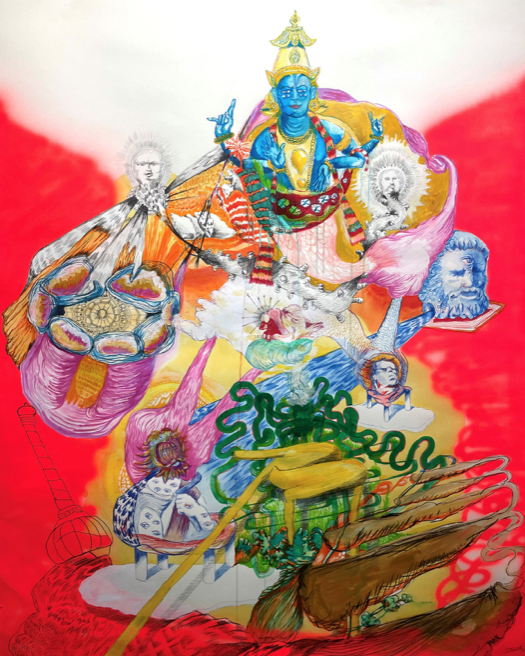
With the start of a new academic year, classrooms are filling up again and exhibition spaces linked to academic institutions are also resuming their activity. While the temporary exhibition dedicated to Sergi Aguilar is drawing to a close at the Autonomous University of Barcelona, the Faculty of Fine Arts at the University of Granada is opening an exhibition at the Damián Bayón Institute-Institute of the Americas in Santa Fe that focuses precisely on the relationship between artistic creation and teaching.
Traces. The task of art and the teaching vocation can be visited from October 7 to November 29, 2026. Curated by Fernando Castro Flórez, professor in the Department of Philosophy at the Autonomous University of Madrid, internationally recognized essayist and art critic, and collaborator of the Master's Degree in Production and Research in Art at the University of Granada, the exhibition brings together works by professors from the Department of Painting at the Faculty of Fine Arts in Granada.
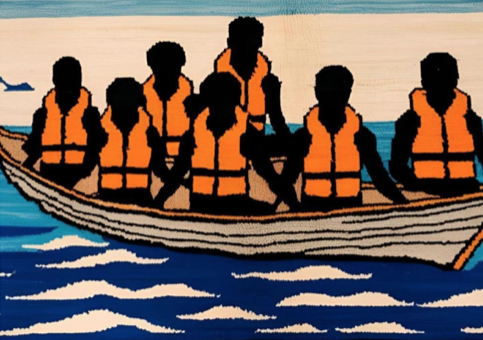
JOSE LUIS LOZANO, Title: Crossing the sacred sea, 2026.
Trazados presents a journey through different ways of understanding painting and, at the same time, through the relationships between artistic practice, research, and teaching. The works allow us to observe how those who teach art continue to develop their own creative processes, making artistic production an inseparable part of their academic activity.
The very concept of 'drawing' serves as a starting point. Fernando Castro Flórez notes that its synonyms include words like design, sketch, outline, scheme, plan, floor plan, project, or rough draft. All of these refer to an action still in progress, to something that is under construction. In contrast to an era obsessed with the idea of the project, the curator champions precisely the value of the process, of learning, and of the discoveries that emerge unexpectedly during the artistic work. In this sense, Trazados proposes focusing on what happens before, during, and after the work: on the research, the decisions, the accidents, and that combination of thought and chance that is part of all artistic practice.
The exhibition thus positions itself far from any rigid definition of painting. Abstraction and figuration appear as distinct territories, but not necessarily opposing ones. The interest lies in exploring their possibilities and observing how each artist constructs their own language from line, color, material, image, or space. Abstraction, Castro Flórez points out, can necessarily be concrete, while figuration does not have to fall into an affected naturalism. Between these two extremes opens up a territory of possibilities in which painting continues to question itself.
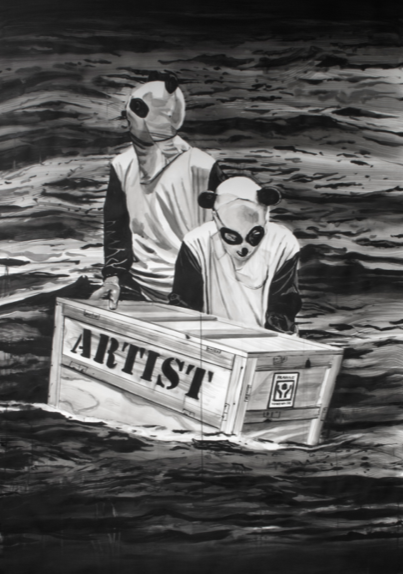
BELEN MAZUECOS, The Colossi, 2022.
Castro Flórez also questions the recurring discourse about the supposed disappearance of painting. In his view, this "funereal discourse" does not stand up to comparison with what artists continue to do. The diversity of proposals gathered in Trazados constitutes, in this sense, evidence of painting's capacity to continue generating questions, moving between languages, and finding new ways of relating to the present.
Line and color take on a particularly significant dimension in this context. Painting is presented as an experience that requires time, both for the artist and the viewer. The pleasure of the brushstroke and the sensuality of color, along with the expansive quality of paint, demand a careful and unhurried gaze. In contrast to the acceleration that characterizes much of contemporary life, the exhibition champions slowness as a form of knowledge and as a way to restore a more physical and reflective relationship between the viewer and the artworks.
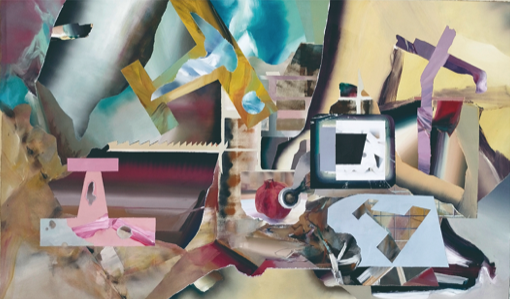
LUIS CANDAUDAP, THE ASSAULT OF THE CUBOFUTURISTS ON THE ALHAMBRA.
Participating in the exhibition are Alejandro del Valle, Iván López Izquierdo, José Luis Lozano, María Dolores Gallego, Asunción Lozano, Reyes González Vida, Santiago Vera Cañizares, the Laramascoto collective, formed by Santiago Lara and Beatriz Coto, Leticia Vázquez, Pedro Osakar, Carmen Ruiz de Almirón, Belén Mazuecos, Luis Candaudap, Ignacio López Moreno, Miguel Peña Méndez, Juan García Villar, María Caro, María Dávila, Consuelo Vallejo and Fernando Bolívar.
The breadth of this roster allows us to understand Trazados as a space where different sensibilities, languages, and approaches to painting coexist. There is no single way to teach painting, just as there is no single way to practice it. The shared condition of all participants is precisely this dual role as artists and teachers.
You may be
interested
...