Exhibitions
The imprint of the stroke
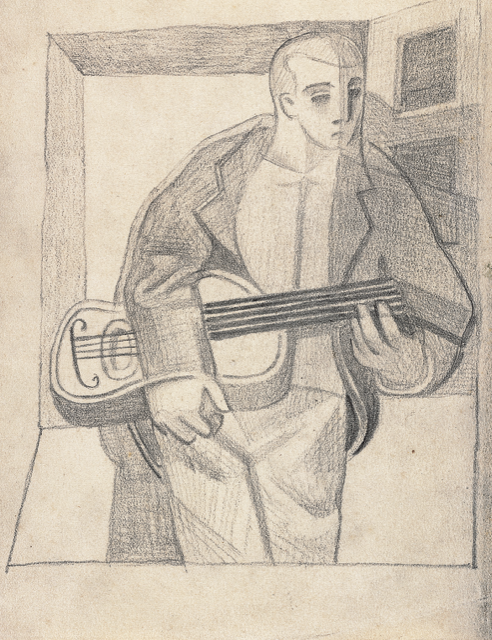
There is something radically contemporary about a drawing. Even before it becomes a work of art, before it acquires a discourse, a technique, or a place in art history, a drawing is a gesture. A line that appears on paper, a correction, an interruption, a stain. A way of thinking with the hand. Drawing Modernity (1864-1968) starts precisely from this essential condition to reclaim a territory that for a long time was relegated to the sidelines in favor of painting and sculpture.
The exhibition, on display at the San Telmo Museum until September 27, 2026, brings together around 160 works from the collections of the MAPFRE Foundation and the museum itself. The result is not merely a chronological journey, but an exploration of the evolution of the modern gaze through a discipline that allows us to observe, perhaps better than any other, the process of constructing an image.
Drawing possesses a quality that distinguishes it from other art forms: its proximity to thought. It is immediate, vulnerable, and, in many cases, still bears the doubts of the artist. Compared to the finished work, the paper can reveal the trial and error, the search, or even the abandonment. Hence, contemplating these drawings has something of an intimate quality: the viewer approaches not only what the artist intended to represent, but also the way in which they attempted to achieve it.
From the studio to the workspace
For much of art history, drawing was understood primarily as preparation—an auxiliary tool for constructing a painting, studying a composition, or rehearsing a figure. But this view began to radically transform at the end of the 19th century, when numerous artists began to grant paper an autonomy it had not always possessed until then.
The exhibition allows us to follow this shift. Drawing gradually ceases to be a mere instrument and becomes a space for experimentation. The line no longer necessarily has to lead to another work: it can be the work itself.
This shift is one of the main keys to understanding Drawing Modernity . Artistic modernity doesn't appear solely in grand manifestos, stylistic breaks, or new forms of representation. It's also found in the way an artist modifies their relationship with the paper—in how they observe, synthesize, distort, or eliminate.
The works of Mariano Fortuny, Joaquín Sorolla, Juan Gris, Maruja Mallo, and Pablo Picasso , among other names linked to the Fundación MAPFRE collection, allow us to trace this process. Alongside them appear essential figures of international modernism such as Edgar Degas, Auguste Rodin, and Egon Schiele , artists for whom drawing was much more than a preparatory exercise.
In Degas, the line can capture movement with almost instantaneous precision. In Rodin, the body dissolves and is reconstructed through strokes that seem to seek energy rather than contour. In Schiele, the line acquires an almost physical tension, capable of transforming the body into a psychological expression. These are very different approaches, but they share the same intention: to make drawing an autonomous language.
A modernity also Basque
The dialogue expands with a selection of works from the San Telmo Museum collection. Among them are key figures for understanding the evolution of Basque art and its relationship with modernist movements, such as Ignacio Zuloaga, José María Sert, Joaquín Sorolla, Aurelio Arteta, Nicolás Lekuona, María Paz Jiménez, and Mari Puri Herrero.
This second collection prevents the exhibition from becoming a mere succession of major international names and allows for the introduction of other perspectives, other contexts, and other ways of understanding artistic transformation. Modernity, in this sense, does not appear as an exclusively Parisian phenomenon nor as a history written solely from the major European art centers.
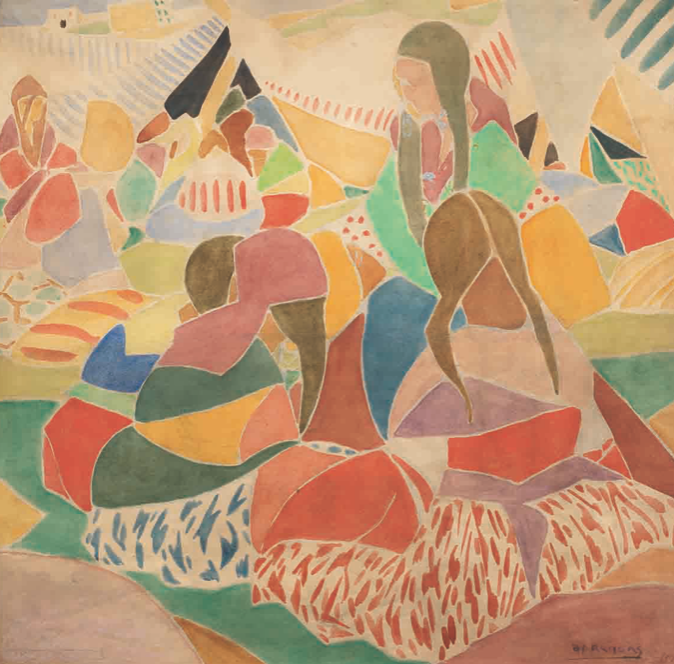
Juan Barrade, Zingaras, 1917 (Mapfre Foundation).
The dialogue between the two collections is one of the most interesting aspects of the exhibition. Alongside widely established names, lesser-known works appear, demanding a different kind of attention. Some stand out for their technical virtuosity; others, for their documentary value; still others simply because they reveal a sensibility that deserves to be rediscovered.
It is precisely there that the exhibition acquires a critical dimension: it does not limit itself to presenting a collection of drawings, but invites us to ask ourselves which works we have learned to consider central and which have historically remained in the background.
Fragility as a value
Furthermore, there is a paradox at the heart of this exhibition. Drawing is possibly one of the most unadorned forms of artistic expression and, at the same time, one of the most difficult to preserve.
Paper is sensitive to light, humidity, handling, and the passage of time. Its fragility necessitates limiting the conditions of its display and makes each public presentation of these works necessarily exceptional. Where a painting can visually dominate a room, a drawing demands a different approach: a closer, slower, and more focused gaze.
Perhaps that's why the experience of encountering these works feels particularly quiet. There's no monumentality. There's intimacy.
And that proximity allows us to discover something that often disappears when we contemplate the great works of art history: the hand behind them.
The line as a testament to an era
The period between 1864 and 1968 encompasses an extraordinary transformation of Western culture. Industrialization, wars, avant-garde movements, social changes, and new conceptions of the body and identity all contributed to this transformation. Art ceased merely attempting to represent the world and began to question it as well.
The drawing accompanied that process in a particularly sensitive way.
The academic approach gradually lost its rigidity. Perspective ceased to be an obligation. The body began to fragment. Reality could be reduced to a few strokes or disappear beneath a succession of gestures. Drawing meant less and less copying the visible and more and more interpreting what was seen.
In this sense, Drawing Modernity offers a particularly thought-provoking reading of art history: observing major aesthetic transformations from a seemingly small medium. Paper thus becomes a territory where one can observe how perspectives change.
The exhibition, curated by Leyre Bozal Chamorro, champions precisely this essential character of drawing. Not as the lesser sibling of painting, but as a practice capable of revealing creative processes, historical tensions, and transformations of sensibility.


You may be
interested
...