News
Chiquita Room opens new headquarters in Brussels
The Barcelona gallery begins its international expansion with a space in the historic Galeries Le Bailli Louise and an exhibition by Laía Argüelles Folch and Pieter Laurens Mol.
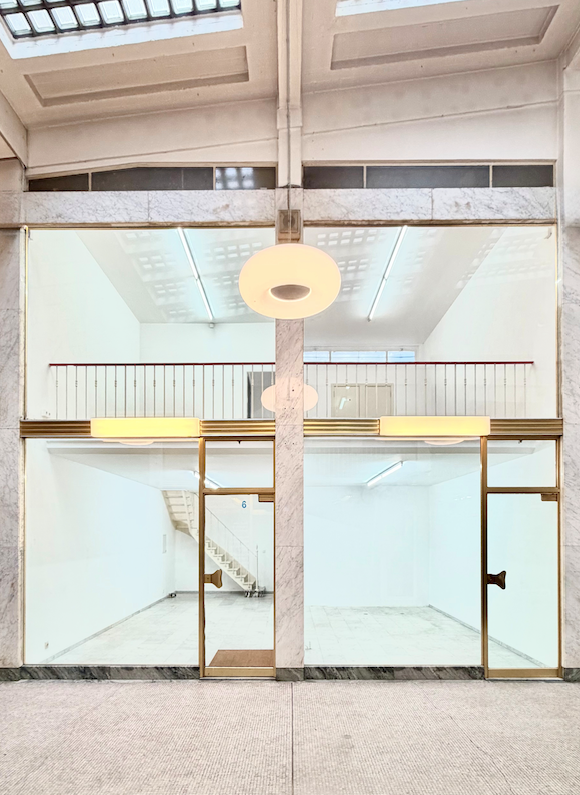
Chiquita Room is taking a new step in its trajectory with the opening of a new headquarters in Brussels. On September 10, the Barcelona gallery will inaugurate a space in the emblematic Galeries Le Bailli Louise, a shopping arcade at Avenue Louise 195 that during the seventies became one of the meeting points for the artistic avant-garde of the Belgian capital.
The opening is part of the official program of RendezVous – Brussels Art Week , the great annual event that marks the beginning of the artistic season in Brussels, and represents a new stage in Chiquita Room's commitment to international projection. About to celebrate eight years of activity in Barcelona, the gallery thus expands its European presence with the aim of strengthening the international projection of the artists it represents and promoting the exchange between the artistic scenes of Barcelona and Belgium.
The new space will open its doors with Once We Existed , an exhibition conceived as a dialogue between two generations. The show brings together works by Laía Argüelles Folch (Spain, 1986) and Pieter Laurens Mol (Netherlands, 1946), two artists separated by four decades of career but united by a common concern: the imprint of time and the capacity of places, objects, images and language to preserve, transform and activate the marks of the past.
The exhibition proposes a reflection on memory and temporality based on two different artistic practices that find points of connection around the fragility of existence and our relationship with nature. Rather than establishing a generational comparison, Once We Existed proposes a shared territory in which the works of the two artists dialogue about what remains when time ceases to be solely a measure and becomes matter.
The arrival of Chiquita Room in Brussels also takes on a special significance for the history of the chosen space. Between 1972 and 1975, the Galeries Le Bailli Louise hosted numerous galleries linked to avant-garde practices and, in particular, conceptual art. Among these were Wide White Space, MTL, galerie d., Paul Maenz, Oppenheim, PLUS-KERN, Hervé Alexandre and Editions Delta, spaces that contributed to positioning Brussels as one of the European foci of artistic experimentation in those years.
Most of these galleries were linked to conceptual artists and practices and, in a context marked mostly by the male presence, they constituted a fundamental episode in the recent history of contemporary art in Brussels. The current installation of Chiquita Room in this same passage thus establishes a direct link between that tradition of experimentation and the contemporary art scene.
For Laura González Palacios, founder and director of Chiquita Room, the opening of the Brussels office represents a natural evolution of the project and an opportunity to build a bridge between Barcelona and Brussels. The new office aims to offer the gallery's artists a more solid international platform and, at the same time, allow Chiquita Room to integrate into a particularly rich and dynamic artistic context.
The choice of Galeries Le Bailli Louise also reinforces this desire to connect past and present. Recovering a space that during the seventies was the scene of some of the most radical artistic practices of its time allows the gallery to establish continuity between different histories, generations and geographies.
You may be
interested
...