Exhibitions
Sex and health through history
From the Greco-Roman world to traditional Japan, the Barcelona Erotic Museum reviews the different ways of understanding the body, pleasure, reproduction and sexual well-being.
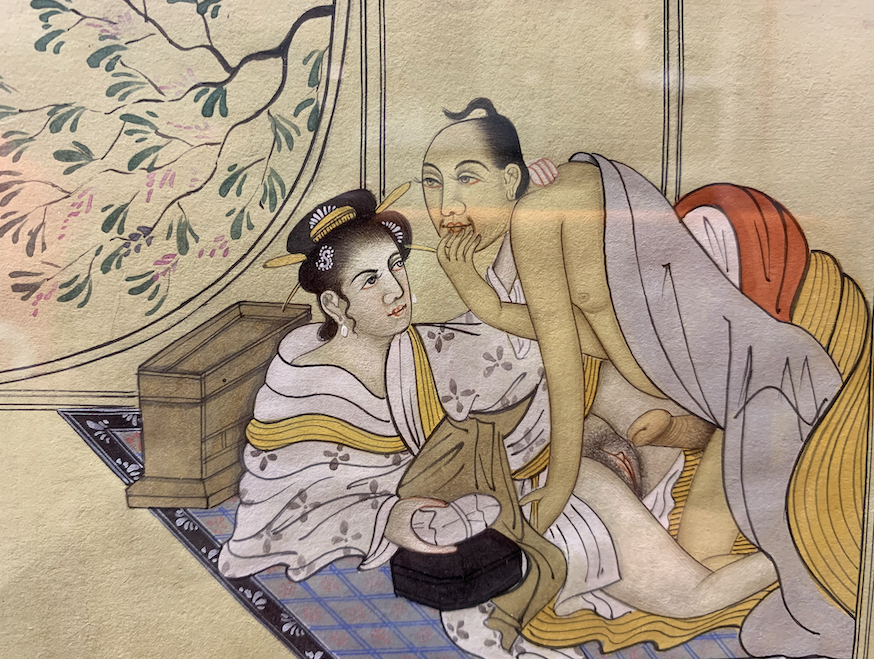
The history of sexuality is also a history of the way societies have understood and cared for the body. On the occasion of World Sexual Health Day, which is celebrated on September 4, the Barcelona Erotic Museum (MEB) is dedicating this month to exploring the different conceptions of sexual health throughout the centuries, from ancient Egypt to traditional Japan, through the Greco-Roman world, Pompeii and medieval Europe.
Through the pieces in its collection, the museum offers a journey through cultures and eras that, despite the enormous temporal and social distances that separate them, had to respond to questions that continue to be part of our experience: fertility, reproduction, hygiene, diseases, pleasure or the relationship with one's own body.
The tour, led by sexologist Sigrid Cervera, head of the Department of Education and Cultural Mediation at the MEB, does not seek to project current values onto past societies. The proposal is based, precisely, on the need to understand each culture within its own context, taking into account available medical knowledge, beliefs, customs, social norms and also the prohibitions that determined the way sexuality was approached.
From ancestral practices to contemporary sexual health
Over the centuries, knowledge about the body has advanced through discoveries, intuitions, rituals and beliefs. Different societies have developed remedies and practices to address issues related to reproduction, fertility and health, but they have also built imaginaries about desire and pleasure conditioned by religion, morality and social structures.
The MEB collection allows us to observe this diversity of responses and, at the same time, detect some concerns that have survived the passage of time. Questions about the body, reproduction, desire or prevention that, in essence, are not so different from those that are still part of the debate on sexuality today.
"Many of the questions we ask ourselves today about the body, pleasure, reproduction or prevention are not new. What changes are the answers that each society constructs for these questions. Looking back allows us to understand where we come from, but also to observe how much our way of understanding sexual well-being has changed", points out Sigrid Cervera.
This historical journey thus allows us to put the contemporary idea of sexual health into perspective. Today, this concept is no longer limited to the absence of disease or the prevention of sexually transmitted infections, but incorporates a much broader dimension: physical and emotional well-being, sexual rights, autonomy, respect and the possibility of experiencing sexuality in a free and positive way.
A look that connects past and present
The proposal of the Museum of Erotica turns its pieces into witnesses to a complex history, in which knowledge and superstition, freedom and prohibition, pleasure and control have coexisted in different ways depending on each period.
Rather than establishing an evolutionary line between a past considered ignorant and a supposedly more advanced present, the journey invites us to observe the diversity of ways in which cultures have interpreted the body and sexuality. A perspective that allows us to understand that sexual health is also a cultural and social construction, subject to constant transformations.
In this sense, World Sexual Health Day 2026 focuses on the slogan Every Body , a call for inclusive sexual health that takes into account all people and all bodies. The message further expands a conception of sexual well-being based not only on prevention, but also on diversity, rights and individual autonomy.
On September 4, to mark this day, the Barcelona Erotic Museum will give away a condom to all its visitors. A simple gesture that connects the historical dimension of the proposal with one of the most current expressions of sexual health: prevention and access to information that allows people to experience sexuality with greater freedom, responsibility and knowledge.



You may be
interested
...