Exhibitions
The suspended obelisk that welcomes visitors in Cairo
A summer stop at the Grand Egyptian Museum to discover one of the museum's most unique pieces, an 87-ton monument dedicated to Ramses II.
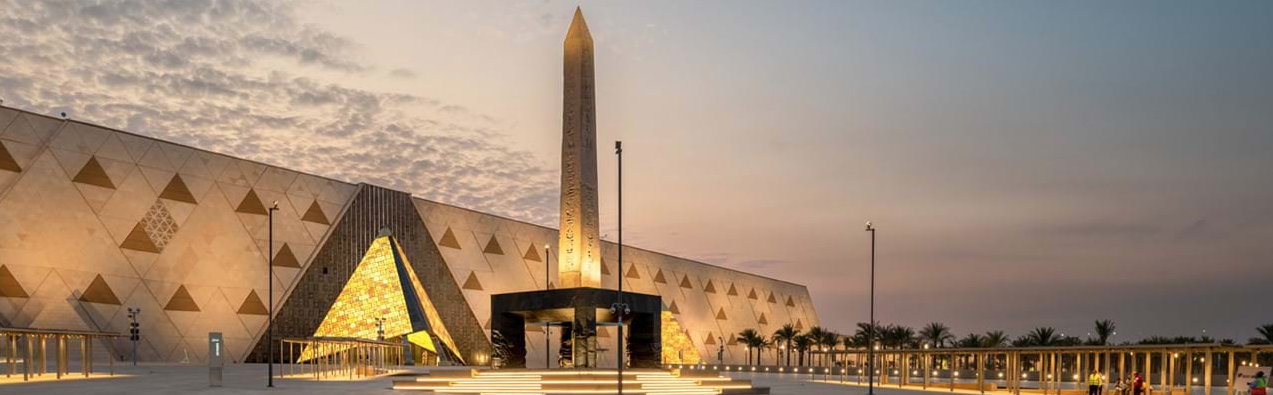
Summer can also be an opportunity to pause and admire some of history's greatest works. In Cairo, one such stop leads to the Grand Egyptian Museum (GEM), where the tour begins with a piece that immediately announces the museum's monumental scale: the Suspended Obelisk of Ramses II.
Located in the large plaza of approximately 30,000 square meters that precedes the museum's main entrance, this monument is one of the most unique architectural and archaeological features of the complex. Its distinctive position allows visitors to view the inscriptions carved into the base of the obelisk from below, a perspective that would be difficult to obtain from a monument placed directly on the ground.
The centerpiece of this structure is an ancient granite obelisk linked to Pharaoh Ramses II, one of the great rulers of ancient Egypt. Standing 16 meters tall and weighing approximately 87 tons, it is the tallest obelisk that once stood in Tanis, the ancient city of San el-Hagar, located in the eastern Nile Delta, in what is now Lower Egypt.
Ramses II erected more than a dozen obelisks at Tanis. As was typical of these monuments, their four sides are covered with hieroglyphic inscriptions that include different royal names of the pharaoh: his Horus name, his throne name, and his birth name. These texts not only identified the sovereign but also linked his figure to the religious and political traditions of ancient Egypt.
An ancient piece suspended above the visitor
The uniqueness of the GEM obelisk lies not only in its age. Its current display completely transforms the relationship between the visitor and the archaeological piece. The monument is elevated on a platform supported by four enormous pillars, installed on a large concrete base. This solution allows visitors to see the cartouches of Ramses II carved into the lower part of the obelisk, an area that would normally be hidden if the piece were resting directly on the ground.
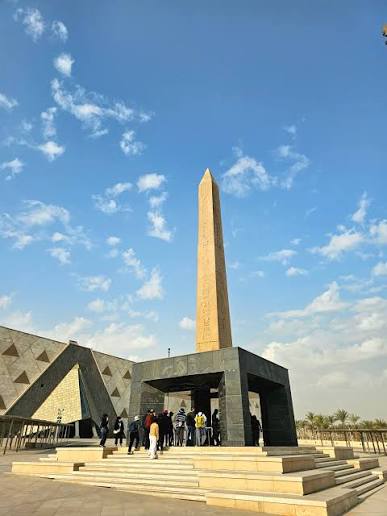
In this way, a contemporary intervention reveals a detail that remained hidden from view for centuries. Visitors can stand beneath the monument and contemplate the inscriptions from a completely different perspective, establishing a dialogue between the museum's current architecture and the monumentality of Pharaonic Egypt.
The Suspended Obelisk occupies a strategic location within the Grand Egyptian Museum's exterior tour. Installed in the grand entrance plaza, it serves as the first archaeological artifact to welcome visitors to the museum, acting as an introduction to the magnitude of the collections and the millennia-old history housed within the complex.
From Tanis to the museum of the future
The journey of the obelisk from the ancient landscape of Tanis to the heart of modern Cairo summarizes, in a way, the vocation of the Grand Egyptian Museum: to connect the country's archaeological legacy with an architecture conceived for the present and the future.
The result is a piece in which past and present coexist in a particularly visible way. The granite worked thousands of years ago, the inscriptions of Ramses II, and the engineering used to lift its 87 tons are all part of the same experience.
For those visiting Cairo this summer, pausing before the Suspended Obelisk is much more than simply viewing an archaeological artifact. Upon entering the museum, it means encountering a powerful image of ancient Egypt's architectural prowess and a contemporary intervention that allows visitors to discover the monument from a unique perspective.



You may be
interested
...