News
The eclipse that will darken Catalonia and be trapped in art
Catalonia looks to the sky as a total eclipse transforms the landscape and brings back the memory of a work by Alexandre de Riquer.
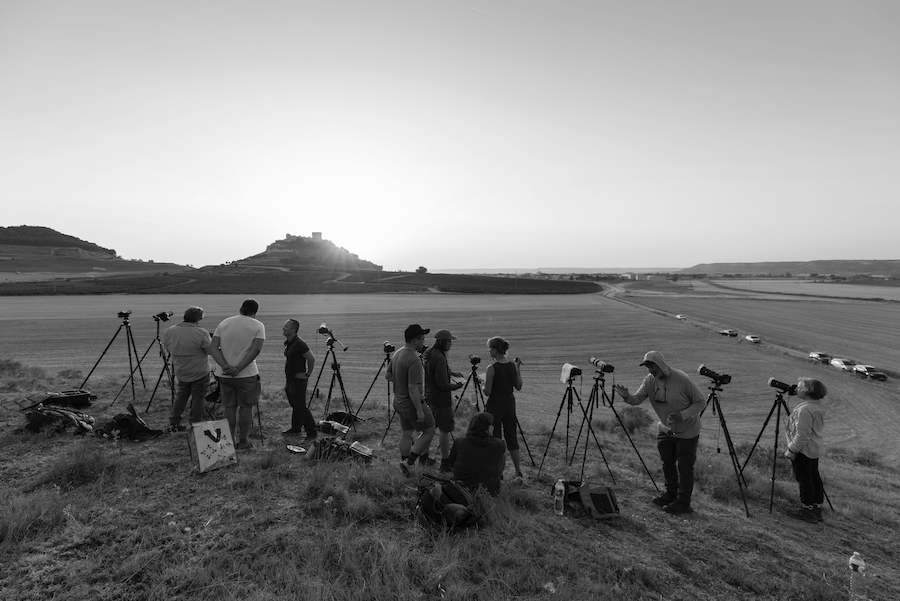
Today, August 12, the sky becomes the stage for one of the most extraordinary astronomical phenomena of the year. Catalonia is preparing to contemplate a total solar eclipse that will make the Sun's disk disappear for a few moments and turn the daytime landscape into an almost unreal scene.
The totality strip will cross Terres de l'Ebre and will have Alcanar as one of the privileged points to observe the phenomenon. In this municipality, the Moon will completely obscure the Sun for approximately one minute and 37 seconds, a brief window of darkness that will allow you to experience one of nature's most unique spectacles.
During these moments, the light will change radically, temperatures may drop suddenly and the behavior of fauna may also be altered. In the middle of the day, the sky will take on an unusual appearance and the first stars may become visible.
The fact that Terres de l'Ebre is one of the privileged territories for contemplating the eclipse is due to a strictly geometric question. The Moon's trajectory will project a narrow strip of shadow onto the Earth's surface and certain points in the territory will be located in the zone of totality.
Eclipses, however, have not only aroused the interest of scientists and sky observers. Throughout history, they have also fueled the imagination of artists, who have tried to capture in their works the transformation of light and the extraordinary atmosphere associated with these phenomena.
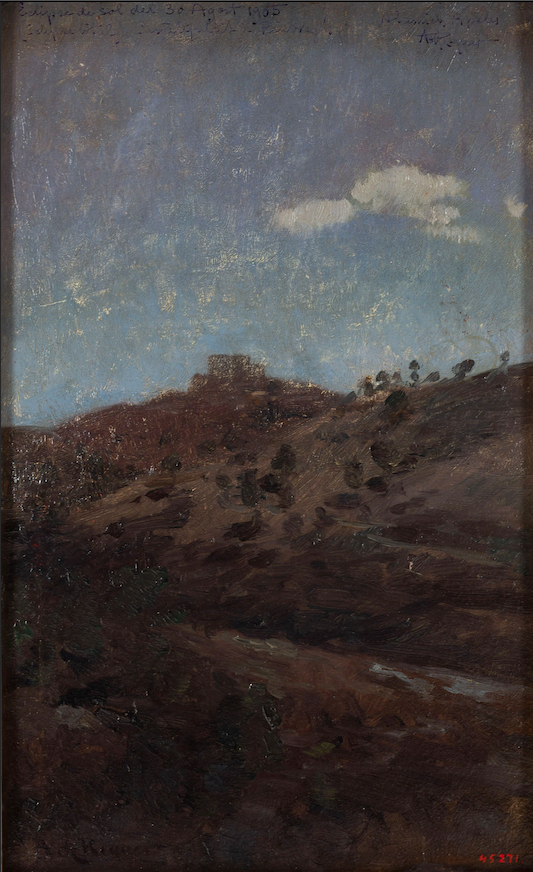
The National Art Museum of Catalonia preserves a particularly suggestive testimony to this fascination. Alexandre de Riquer immortalized the atmosphere of an eclipse in a work dated August 30, 1905, where a darkened landscape is surrounded by delicate twilight and a sky of deep blue tones.
The painting also retains an intimate dimension. Riquer noted the date and place from where he possibly viewed the eclipse and included a dedication to his friend Apel·les Mestres. The work later reached the MNAC collections thanks to Mestres' legacy, becoming the material memory of an instant that, like the one that will once again darken the Catalan sky today, only lasted a few minutes.
While thousands of people today look up to contemplate an exceptional phenomenon, a work preserved at the MNAC reminds us that eclipses have aroused fascination for centuries. Science explains their trajectory and mechanics; art, on the other hand, seeks to preserve the imprint of a fleeting moment, that extraordinary light that transforms the landscape for only a few moments.


You may be
interested
...