
Exhibitions
Wounded Militiaman, the digital rescue of an almost lost work
The National Art Museum of Catalonia presents an intervention that reconstructs, with artificial intelligence, the image of a painting by Francisco Mateos marked by the Civil War and irreversible deterioration.
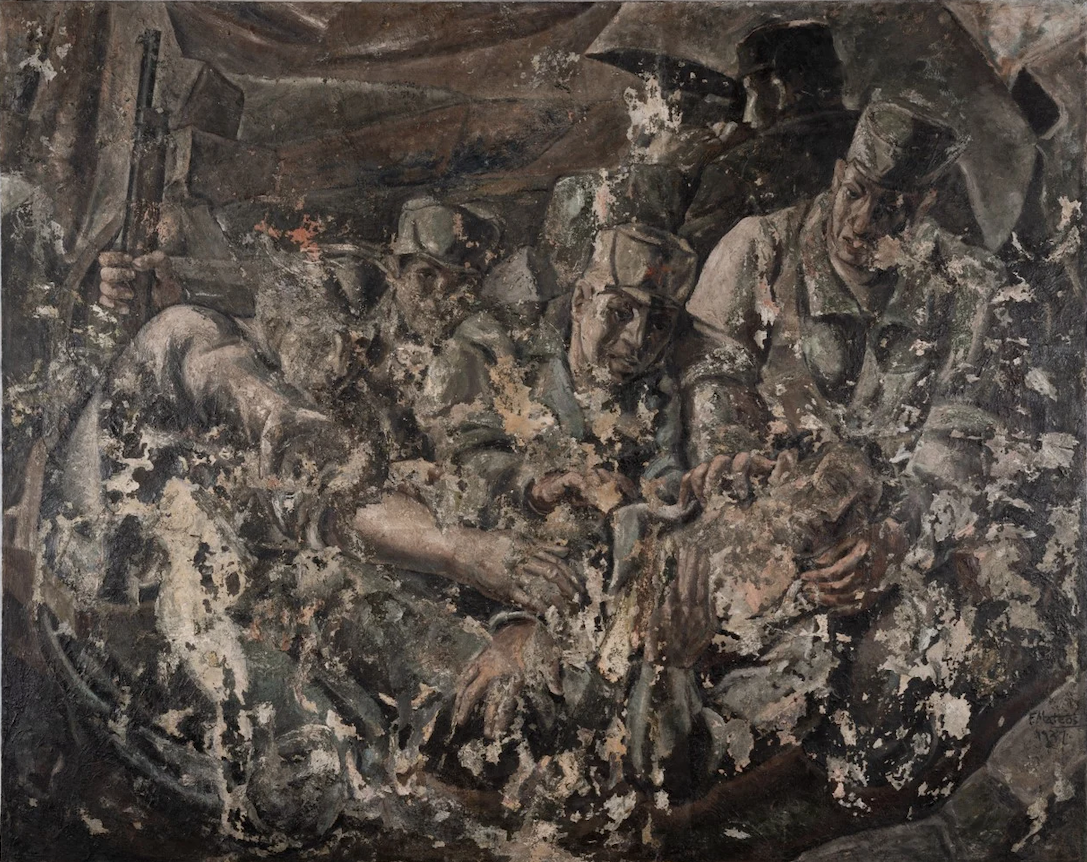
Since May 7, the National Museum of Art of Catalonia has been presenting Wounded Militiaman , by Francisco Mateos, a work conceived in the midst of the Civil War as a propaganda painting, denouncing the violence of war and demanding brotherhood among soldiers. Now, decades after its creation, the museum is facing one of the main obstacles to the piece: its state of conservation prevents it from completely recovering its original image.
Mateos painted Wounded Militiaman in a context marked by urgency and scarcity of resources. The artist reused materials and even joined two of his own paintings to construct a larger canvas on which to represent the scene. This solution, together with the precariousness of the materials and possibly an accelerated execution process, has favored various chemical reactions that have caused, over time, the continuous detachment of the pictorial layer.
The history of the work is closely linked to one of the most significant episodes in the artistic culture of the Civil War. Conceived with the intention of forming part of the Spanish Pavilion of the Republic at the 1937 Paris International Exhibition, 'Wounded Militiaman' coincided in that context with another of the great icons of 20th century political art, Pablo Picasso's Guernica .
However, the return of the work from Paris in 1938 marked the beginning of a long silence. During the Franco dictatorship it could not be exhibited due to its nature linked to the art of the vanquished. When the political circumstances changed, the painting had already deteriorated so deeply that its exhibition remained practically impossible.
The losses of pictorial matter are now irreversible and progressive. The surface only preserves fragments of the original composition and makes it difficult to read the image that Mateos had conceived. It is not, therefore, a work that can simply be restored to recover its initial appearance, but rather a material testimony in which the passage of time has erased a good part of the representation.
Faced with this situation, the project proposes an alternative path: digitally recreating the painting through images generated with artificial intelligence. The aim is not to replace the work or present a reconstruction as if it were the original, but to approximate its appearance and allow the public to understand the visual and expressive force of the message that Mateos wanted to convey.
Technology thus becomes a tool at the service of memory. Where matter no longer allows the complete recovery of the image, digital recreation opens up the possibility of imagining what the work could have been like and of restoring, even if only partially, its narrative capacity.
Wounded Militiaman is also a testament to a way of making art in times of conflict. The reuse of materials, the speed of execution and the limitations imposed by war are part of the physical history of painting. What was once a response to precariousness ends up becoming, decades later, one of the main causes of its fragility.
You may be
interested
...