Exhibitions
Katharina Grosse inhabits the Llotja with 'Arrels'
'Roots', co-produced by Es Baluard and the Government of the Balearic Islands, goes beyond the traditional limits of painting and transforms one of Mallorca's great heritage spaces into an immersive experience where architecture, color and memory become inseparable.
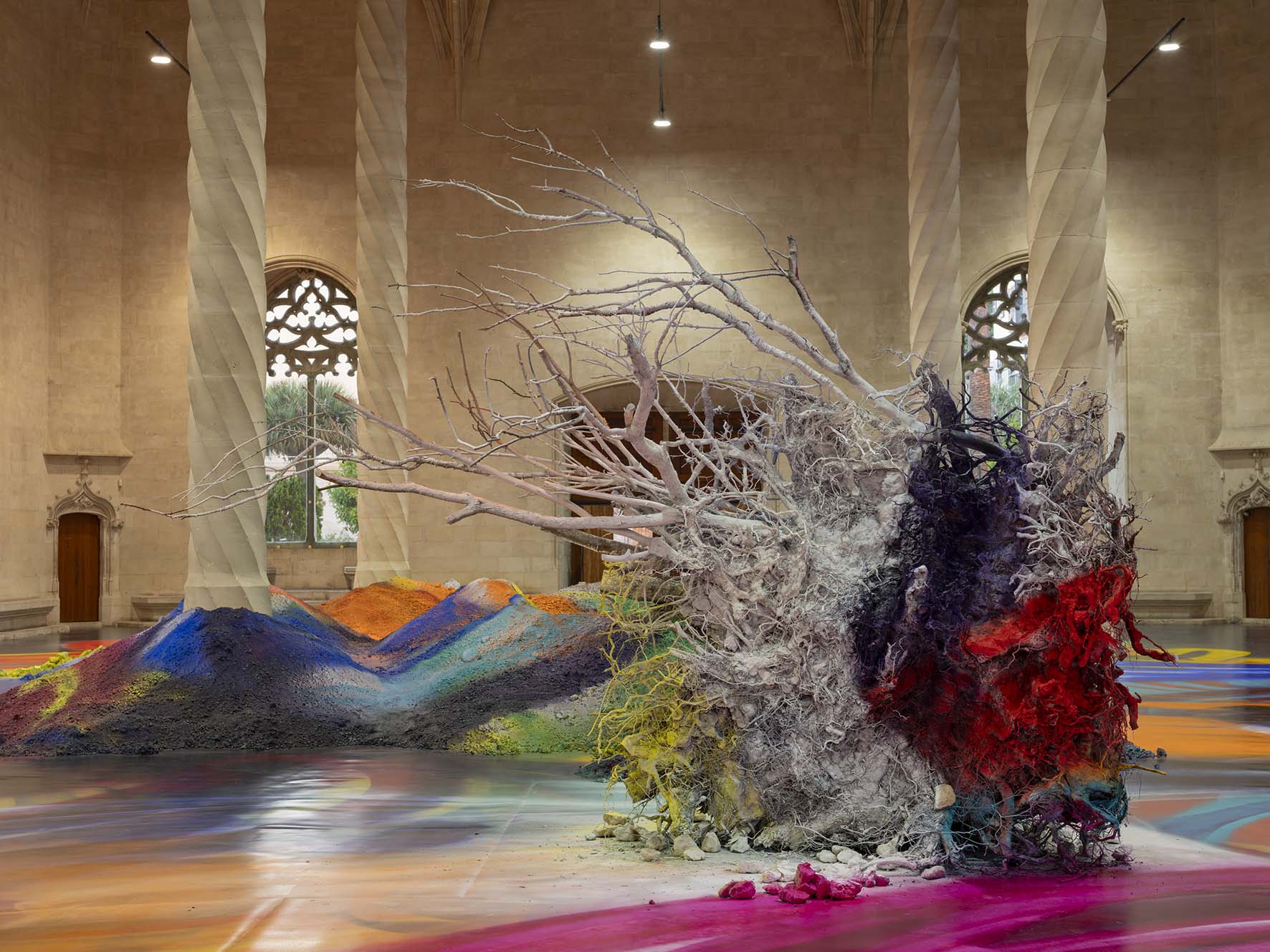
Katharina Grosse's painting has long since ceased to be an object and has become a way of inhabiting space. For more than three decades, the German artist has expanded her pictorial language beyond the canvas, occupying buildings, landscapes and urban environments with interventions that dissolve the boundary between work, architecture and spectator. With Arrels , the new project co-produced by the Balearic Islands Government and Es Baluard Museu d'Art Contemporani de Palma, this research reaches one of its most significant contexts: the Llotja de Palma, one of the jewels of Mediterranean civil Gothic.
Curated by David Barro, also director of Es Baluard, the proposal does not consist of installing a painting inside a historic building, but of converting the architecture itself into a pictorial event. The color, applied with the characteristic spray guns that define Grosse's work, ceases to be a coating to act as a force capable of reorganizing perception, altering spatial hierarchies and activating an immersive experience that involves the visitor's body.
Grosse's practice questions an essential idea of the history of Western art: that painting is a delimited field. In her interventions, limits disappear and color becomes an agent capable of modifying the way we read a place. The viewer no longer observes a work, but circulates within it, crosses it and becomes part of it. As the artist herself states, "the container and the work are completely one and the same thing, accessible from all sides," a statement that accurately summarizes her expanded conception of painting.
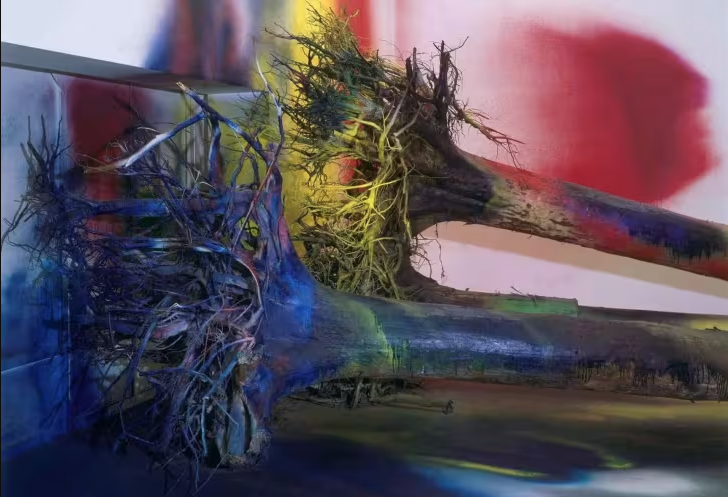
In the case of Arrels , this approach takes on a particularly relevant dimension because it dialogues with the history and symbolic charge of the Llotja, a 15th-century building that preserves its heritage identity intact. If in other projects architecture functioned mainly as a physical support, here it also becomes a conceptual matter. The work responds to the building's mercantile past, to its function as a space for exchange and to its permeability, turning these historical values into an active part of the intervention.
For David Barro, Arrels proposes "a radical relationship between painting and space", a statement that places this intervention within a line of work that has made Katharina Grosse one of the most influential figures in international contemporary art. Her work does not aim to represent the world, but to transform the way we perceive it.
This dialogue between heritage and contemporaneity avoids simple visual spectacularity. Rather than imposing itself on the space, Grosse establishes a productive tension with its memory, demonstrating that painting can generate new readings of heritage without erasing its identity. Color does not hide architecture; it reacts to it, revealing qualities that usually go unnoticed.
You may be
interested
...