Exhibitions
Erin Milez explores urban disconnection in 'Everything the Light Touches'
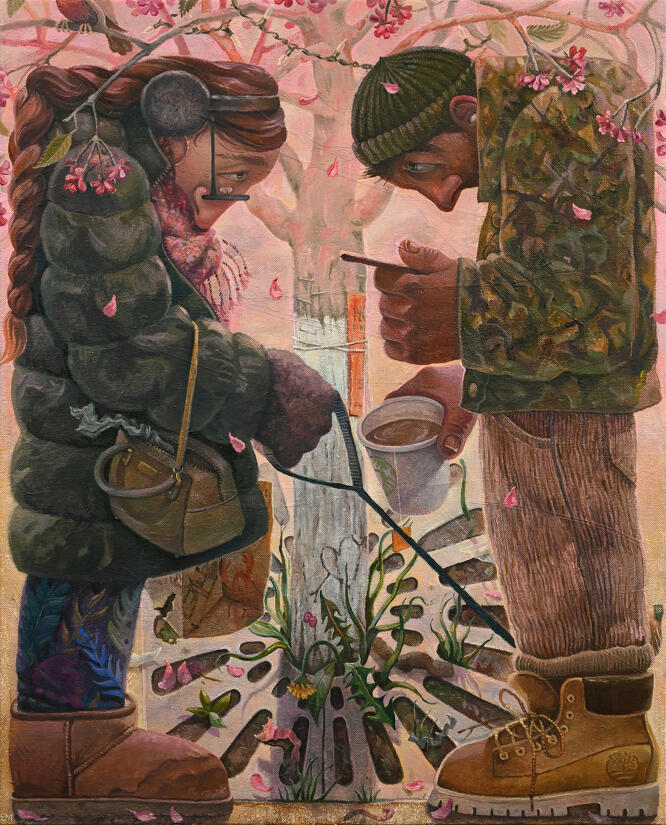
After leaving the New York area to settle in Seattle, artist Erin Milez has turned her gaze from East to West, focusing on the urban landscape and a culture marked by a fast pace, visual saturation, and the difficulty of establishing deep human connections. This reflection materializes in Everything the Light Touches , an exhibition on view from September 10 to October 24, 2026, at the Monya Rowe Gallery, and which is shaping up to be one of the most anticipated shows of the New York art season.
In this new series of works, Milez presents scenes featuring individuals who seem trapped in cramped, overcrowded spaces. Her characters move through the city immersed in a frenetic routine, seemingly oblivious to the possibility of genuine connection with those around them. They are workers, ambitious professionals, and anonymous citizens traversing crowded urban beaches, subway cars, congested highways, or endless escalators—scenarios where physical proximity contrasts sharply with emotional distance.
The exhibition stems from a deep observation of everyday life and draws on the influences of artists such as Jacob Lawrence, L.S. Lowry, Winfred Rembert, and George Tooker. They all shared an interest in depicting the daily movement of people in collective spaces, showing how the city can simultaneously become a place of coexistence and isolation.
One of the most significant elements of Milez's paintings is the way she depicts her subjects. Many appear partially cut out, especially their faces, as if their identity were incomplete or fragmented. The artist herself explains that this technique arose intuitively: "I was surprised to discover how many figures appear cut out, especially their facial features. It was my subconscious designing these people who experience certain sensory limitations, who don't use their whole being to be attentive to the world. "
This lack of a fully present gaze becomes a metaphor for contemporary life: people surrounded by stimuli, yet increasingly disconnected from what is happening around them. Milez thus poses a question about how we inhabit cities and what we lose when we stop observing, listening to, or connecting with our surroundings.
In contrast to this urban reality dominated by concrete and speed, nature appears in his works as a force that constantly forces its way through. Mountains emerge above a highway during rush hour, a subway passenger holds a bouquet of flowers, a shop overflows with plants, palm fronds decorate a shirt, and weeds grow through the tree grates on the sidewalks. These small natural gestures introduce a pause within the urban chaos and remind us of the persistence of life in the face of artificial spaces.
One of the central pieces in the Monya Rowe Gallery exhibition, A Giving Tree (2026), depicts two figures passing each other on a sidewalk, exchanging a fleeting, silent glance. The nature of their relationship remains open: they could be strangers, neighbors, or simply two people who happen to cross paths for a few seconds in the vastness of the city. The scene evokes a common image of our present: individuals walking with their heads down, focused on their phone screens, and avoiding any spontaneous interaction.
Through these compositions, Erin Milez revisits a profoundly human concern: the need for connection. Echoing E.M. Forster's famous phrase, "just connect," the artist proposes pausing, looking around, and rediscovering the ability to be present. Everything the Light Touches thus becomes an invitation to recognize the hidden beauty in everyday spaces and to rediscover the small encounters that can still transform our experience of the city.



You may be
interested
...