Exhibitions
Disputed Memories: Cinema, Territory, and Revolution in Central America
The series organized at the Museo Nacional Centro de Arte Reina Sofía (MNCARS), curated by Alonso Aguilar, in collaboration with the Instituto Cáder de Arte Centroamericano (ICAC), proposes a three-part reading of political cinema produced in Central America during the 1960s, 1970s, and 1980s. More than a retrospective, the program functions as a critical device that articulates a rereading of the images from their material conditions of production, their historical tensions, and their still-present political power.
The exhibition is structured around three programs that trace a narrative and conceptual arc: from rural economies and their forms of resistance to armed insurgency and its visions of social transformation. The first section focuses on the territorial base, exploring the specters of agricultural exploitation and the resistance emerging from the peasant world. The second shifts the focus to the body as a site of conflict, where patriarchal and state violence is expressed and confronted through dissident formal and political languages. The third culminates in an epic dimension, traversing geographical and narrative boundaries, embodying the experiences of armed struggle and the often-shattered promise of revolution.
Far from being an archaeological or merely archival approach, the proposal seeks to revive interrupted conversations about how these images contributed to the construction of forms of collective organization, political aspirations, and historical consciousness in the region. The films are not presented as closed documents, but as living materials that allow for an active dialogue between past and present.
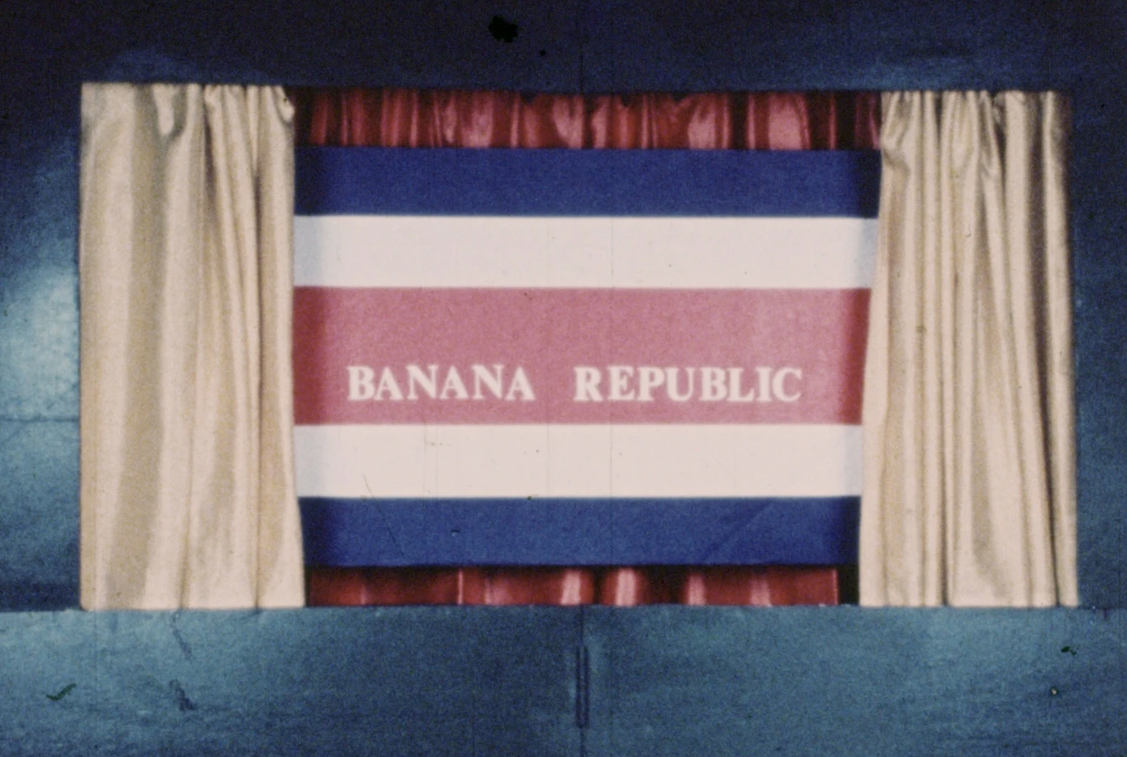
The series also critically revisits the concept of the 'banana republic,' a derogatory term that emerged in the early 20th century to describe Central American countries marked by economic dependence, political instability, and the strong influence of foreign capital, particularly from US corporations like the United Fruit Company. In response to this label, Central American political cinema of the time appropriated the stigma to challenge and subvert it, claiming its own place within global narratives of emancipation and anticolonialism.
In this context, various institutions, collectives, and independent filmmakers—both within and outside the region—promoted audiovisual production deeply connected to their immediate surroundings and the international climate of anti-imperialist struggles. Among them were the Film Department in Honduras, its counterpart in Costa Rica, INCINE in Nicaragua, the University Experimental Film Group in Panama, the Guatemalan Film Institute, and collectives in El Salvador such as Taller de los Vagos, Cero a la Izquierda, and the Venceremos Radio System.


You may be
interested
...