
reports
The suspended moment: basketball transformed into art in classic photojournalism
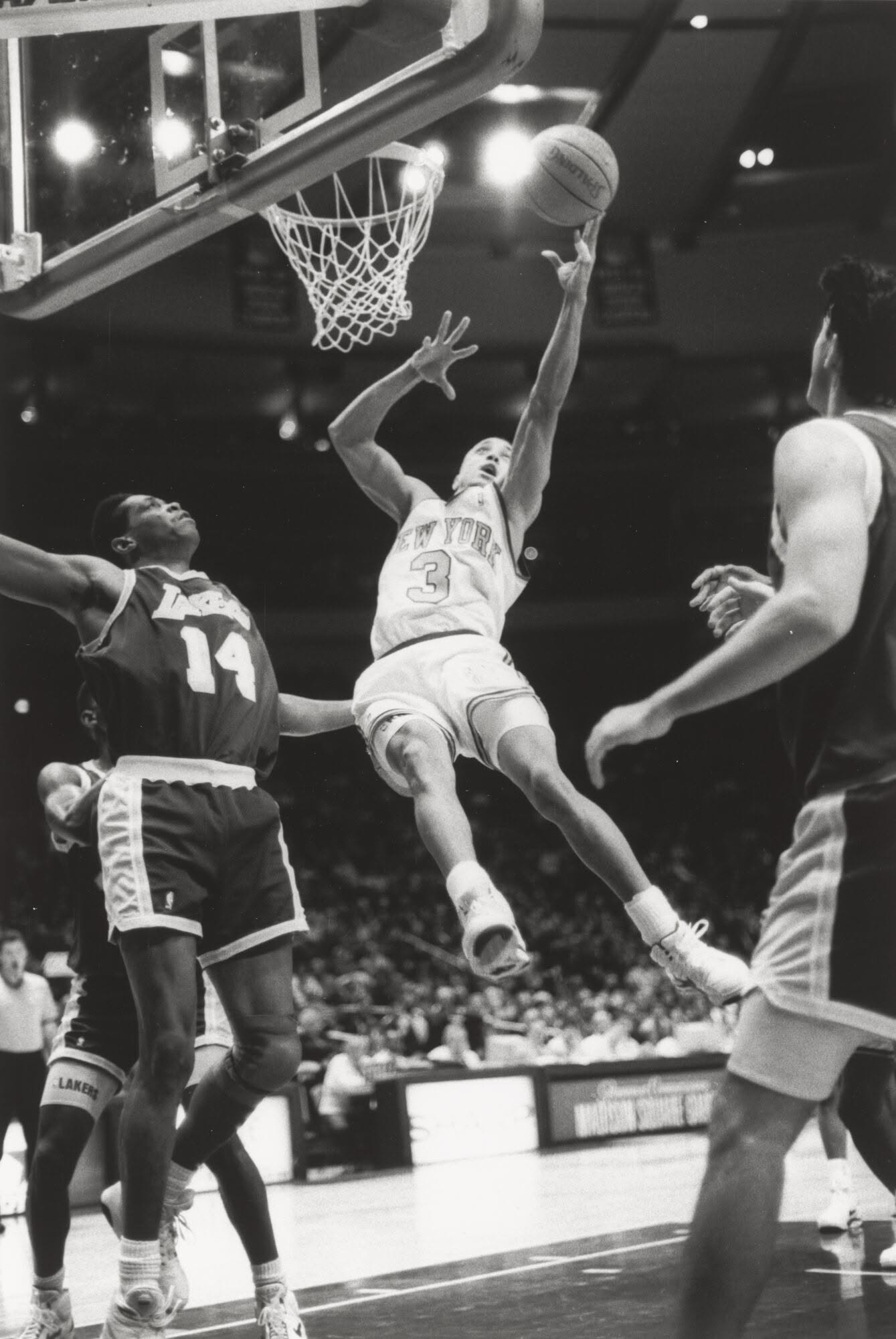
"Go New York, go New York, go!" — the almost choreographed chant that accompanies the culture of Madison Square Garden echoes in a contemporary image that, nevertheless, already belongs to the classic annals of sports photojournalism. The photograph "Lakers at the Knicks" (March 10, 1992), taken by Barton Silverman for The New York Times , is part of that visual genealogy in which basketball ceases to be merely a sport and becomes an aesthetic construction of movement, risk, and the suspension of time. The Knicks, leading 2-0 in the 2026 NBA Finals against the San Antonio Spurs, await a New York City eager to witness a new title after decades.
The first thing the image strikes you about is its frozen moment. A player soars through the air on an elongated, almost excessive, layup, as if his body were defying gravity. Two defenders surround him, stretching the space, trying to interrupt the inevitable. The ball, at the peak of the action, acts as a symbolic focal point: all the uncertainty of the outcome, all the drama of the gesture, is concentrated there. The framing, taken from a low angle near the basket, transforms the play into a vertical architecture of bodies, where height is not only physical but also narrative.
Visually, the choice of black and white is decisive. Far from being a nostalgic device, it functions as a purification mechanism: it eliminates the noise of the spectacle and forces the viewer to focus on the structure. What remains are tensions of light and shadow, volumes, and directions. The intense lighting of the arena highlights the ball, the hoop, and the fabrics of the jerseys, while the dense shadows emphasize the effort in the bodies. It is an almost theatrical setting, where every muscle seems underscored by the contrast.
The composition reinforces this sense of contained instability. The hoop is positioned in the upper left, like an inevitable point of destination, while the figures intersect diagonally, suggesting collision, impulse, and resistance. Stillness is impossible: everything in the image pushes upward or falls downward, as if the frame had captured not an action, but its internal tension.
This type of photography has been widely valued in institutions like MoMA precisely because it transcends the sports document. It doesn't simply record a Knicks game, but explores the grammar of the moving body, energy as a visual form, and time as a fragment. Henri Cartier-Bresson's reflections on the 'decisive moment,' where photography doesn't describe the world but condenses it, also fall within this tradition. And, in a different but complementary vein, it can engage with the documentary approach of Walker Evans , who understood the image as a rigorous construction of reality, even when reality seems to overflow.
Viewed from today's perspective, this photograph transcends the Lakers and Knicks sports archives to become part of a broader narrative: the way the 20th century learned to observe movement, to freeze the unstable, and to discover beauty in the collision of bodies suspended in mid-air. In that brief moment—that instant before the ball touches the rim or is deflected—a field of interpretation opens up that remains entirely relevant. Because what this image preserves is not the outcome of the game, but the unrepeatable density of a moment brimming with possibility.


You may be
interested
...