
interviews
Guillem Terribas presents his new paperback book Tomorrow will be another day, twenty years later
The bookseller and filmmaker reviews two decades of his career and reflects on the future of independent bookstores and the Truffaut Cinema.
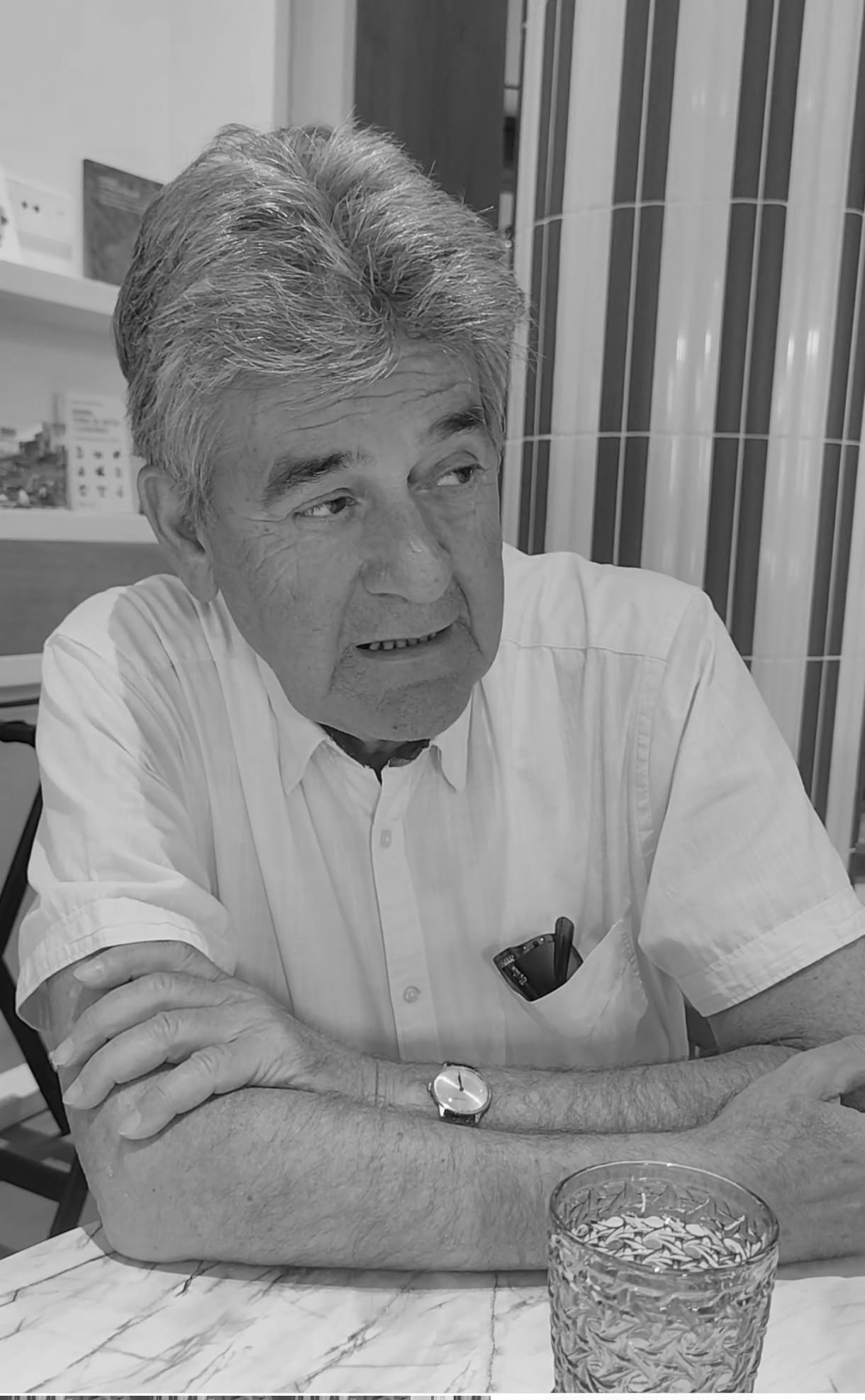
Last Friday, May 22, at eight in the evening, Guillem Terribas (Salt, 1951) presented his new paperback book entitled Demà serà un altre dia, vinto anis depresa at Llibreria 22 in Girona. He was accompanied at this event by the writer Josep Maria Fonalleras, the writer and teacher Marta Pasqual and the artist from Salta, Joan Mateu.
It should be remembered that the original book of Demà será un altre dia was published in 2007 and was his biography linked to Llibreria 22 in Girona. The new 2026 edition appears with an expanded revision, with references to the original story and a new epilogue.
This book has been published by La Col·lectiva d'Ara Llibres, consists of about 200 pages and a total of 1,500 copies have been published nationwide.
Guillem Terribas is one of the founders of Llibreria 22. From 1978 he was its soul and manager until 2015. He is currently part of the Girona Film Critics' Group, which is the entity responsible for the Truffaut Cinema.
During the course of his professional career, Terribas has received awards such as the Tres de Març Award, the Creu de Sant Jordi and the Trajectòria Award, among others. He has also written the children's stories L'avi de la Martina (2017), La Martina va al cau (2019) and Un regal per a la Martina (2024), as well as Alegra'm la vida (2017), where he conveys his passion for cinema and recommends 22 films to watch with children.
What are the new sections included in this new 2026 edition?
This new edition incorporates a retrospective on the last twenty years, marked by profound vital and cultural changes (about thirty more pages).
I begin by explaining that twenty years have passed since I presented this book at the Sala La Planeta in Girona, in an event in which twenty-two people participated and spoke about the book and me; all of them were people who were part of my life and who also appear in the book.
I published this first book a month after my mother died, on October 22, 2007. In it, I talk about being a grandfather and having a heart attack, as well as about important losses of people who were (and always will be) part of my life, and I review all the projects and initiatives with groups and associations from that time.
Another novelty is that in this new paperback book I have changed the hardcover of the cover of the previous book, in which I was smoking, to the current one, in which I am portrayed with glasses and without smoking.

How do you see the role of independent bookstores today, compared to twenty years ago?
As things stand in the publishing world, whether it's a bookstore or a publishing house, if you want to grow an ambitious project it's very difficult to move it forward if you don't have a company or a structure with sufficient human and financial resources.
The utopias, enthusiasm and vitality of the 1980s have now passed into history. One of the questions I ask myself is whether I would now be able to create an ambitious bookstore and open other establishments, or whether I would stick with a more controllable bookstore, between two people, and gradually build readers, without rush or pressure.
Regarding Llibreria 22, four years ago I started relations with Abacus, which is a large consumer and worker cooperative focused on the distribution of educational, cultural and leisure products. Immediately afterwards, the manager of Llibreria 22, Jordi Gispert, closed the negotiations with this company and, finally, Abacus is the large company we were looking for and has retained 51% of the shares (it is our majority partner). The remaining 49% of the shares are held by 25 people who act as partners.
As for the creation of more independent bookstores throughout Catalonia, it could be a future project... why not?
Do you plan to carry out new presentations of this new book in other cities or cultural spaces?
I no longer organize presentations or events, like I did at Llibreria 22. I have promoted more than 4,000 presentations and events in my life, in recent years with an average of one presentation per day.
What is your assessment of the 25 years of management of the Film Critics' Group?
I think they've been very positive. As I say in my book, one of my great passions is cinema.
Last year marked 25 years since, with a group of film enthusiasts, we created a non-profit association called the Girona Film Critics Group and, previously, through a public competition, we assumed responsibility for the programming and organization of the Truffaut Cinema, which belongs to the Girona City Council.
In short, it has been a very intense few years and a lot of good teamwork to give coherence to a different way of watching and experiencing films and going to the cinema. After more than two decades as president of the entity, I have taken a step aside and am now part of the association as a member.
There is a public tender from the City Council that could award management to a private company from Cambrils. What is your position on this risk of change of management?
The Collective will not make any statement, as the final resolution has not yet been published. Since the mayor of Girona, Lluc Salellas, has not ratified anything on this issue, it is all street speculation, and the Collective of Critics will not say anything and will wait.
It should be remembered that the Catalan Film Academy has launched a letter of support for the Truffaut Cinema, which has collected a total of 6,000 signatures in favor of the Truffaut and the Collective continuing to exist. This letter emphasizes that "cinema is not just entertainment; it is culture, identity and collective memory. And that is why the Truffaut Cinema in Girona is absolutely essential." For its part, the Critics' Collective, during these years of existence, has established a firm commitment to culture and to this audience that fills the theaters.
It also highlights that “losing the Truffaut from the Critics' Group is losing a key space to give visibility to our cinematography” and that it is essential to understand that facilities like the Truffaut cannot depend solely on economic criteria, since privatizing them or subjecting them to the logic of profit puts at risk everything that has been built over decades. Culture is not a luxury, it is a common good and a right.
Finally, it is pointed out that Truffaut is a consolidated cultural project and that, if spaces like this are lost, "we don't just lose screens; we lose voices, we lose looks and we lose an essential part of who we are."
For my part, I want to add that from Truffaut and the Collective we will try to do our best to continue our work normally, making less commercial cinema, with relevant film directors, managing a film library, etc. I believe that we are not the competition of other more commercial cinemas and, as always, we will continue working 365 days a year.
As a cultural activist, bookseller, etc., with so many years at Llibreria 22 in Girona, how has your career influenced the vision of cinema as a cultural and social element?
I hope it has influenced me for the better, and as the last sentences of the new book I have published say: “I love life, my land and its people, and I always, always think that tomorrow will be another day.”



You may be
interested
...