Exhibitions
From urban gesture to global icon: comics as the visual grammar of the present
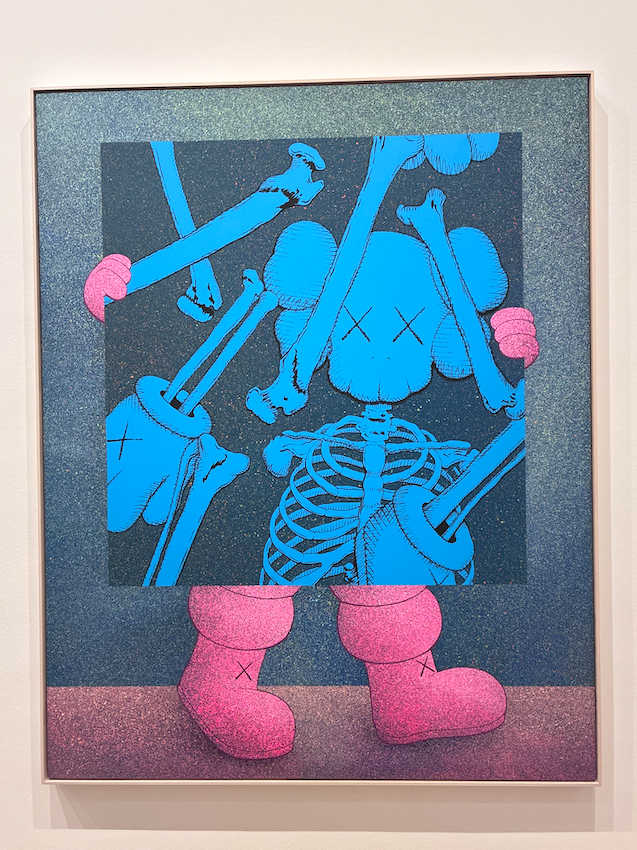
The exhibition KAWS. Art & Comix , on view at the Albertina Modern until October 27, offers a journey that goes beyond simply displaying artworks: it constructs a system of relationships where comics, caricature, painting, and contemporary sculpture intersect as equivalent languages. Curated by Angela Stief and Florian Waldvogel, the exhibition posits a clear hypothesis: comics are not a marginal genre, but rather one of the most influential visual structures in the contemporary global imagination.
From the outset of the exhibition, the dialogue between KAWS's work and pieces by artists such as Roy Lichtenstein, Keith Haring, Jean-Michel Basquiat, and Gottfried Helnwein establishes an open genealogy in which the graphic line ceases to be mere illustration and becomes an autonomous language. Pop art, political cartoons, graffiti, and neo-expressionist painting appear here not as isolated styles, but as variations on the same impulse: to translate the urban experience into immediate, legible, and emotionally direct signs.
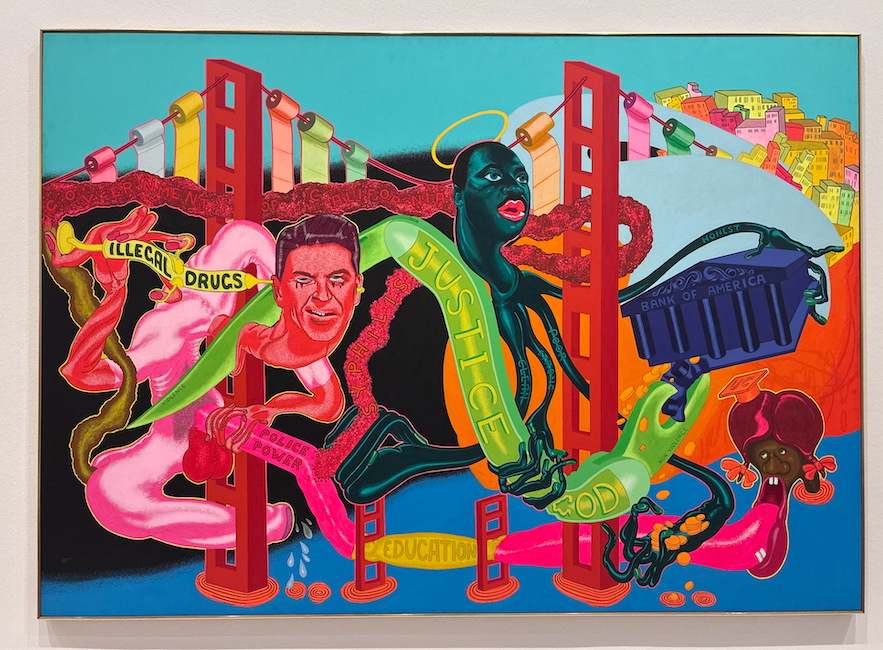
Peter Saul, The Government of California, 1969.
In this context, comics reveal themselves as a form of visual thought that predates even their modern institutionalization. Their sequential structure, narrative economy, and ability to condense emotion into a few gestures make them a transnational cultural device. The exhibition reinforces this idea by placing artists like Basquiat and Ad Reinhardt within an expanded reading of the “language of comics,” where the boundary between painting and narrative blurs.
KAWS's work occupies a central place in this framework. His career, which began in the graffiti of the 1990s, stems from a direct intervention in public space: altering advertisements, posters, and urban advertising to disrupt their visual codes with his characteristic crossed eyes. This seemingly simple gesture shifts the meaning of the commercial image toward an ambiguous zone between irony and melancholy.
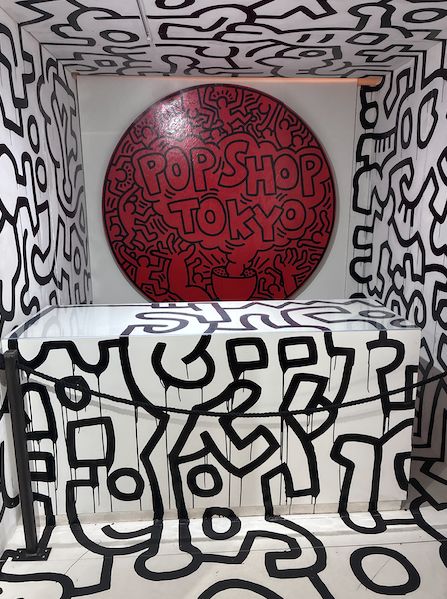
Keith Haring, Pop Shop Tokyo.
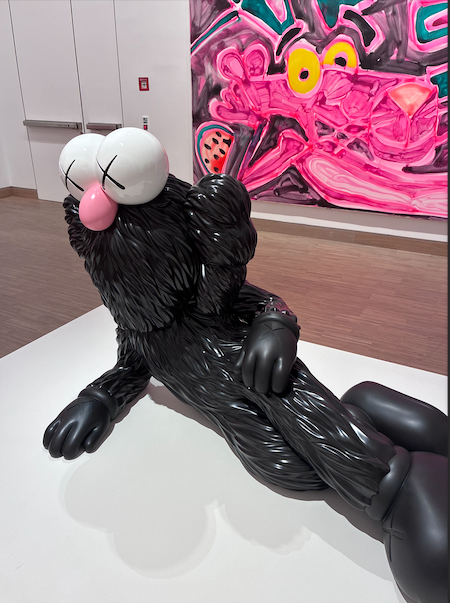
In his large-scale sculptures, crafted from diverse materials such as wood, bronze, or inflatable structures, his figures—the so-called COMPANION and BFF—appear as characters suspended between tenderness and alienation. Sometimes they embrace, other times they cover their faces or remain isolated, constructing an emotional iconography that reflects a contemporary subjectivity marked by loneliness, visual saturation, and hyperconnectivity. In this sense, KAWS's work not only translates the language of comics into sculpture: it transforms it into an affective system.
But the exhibition's interest lies not only in the artist's consolidation as a global icon, but also in how his work sparks a broader dialogue about contemporary imagery. In a culture where the boundaries between art, entertainment, advertising, and digital networks have become porous, comics emerge as a dominant grammar. Their fragmented logic, their capacity for synthesis, and their accessibility make them a form of collective perception.
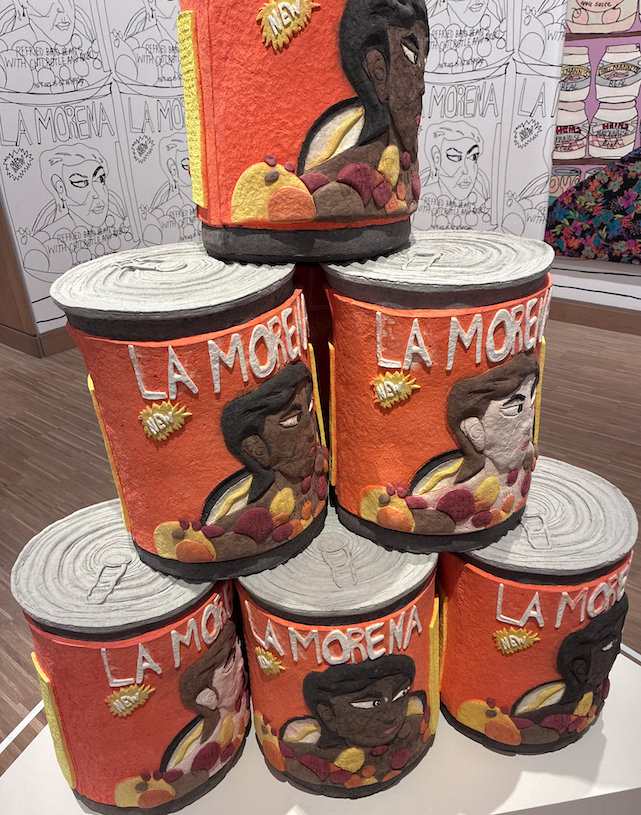
Tschabalala Self, La Morena Pyramid, 1990.
Amidst this journey, one intervention stands out, introducing a distinct dimension to the discourse: the installation by Mimi Gross and The Ruckus Construction Company. Far removed from the digital world or the polished aesthetic of the global icon, this project harks back to a tradition of manual, collaborative, and profoundly material construction in art.
Mimi Gross, an artist born in New York in 1940, has developed a practice centered on three-dimensional installations that transform exhibition space into a habitable experience. Her work, alongside The Ruckus Construction Company—formed in the context of the Red Grooms projects in the 1970s—resulted in the celebrated “Ruckus Manhattan,” a satirical and expansive reconstruction of New York City. That work did not represent the city; it reimagined it as a three-dimensional comic strip in which urban spaces could be physically traversed.
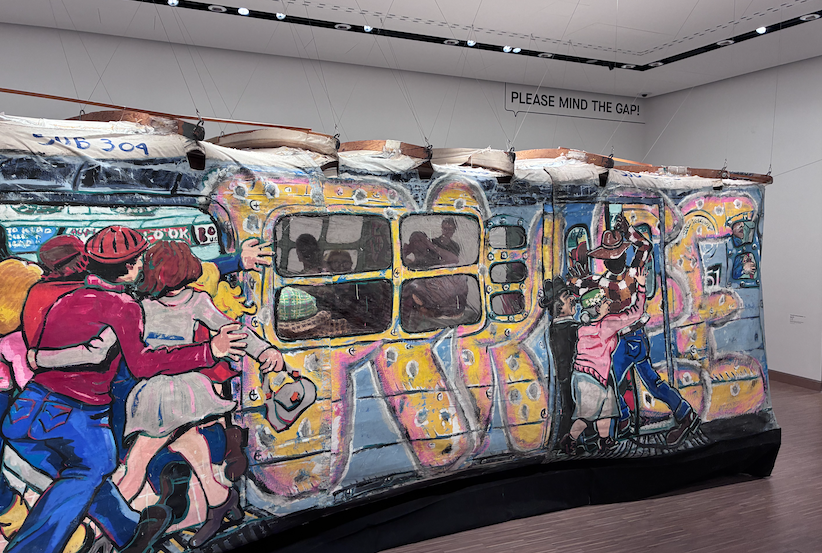
In the context of the Albertina Modern exhibition, this installation takes on particular significance: it functions as a historical and conceptual counterpoint to KAWS's digitized aesthetic. While his sculptures synthesize the language of comics into reproducible global icons, Gross and his collective's project returns that same language to its physical, artisanal, and communal dimension.
The KAWS. Art & Comix exhibition thus presents a fundamental tension: between the image as a global product and the image as a lived space; between the reproducible icon and the collectively constructed city; between the polished surface of contemporary visual culture and the unstable matter of its graphic origins.
Ultimately, the exhibition doesn't simply celebrate comics as an artistic influence, but places them at the heart of a broader question: how do we see today, how do images circulate, and what kind of subjectivity do they construct? In this context, comics cease to be a genre and become a defining characteristic of the present.
You may be
interested
...