Exhibitions
Jaume Muxart and the woven memory of Catalan modernity
The DYX tapestry reappears in Sant Cugat as a witness to one of the most innovative episodes of Catalan art of the 20th century.
There are exhibitions that present a work and there are others that reactivate a story. The exhibition Jaume Muxart and the Tapestry , which Canals Galeria d'Art is dedicating to the artist between June 2 and August 30, 2026, clearly belongs to the second category. The presentation for the first time of the DYX tapestry (1965) not only recovers an exceptional piece, but also allows us to revisit a fundamental moment in Catalan artistic renewal: the adventure of the Catalan Tapestry School of Sant Cugat.
Coming from the collection of Júlia Samaranch, the tapestry emerges today as a living document of that singular project promoted by the entrepreneur Miquel Samaranch at Casa Aymat. More than an artisanal discipline, tapestry became during the sixties a space for contemporary research where artists and weavers shared languages, materials and creative processes. In this context, Jaume Muxart found a natural extension of his pictorial concerns.
The creation of DYX involved weavers Joan Aymerich, Josep Royo and Toni Busquets, indispensable protagonists of an artistic revolution that placed Sant Cugat on the international map of contemporary textile art. The value of the work does not reside solely in its formal quality, but in its capacity to condense a model of collective creation that questioned the traditional boundaries between the major and applied arts.
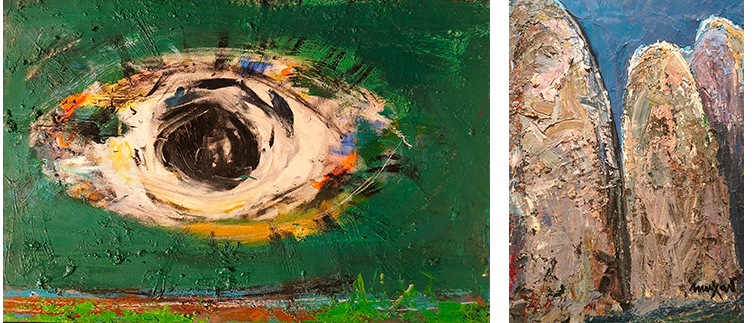
Jaume Muxart (Martorell, 1922 – Barcelona, 2019) occupies a central position in the history of 20th-century Catalan art. A founding member of the Taüll Group in 1955, alongside figures such as Modest Cuixart, Josep Guinovart, Antoni Tàpies, Joan Josep Tharrats, Marc Aleu and Jordi Mercadé, he actively participated in the redefinition of post-war artistic languages. However, his career has often been overshadowed by other names of his generation, despite the solidity and coherence of a work that evolved always faithful to its principles.
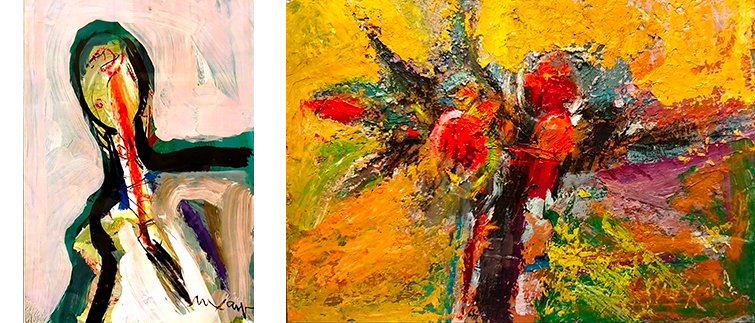
His painting, marked by a dense and material abstraction, did not limit itself to assimilating the influences of the European avant-gardes. Muxart built his own universe, characterized by a constant tension between structure and gesture, between rigor and freedom. His work conveys the sensation of a sustained search, alien to fashions and the demands of the market, a fact that today reinforces its critical validity.
The Canals Galeria d'Art exhibition establishes a particularly revealing dialogue between the DYX tapestry and a selection of paintings made between 1998 and 2010, chosen by his daughter, Paulina Muxart. This temporal confrontation allows us to observe the surprising continuity of some formal and conceptual concerns over decades of work. The late works maintain the expressive intensity and material density that already appeared in the textile experiments of the sixties, demonstrating that, for Muxart, each support was a variation of the same visual thought.
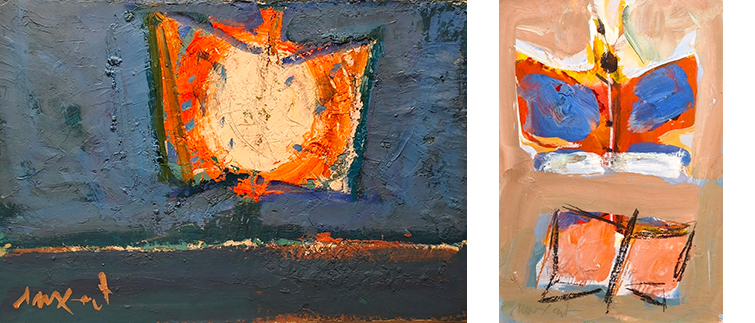
The public recovery of DYX thus acquires a dimension that goes beyond homage. It is an opportunity to reconsider the role of Muxart in the construction of Catalan modernity and to vindicate the contribution of Sant Cugat as a creative laboratory of international scope. At a time when the revision of the artistic narratives of the 20th century is becoming increasingly necessary, this exhibition reminds us that innovation did not always occur in the great centers of cultural power, but also in spaces of collaboration and experimentation such as those that made the Catalan Tapestry School possible.
You may be
interested
...