Opinion
The return of the Knicks: the urban body as myth in contemporary New York
Knicks, visual culture, and the return of the New York myth. From the hardwood to the museum, uniting sports, contemporary art, and the symbolic reinvention of New York.
There are sporting comebacks that go beyond the scoreboard. The New York Knicks' return to the NBA Finals, for the first time since 1999, functions more as a reshaping of the collective imagination of a city that defines itself through its teams, its icons, and its cultural narratives. It's been 27 years since their last appearance on the league's decisive stage, and the team has arrived here with a forcefulness that goes beyond mere results: a 130-93 victory over the Cleveland Cavaliers in Game 2 of a series they swept.
Madison Square Garden is once again a space of symbolic density, where sport blends with urban ritual. But what's truly interesting happens off the court: in the way this return reconfigures the images with which New York represents itself.
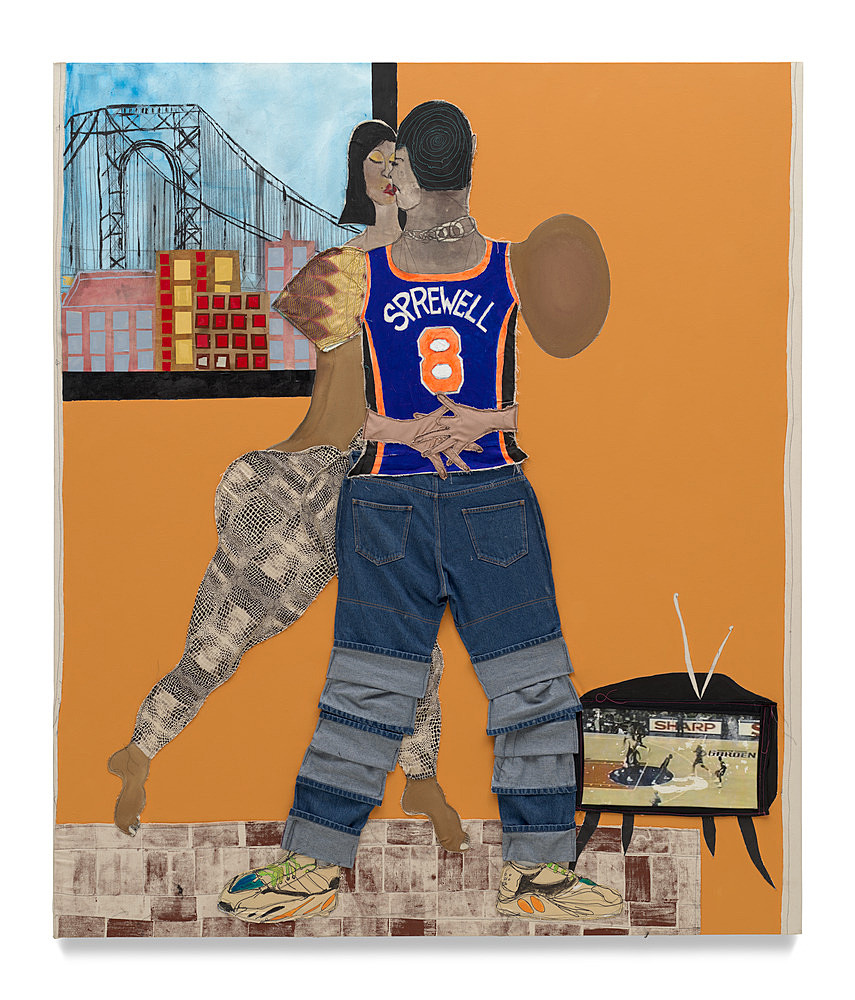
At this intersection of sport and visual culture, Tschabalala Self's work, Sprewell , currently on display at the Guggenheim Museum, emerges. Self, one of the most recognizable voices in contemporary American art, has worked for years at the intersection of body, identity, and popular culture, with particular attention to the ways in which African American identity has been represented—and constructed—in the dominant visual imagination. His language, based on collage, textiles, and figurative fragmentation, does not seek to represent bodies, but rather to reconstruct them as symbolic territories.
Sprewell , as its title suggests, engages with the world of basketball through the figure of former player Latrell Sprewell. However, the work doesn't dwell on his sporting biography, but rather uses this figure as a cultural catalyst: the athlete transformed into an icon, fame as an aesthetic construct, the body as a surface for social projection. In Self's hands, sport ceases to be an event and becomes a language.
This shift is no coincidence at a time when the Knicks are once again at the center of public discourse. New York's visual culture has also registered this changing of the guard. The June 1st cover of The New Yorker , titled "Kings of New York," places Jalen Brunson—point guard and team leader—at the center of a composition in which, in the background, legends from different generations of the franchise, such as Carmelo Anthony and Patrick Ewing, appear. The image establishes a clear hierarchy: the present, embodied by Brunson, dominates the frame, while the past functions as a historical chorus.
The contrast with another cover from 2021 is unavoidable. At that time, the city's visual narrative favored the Brooklyn Nets, represented by Kevin Durant, Kyrie Irving, and James Harden, over the Knicks' icons. It was a different symbolic city, a different distribution of sporting prestige. Today, that narrative is reversed with almost choreographed precision.
Brunson's figure not only embodies recent sporting success—culminating in reaching the Finals after his fourth postseason appearance with the franchise and a decisive series won decisively—but also becomes an emblem of a broader transformation. His image belongs not only to basketball but also to the contemporary iconography of New York, where the sports hero is once again taking center stage in urban mythology.
What's really at stake goes beyond a series or a season. It's the recovery of a narrative. One in which sports, contemporary art, and visual culture cease to be separate spheres and become part of a single conversation about identity, memory, and representation. New York, once again, isn't just competing: it's telling its own story.


You may be
interested
...