Opinion
The Amber solace of the book
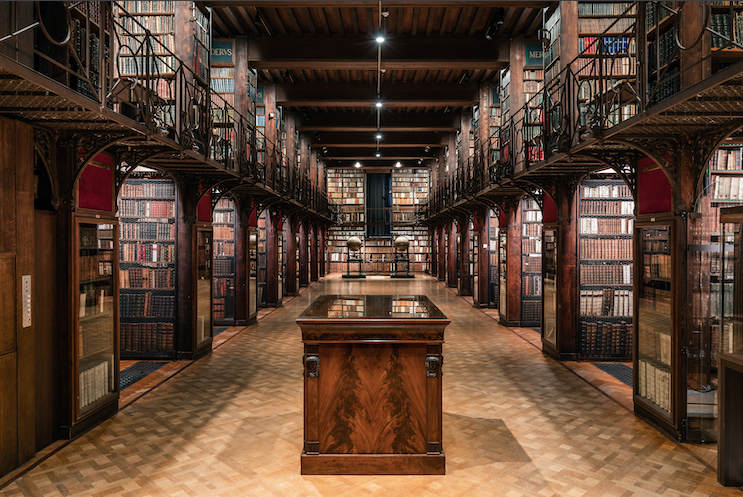
Founded in 1481 in Antwerp, the second largest Belgian city, as a repository for its municipal officials, the Hendrik Conscience Heritage Library holds 1,500,000 titles in its more than 35 kilometers of shelves, 40,000 of which were published before 1830.
Named after the 19th-century writer, this catalogue is the culmination of a tireless effort, despite its many challenges. Its collection of unique copies, both antique and contemporary editions, encompasses more than five centuries of Antwerp and Flanders history, its cultural heritage, and Dutch literature.
Its first 41 incunabula, donated to the city by the procurator Willem Pauwels, were destroyed by fire in 1576 during the Spanish invasion. The local printer Christoph Plantin spurred its revival with his Biblia Polyglotta and his Opticorum libri VI , by Francisco Aguilonio: an example that his successors continued with successive copies of each printed book. Antwerp was already a world-class publishing center.
In 1604, Bishop Joannes Miraeus founded the episcopal seminary, and his nephew Aubertus promoted the Bibliothecae Antverpianae Primordia , with 356 works that he added to the collection. After several moves, in 1802 it acquired volumes from the École Centrale, expropriated from the cloisters closed during the French occupation. Its 43,000 volumes prompted the purchase of its final location in 1883.
In addition to the humanities, its librarians of the two preceding centuries amassed printed materials from the Southern Netherlands dating back to the Middle Ages. Frans Mertens and Constant Hansen devised an organizational system and published the first catalogue. In 2008, it was granted heritage status. Its local collection, the Antverpiensia , includes ordinances and edicts from the 16th to 18th centuries, a chronicle of the city, and more. Furthermore, the library houses various collections, such as those of the Folklore and Maritime Museums.
The flagship: the Nottebohm Hall
Designed in 1936 in honor of Oscar Nottebohm, a local businessman and patron of the arts of German origin, it houses 150,000 unique titles and a 3,000-year-old Egyptian papyrus. The hall replaced the old Baroque chapel of 1621, decorated by Rubens and Van Dyck, a meeting place for the fraternities fostered by the Society of Jesus.
Some of his incunabula were featured at the last edition of the Brussels Art Fair (BRAFA), at the stand of the Belgian Professional Chamber of Antique and Modern Booksellers (CLAM), made up of 30 antiquarian booksellers specializing in rare books, autographs or manuscripts.



You may be
interested
...