Exhibitions
Refounding form: the sculptor Gabrial at the Grand Palais
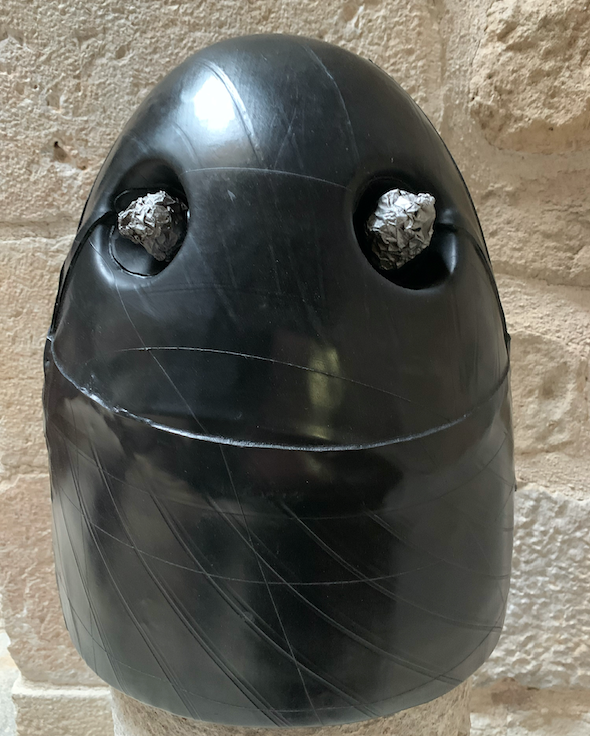
At the beginning of the season (2026) I announced in this magazine the return of form to contemporary creation based on the exhibition of three young sculptors: Eva Fàbregas, Teresa Solar and Nathalie Rey, among others. Now I have a very good opportunity to nail the nail on the occasion of the “return” to the exhibition scene of the sculptor Gabriel, because his work, for years, has been pure form. The sculptor exhibits with Alzueta Gallery at Art Paris, at the Grand Palais, between April 9 and 12.
Return
Gabriel is one of the most representative sculptors of the artistic scene of the eighties generation, along with Cristina Iglesias, Juan Muñoz, Sergi Aguilar, Susana Solano, Txomin Badiola, Peio Irazu, Jaume Plensa, Miquel Navarro, Tom Carr and Fernando Sinaga. All of them have in common that their works achieve the powerful force of matter and form.
Using the cliché, I would say that he needs no introduction, but since my memory is weak, I will cite some critics who, like me, were interested in his work: José Corredor Matheos, Teresa Camps, Vicenç Altaió, J. Sala Sanahuja, Dan Cameron, Kevin Power, Gillo Dorfles, Menene Gras, Fernando Castro, Pedro Azara, Chantal Grande, Josep Miquel García, Juan Bufill, Glòria Bosch, Rafael Argullol and Ricard Planas. We all agree in highlighting both his uniqueness and the value of his contribution to the creation of a new axiom of contemporaneity that allows us to uphold the cause of art.
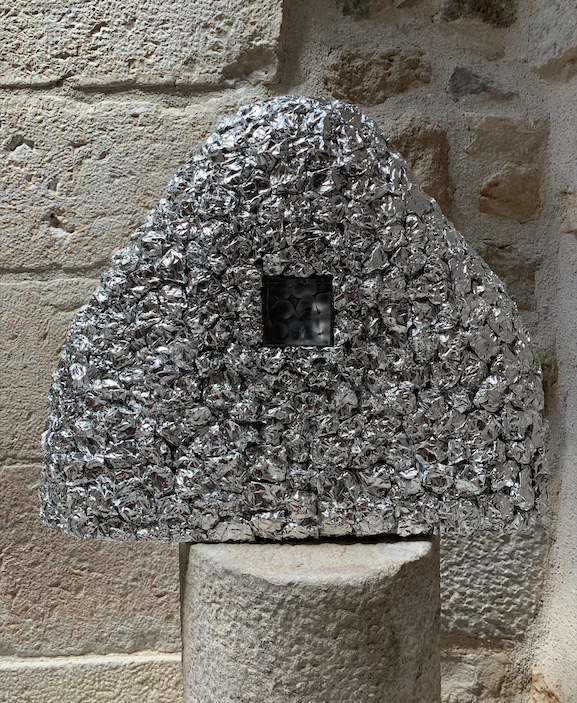
Gabriel, Midstuff.
Gabriel is a sculptor who, despite belonging to a generation of the so-called new Spanish sculpture, has always carried out solitary work. Although in those 80s/90s he was a clear reference for the exhibitions at ESPAIS Centre d'Art Contemporani de Girona, where he exhibited regularly, I would say that he created a trend for an entire generation. He has never wanted to inhabit the center; he feels more at home on the periphery. He says that this allows him to go to the substratum of things, develop his own discourse without references and create from outside the system: “because the system gives you the answer it wants, and that is incompatible with creation”.
Gabriel's work represents itself, it does not need complementary arguments, but, in my opinion, the physical materiality of the sculptures is as important as the texts he has written to accompany them: the poetry collections La rossor de la tenebra and Sic et non . Also the essay Ultra la forma autárquica – L'art sense significat (Viena Edicions) or the numerous reflections —more than 150— that have accompanied his exhibitions over the years and that he has constantly written about his work. This path will soon culminate in a book, still in publication, called Polutropon: un axioma sobre l'art , where he will perfectly define the foundations of artistic practice.
Annihilation
Despite my great interest in his work and thought, I have the strange feeling that the tools I have as a critic are not adequate to approach his art. Faced with these recent sculptures, I see this helplessness and the same feelings that I had a few years ago emerge. I wonder why and I propose to find answers to help the viewer approach the hermetic work of this sculptor.
I think I have found some reasons for this impossibility. First of all, Gabriel's ideology is based on an attitude that annihilates all the conventions we have about art. This is a starting point that puts a hand on your mouth. Because, as his maxim says, "annihilate: beyond the autarchic self", he proposes that we go against the "self", which is one of the foundations of contemporary art and of the critical opinion that we have been building over more than two hundred years, from Romanticism to the present. He proposes that we overcome it when we are all too attached to the opinions, conventions and artistic tastes of the time.
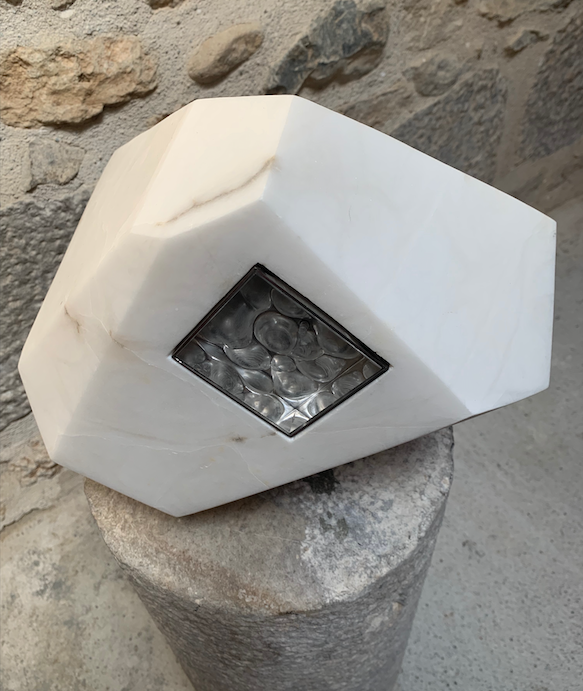
Gabriel, The absolute center is the door to emptiness.
A second reason for this difficulty of approach is that it fundamentally questions the stereotypes on which culture has been built, claiming an original state in which clairvoyance, recollection and silence are required. I understand this attitude because it also belongs to an entire generation, the one we baptized as counterculture. But Gabriel is even more radical and proposes a posthumanism that goes beyond this autarchic, dominating and omnipresent self. For this reason, the subject who wants to assert himself in front of his work ends up being defeated by it. Identity is questioned, even that of the author himself, who puts his own in crisis, as if he were only a mere transmitter.
Enigma
The third difficulty lies in the enigma. Given these conditions, to anyone who interprets his work it turns out that affirming, arguing or demonstrating are infinitives that are neutralized by the dense presence of his works. A respectful silence before the unknown force of the primordial matter with which he works. For example, perhaps it was the first, José Corredor Matheos, and lately José Castro Flórez.
They have all approached Gabriel's work and tell us about this enigma. José Corredor Matheos says: “Gabriel's work is one of the most interesting and enigmatic of the eighties… The materials used serve to evoke, with the necessary ambiguity, symbolic and mythical themes and languages. And we are not referring only or mainly to themes or situations in which the openness to mystery is more or less explicit, but also to those in which the form seems to hide and reveal to us at the same time something that worries us… His work straddles an evocation of the primitive that lies beneath our rationalized daily life… a challenge to which he wants to respond.”
For his part, Castro Flórez argues that material rhetoric gives him the enigma: “It is undeniable that in Gabriel's sculptural proposal there appears a constant concern for the material, for the sense of material imagination. And from here, as Bachelard assures, the intangible space of imagination appears, the entry into the hermetic circle of the symbol, and this always generates a pathos of the hidden. And, consequently, of the symbolic enigma that forces us to free our gaze from the conditioning that hereditary habits entail.”
“Enigma, matter, hiding and showing something that worries us, evocation of a primitive state under rationalized life, a challenge that must be answered” are some of the ideas found in these reviews. To address enigmas, superficial uses of the intellect are not useful; even so, many have written about it with an attempt —like what I am doing here— to access its meaning.
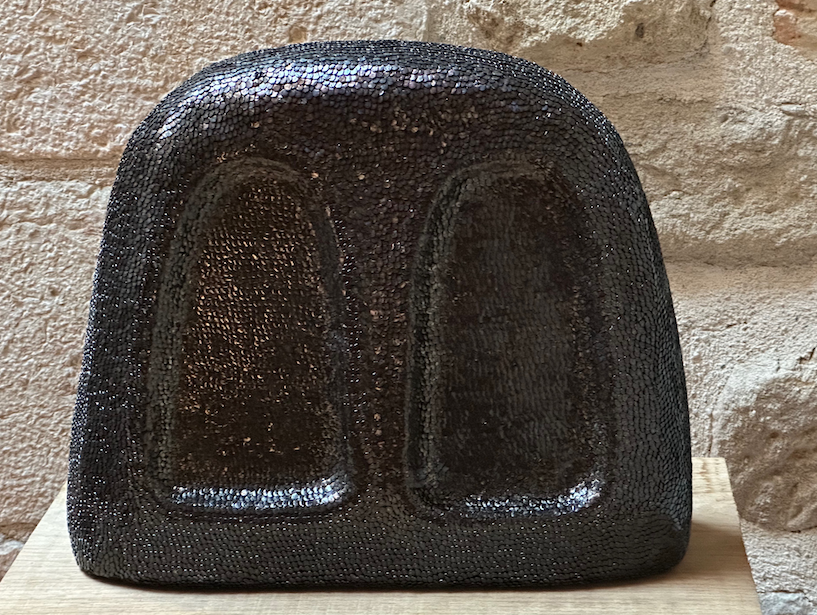
Gabriel, Humbaba.
Matter: “Art is the dream of matter” (Gabriel)
A very important point is that this enigma is not an added element, but is found in the sculpture itself, in its skin, in its matter, in its form. There is nothing more: everything is found here. Many current works and exhibitions are based on sociological, linguistic, anthropological or political assumptions, which leave no room for those who, like him, still continue to investigate the languages of matter and form in the work of art.
I will mention the materials with which he works: they are more than simple matter, they are the emblematic signs of a fundamental axiom that involves matter and form. This hylemorphism alludes to the balance between matter and form, which is nothing other than the interaction between the material he chooses and the form that is born in it. Here is the great importance of what he has used in the works in this exhibition, and some of them accompany the text: rubber, wood, cast aluminum, stainless steel, methacrylate, lacquered wood, alabaster, glass, nails, gilded cloth, brass.
With these materials he is summoning the forces that drag him. Because, as one of his concept phrases says, “form is the dream of matter: perhaps we make forms to contemplate this dream.”
The unknown force of matter is primordial and is invoked by its rite of creation. This power of matter is one of the magnetic attractions of Gabriel's works for the viewer, who is always surprised. A strange isomorphism is created: we feel attracted by the hardness and ductility of the sculptural materials. By capturing the drive of matter we enter a new cosmos, that is, a new order.
Form and preform
Another difficulty in approaching his work and his ideas about art is the notion of form and preform. These essential words of art carry the stigma of being labeled as formalism, mannerism or aestheticism. Nothing could be further from the consideration of this sculptor, who, in fact, claims metaphor and form and opens the door to the abyss, not to its pleasant comprehensibility.
It claims form because there is no language or thought if it is not constructed by form; on the other hand, there would be no enigma or symbol either.
In fact, I like the idea that the preform is what precedes the form itself, as if it were the word before language. The place where Gabriel's preforms inhabit seems to shake consciousness. Strange forms that, breaking the conventions of the gaze, appear to us with the force of the original magma where they were gestated. They refer us to the origin of a previous time, to the logos , prior to the moment the earth was made. He works with the force that the word of the one who names something for the first time has.
His works free form from its culturalist contamination; they even go beyond the notion of abstraction or figuration, beyond materiality or virtuality, always seeking the forcefulness of the first levels, beyond the primary senses.
Given these circumstances that I have been determining, the main initial argument about the inaccessibility of Gabriel's work is confirmed.
It is consistent with the idea that he maintains that art is inaccessible, unattainable through rationalized and cultured strategies that seek to invade the core. The only way is to make it tangible through matter and form, which generates a deafening cry thrown into the infinity of space. That is why his works seem from a time that has yet to come.
Gabriel's works do not need the viewer. Their radioactive brilliance drives away the curious; they are self-sufficient, wholesome, they like solitude, they do not need anyone's complicity.
In this exhibition in Paris he presents works with cryptic titles such as: “Cripsi”, “Midstuff”, “Gorgona”, “Karker”, “Oracle”, “Humbaba”, “Aula teofanica”, “Plectopos” or “Psicopompo”. All in search of the precise form, the form that contains time. There are the secrets of creation: chaos linked to order, the organic with the inorganic, the skin with its internal musculature, the material weight of the work with the revelations that light creates.
There is no pleasure in Gabriel's creative process, as in this object of apparent unsustainable density and a metal surface flaked by thousands of nail heads, nor in the folds and roughness of the lacquered wood.
These works, in their darkness, correspond to the program presented at Art Paris 2026 by the Alzueta Gallery, focused on black as an essential language and defining element of the history of Spanish art. For Velázquez and Goya, as well as for Tàpies, Chillida and members of the El Paso group such as Saura and Millares, black has been an expressive matrix associated with both material depth and a spiritual dimension.
Gabriel's conceptual sculptures, crafted in wood and hammered nails, extend this exploration of materiality and gesture to three dimensions. Matter and gesture prevail over image, where the works offer a cohesive and powerful experience, inherited from tradition but projected, with a contemporary voice, towards the future.

You may be
interested
...