Exhibitions
Where the light blinds: Bernardí Roig and the poetics of blackness
The Miguel Marcos Gallery inaugurates Dislodging the Face by the artist Bernardí Roig.
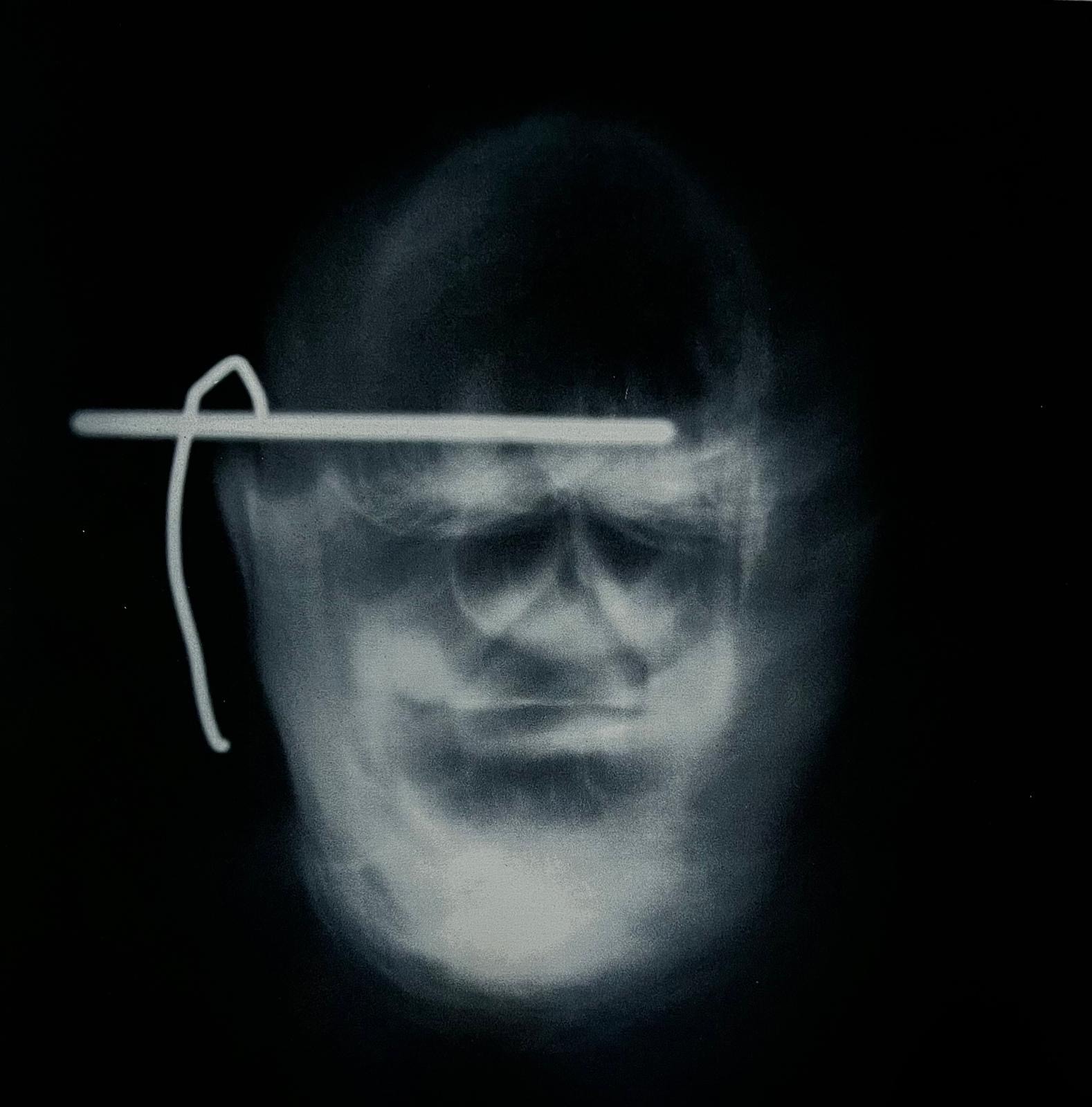
Artist Bernardí Roig presents the exhibition Desalojar el rostro at the Miguel Marcos Gallery, an intense journey that brings together a selection of recent works in various formats—painting, sculpture and drawing—. The show invites the viewer to delve into the absorbing depth of black and to be captivated by the violent contrast of fluorescent light, a resource that Roig uses to provoke visual vertigo and question the very perception of the human figure.
Bernardí Roig (Palma, 1965) is one of the most recognized contemporary artists on the Balearic and Spanish scene. His work, which encompasses sculpture, installation, drawing and video, delves into the great themes of the human condition: solitude, desire, blindness, silence and the difficulty of communicating in a society saturated with images.
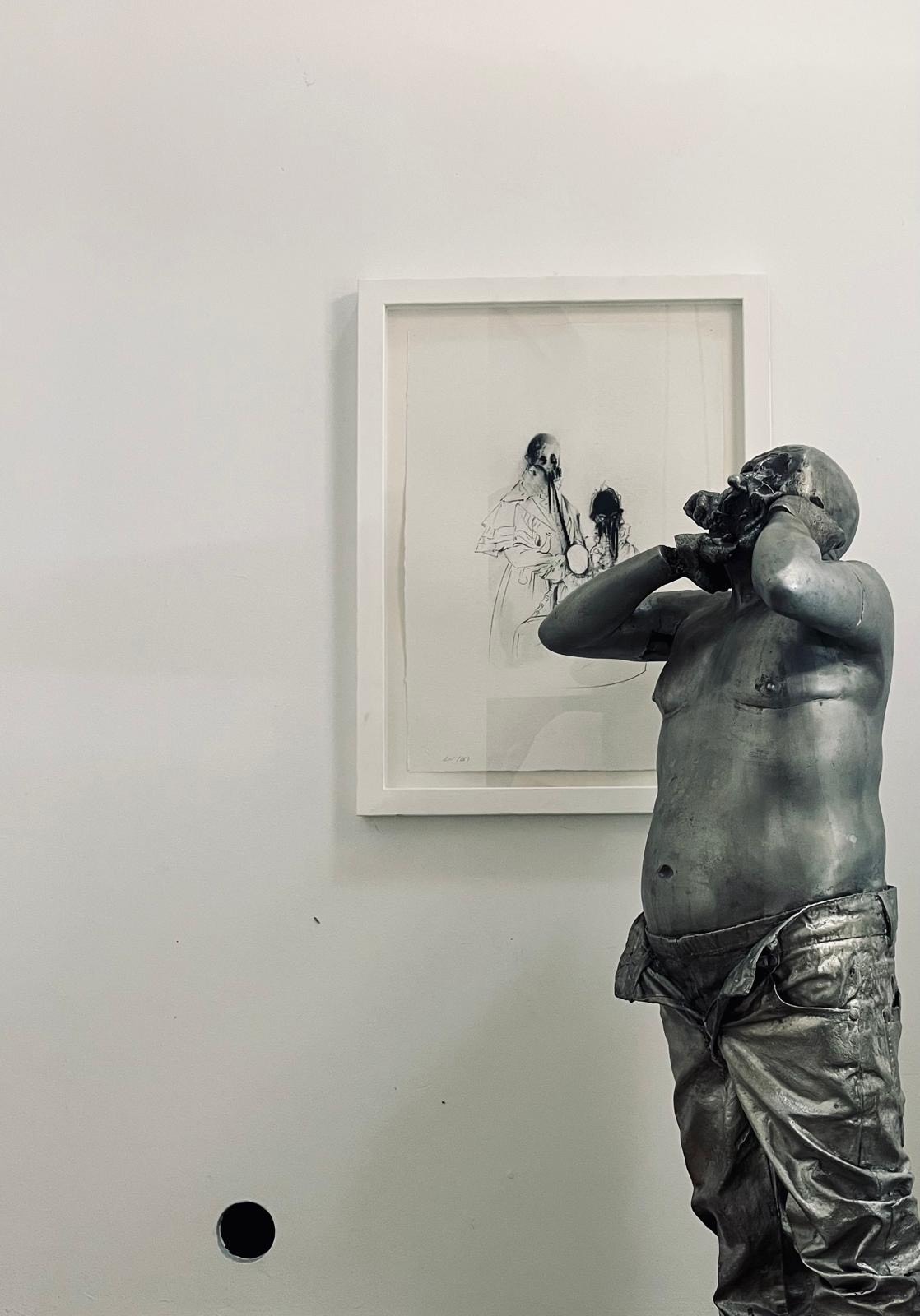
Bernardí Roig, Homo aluminum black, 2024.
The experience of the body is the main focus of Desalojar el rostro , which opens on November 5. The works presented are expanded drawings that explore the drive for painting understood as a defeat and the need to reinterpret the body's passing within an authentic dramaturgy of space. His pieces synthesize a complex and polyphonic universe, marked by a baroque style of metaphors that, through an excessive narrative, reveal a constellation of obsessions and obstinacy. This symbolic universe becomes a fight against the individual's incommunicability in the face of a destiny inevitably headed for extinction.
One of the great virtues of Desalojar el rostro at the Miguel Marcos Gallery lies in its ability to free the pieces from the tyranny of time and its furrows, as if each work managed to suspend the passage of hours to become a timeless presence. In this gesture, Bernardí Roig assumes the paradoxes of minimalism, using space as raw material, a territory where the figure can be placed, confronted or even dissolved. It is in this setting where the artist articulates a reflection on memory, a memory that, by dint of sedimentation, has become encysted on the edges of memory, until erasing the limits of its own representation. In this way, the exhibition becomes a poetics of persistence and disappearance, a space where time and light confront each other in silence.
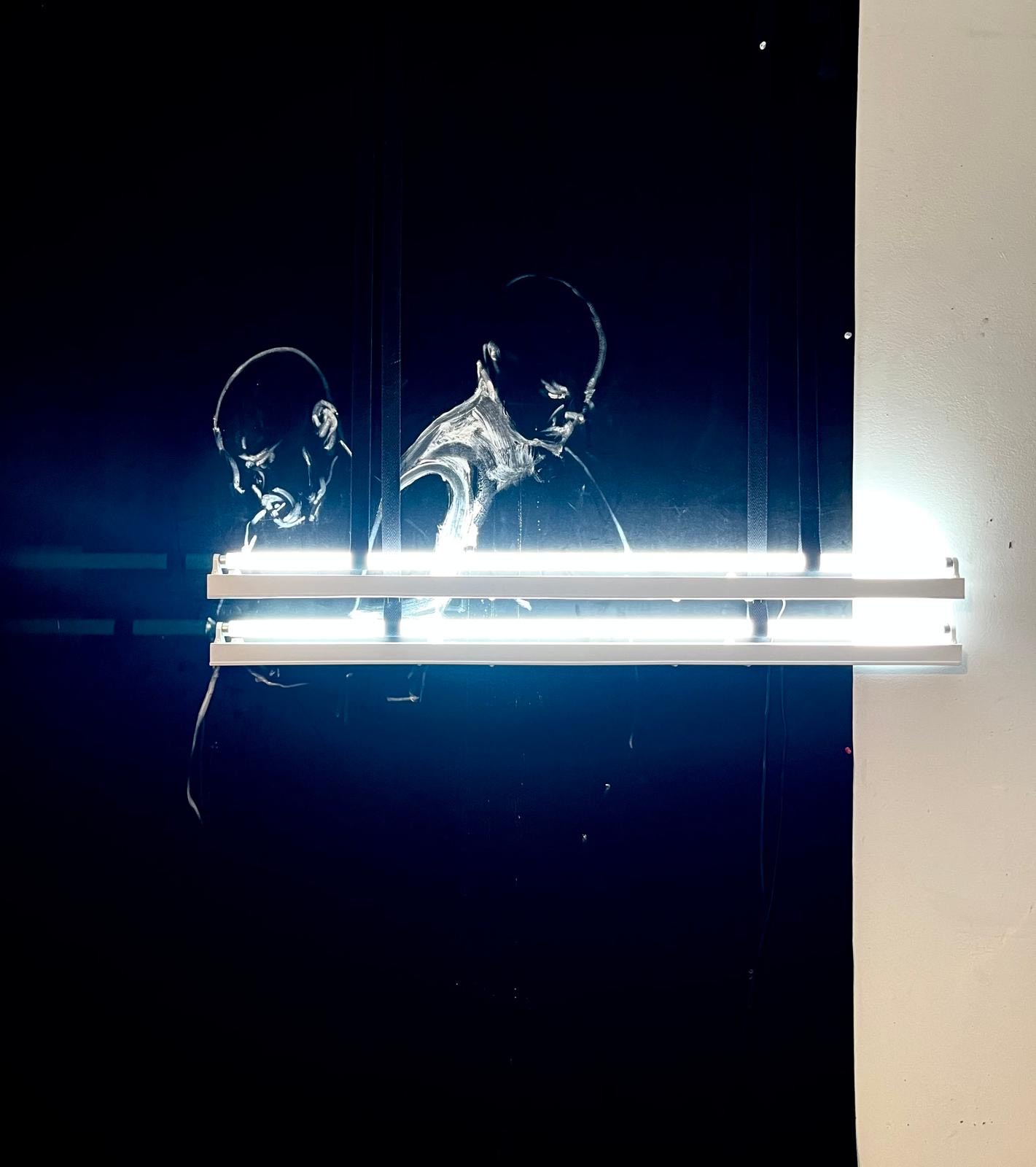
Bernardí Roig, Black painting III, 2025.
At the entrance to the gallery, a life-size aluminum figure, titled Homo Lux (2025), imposes its silent presence. The sculpture, emerging from a mold —from the void that a body occupied— becomes the imprint of an absence, a spectral and ephemeral presence, as figurative as it is uncertain. The image shows a half-naked, fragile and almost pathetic man, a kind of monastic golem, at once meditative and a victim of his own existential weight. Roig invokes an evicted masculinity, full of symbolic resonances and allusions to the dismantling of the contemporary male figure, caught between light and its own disappearance.
Pinturas Negras de 2025 are three large paintings on black velvet that take the relief of Homo Lux . The works show bodies hinted at by white, delicate and trembling lines, which tear the density of the black and allow light to filter through like a contained breath. They are cracks in the darkness, cuts in the definitive night, where the fragility of the human figure is exposed without defenses. These are disfiguring paintings, surfaces that function as fragile mirrors, where a body that expires is reflected - ours, irremediably temporary. In front of these shadows, the Pinturas Negras series emerges, especially Black-Father White (2018–2025), a set of light portraits in which the artist seeks to capture the fleeting resemblance of his father's face, as if, in this gesture, he were trying to retain what memory is already beginning to erase.
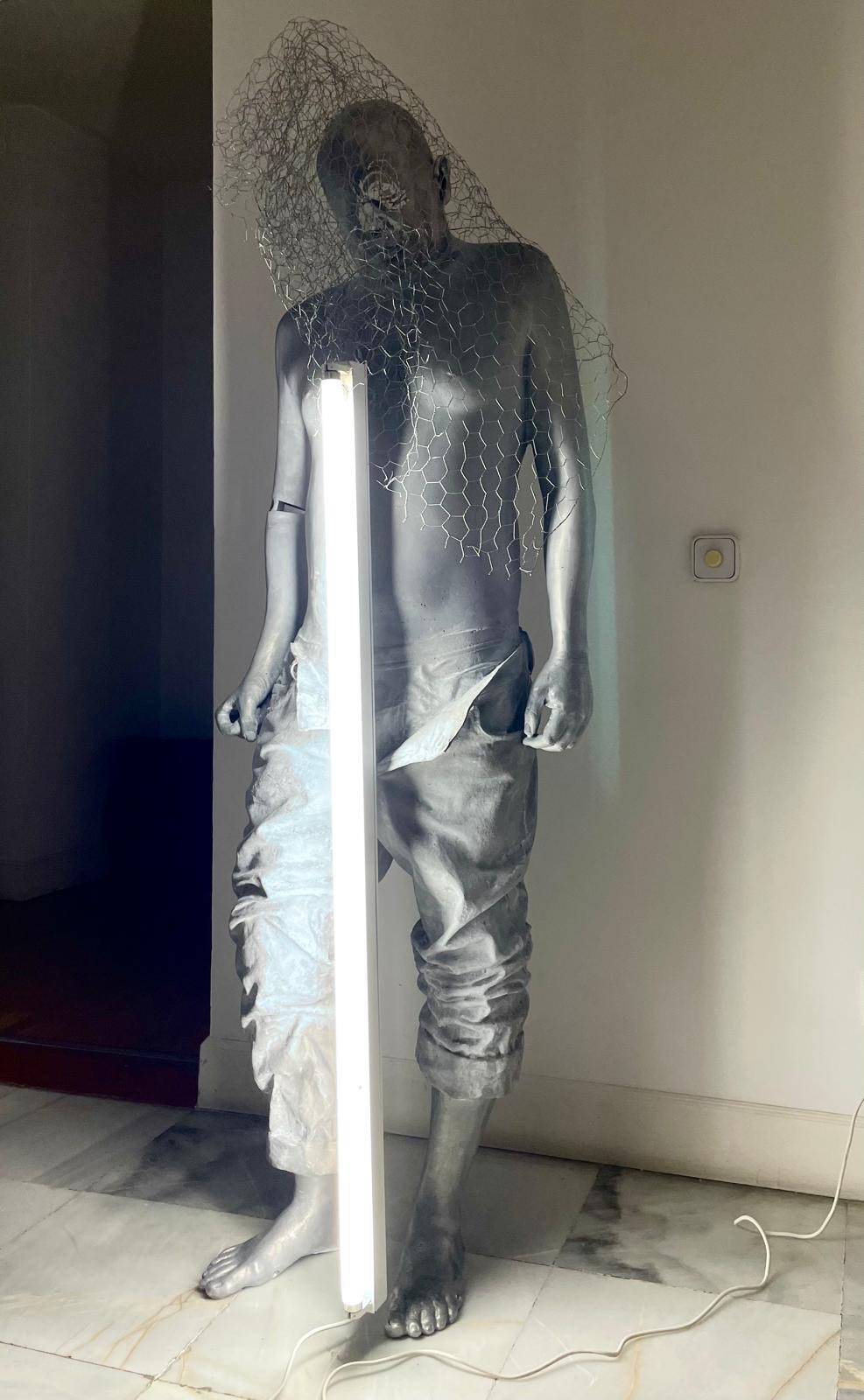
Bernardí Roig, Homo-lux, 2025.
Homo Aluminium Black and Aristrocazia Nera from 2015 are other sets that can be seen in Desalojar el Rostro at the Miguel Marcos Gallery. These presences of bodies —sometimes blinded, confined or exposed to the harshness of fluorescent light— act as metaphors for human fragility, the constant battle between light and darkness, between knowledge and oblivion. In Roig's work, artificial light becomes both a physical element and a concept, a matter that not only reveals, but also blinds and devours. Its intensity is transformed into tension and an almost violent presence, capable of shaking the viewer's gaze and forcing them to confront their own vulnerability in the face of the light that exposes everything.
You may be
interested
...