
Exhibitions
Belkis Ayón challenges the power of myth and patriarchal tradition at MALBA
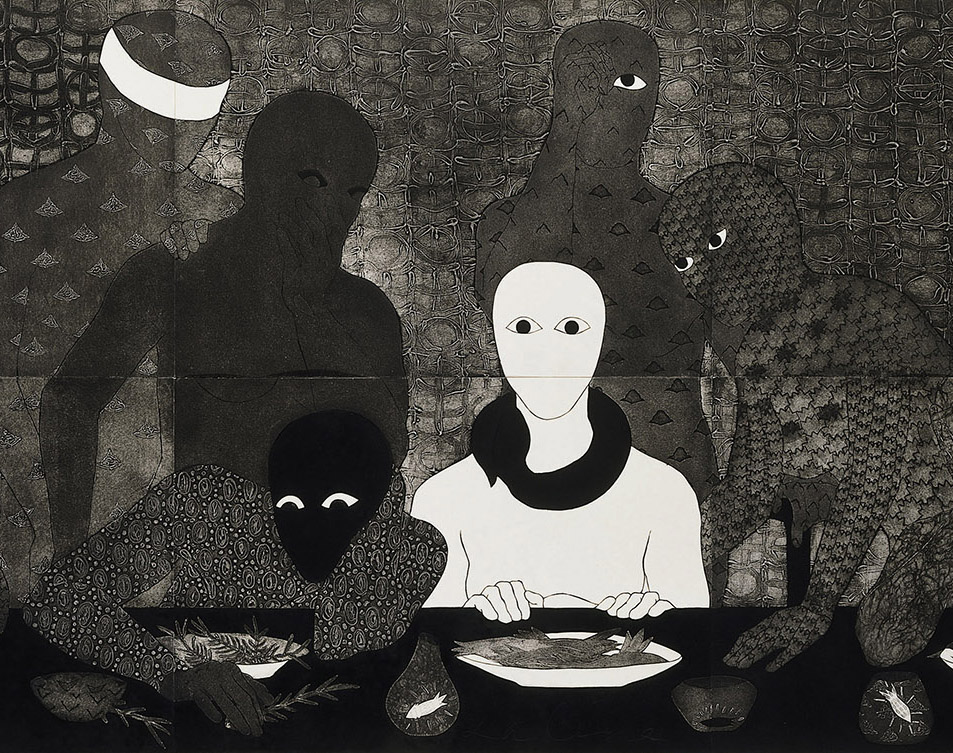
The work of Belkis Ayón (Havana, 1967-1999) constitutes one of the most unique contributions to contemporary Cuban printmaking. Her artistic research, deeply linked to African cultural memory and the religious traditions of the diaspora in Cuba, found in collography an exceptional means of expression to construct a visual universe full of symbolism, narrative density, and material richness. The MALBA in Buenos Aires presents Belkis Ayón. Myth and Disobedience, an exhibition open from July 17, 2026, to March 29, 2027, featuring seven works belonging to the Malba–Costantini Collection.
The exhibition, curated by María Amalia García, Alejandra Aguado, and Nancy Rojas, allows visitors to approach a fundamental stage of the artist's trajectory, developed between 1991 and 1998. During these years, Ayón delved into the representation of the myth of the Abakuá Secret Society, a male fraternity originating from the Calabar region in present-day Nigeria, which arrived in Cuba during the 19th century through the African slave trade. This ritual and spiritual universe became the axis of a plastic investigation through which the artist addressed issues related to identity, exclusion, power, and patriarchal structures.
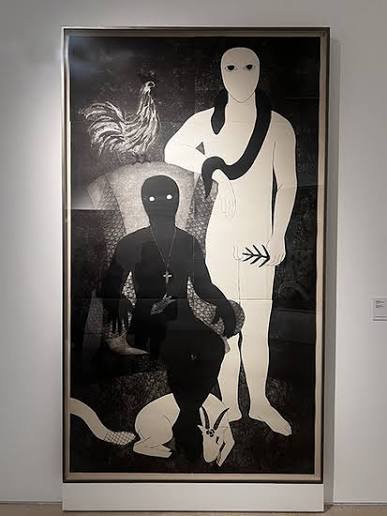
The discovery of this imagery occurred when Ayón was around seventeen years old and in her third year of printmaking at the San Alejandro Art Academy in Havana. The reading of El monte by Cuban anthropologist Lydia Cabrera was decisive in her approach to the spiritual traditions and religious diversity of African root present on the island. Based on this knowledge, she developed a unique language that transferred to the visual realm a set of stories and rituals that until then had largely remained linked to oral transmission.
One of the central elements of her production is the figure of Sikán, the female protagonist of the foundational Abakuá myth. Ayón recovered and re-signified this character to question the exclusively male nature of the fraternity and the power structures that determine the exclusion of women. Her representation is not limited to illustrating an ancestral tradition but introduces a critical reading on memory, authority, and the female position within symbolic and religious systems.
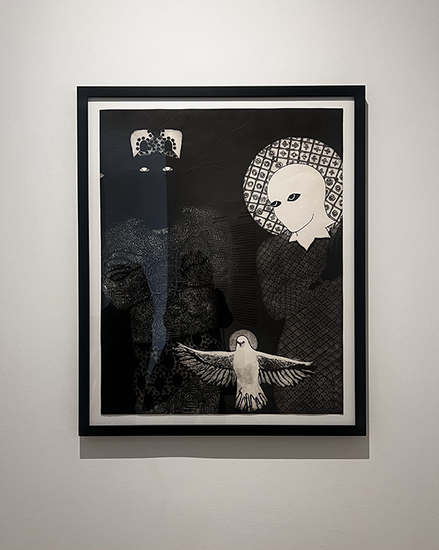
Collography played an essential role in this artistic construction. Through plates made as collages of materials adhered onto sheets, generally cardboard, the artist managed to develop surfaces of extraordinary complexity, where textures, reliefs, and contrasts contribute to intensifying the narrative dimension of the images. This technical experimentation allowed her to expand the expressive possibilities of printmaking and configure a recognizable visual universe in which matter acquires a symbolic and emotional dimension.
The exhibition also places this research in the political and social context of 1990s Cuba. The crisis caused by the collapse of the European socialist system after the fall of the Berlin Wall in 1989 profoundly transformed the geopolitical scenario and living conditions on the island. In that period of uncertainty, marginalization, fear, and censorship, Ayón’s artistic practice acquired a dimension of resistance. The recovery of an ancestral myth and its reinterpretation from a contemporary perspective became a way to challenge established discourses and open new spaces of representation.


You may be
interested
...