
News
Lluïsa Vidal expands her footprint in the National Collection with eleven new works
Cultura is incorporating into the public heritage a set of paintings and drawings by the modernist artist, dated between 1901 and 1914, for an amount of 129,000 euros. The acquisition highlights her versatility as a portraitist, painter and illustrator, as well as her pioneering role in the professionalization of women artists.
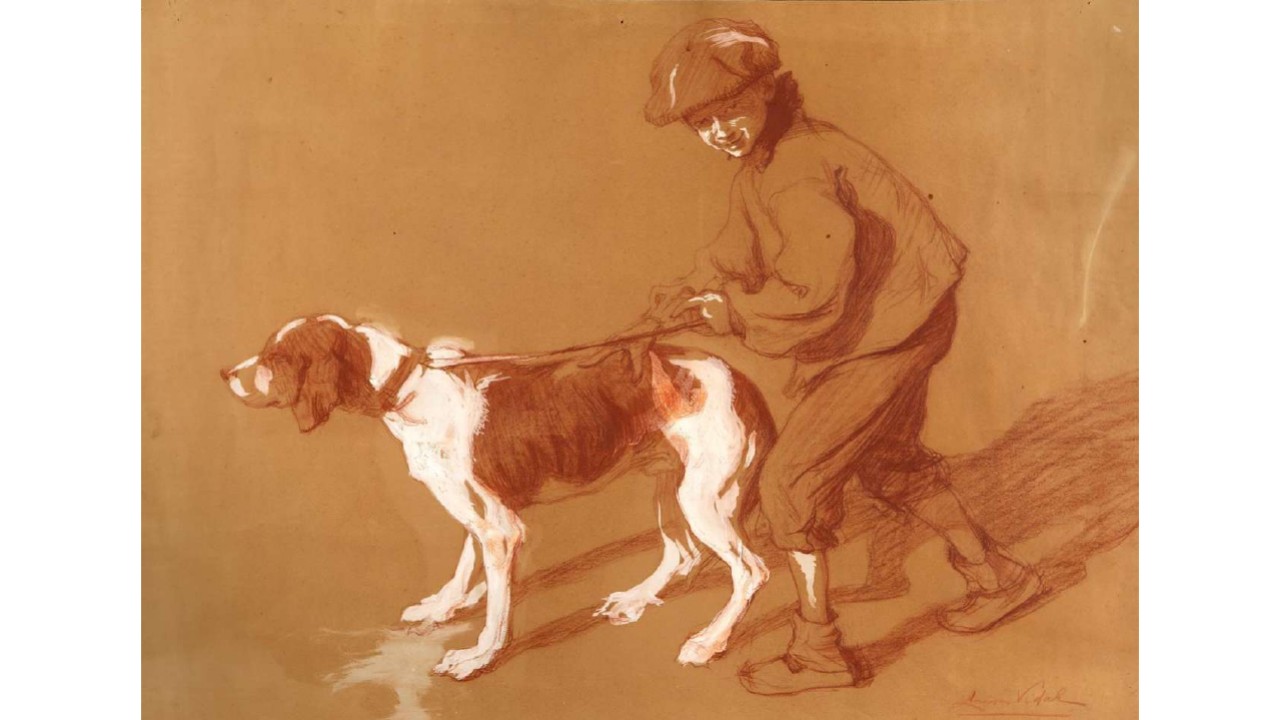
The Department of Culture of the Generalitat de Catalunya has acquired eleven works by Lluïsa Vidal i Puig (Barcelona, 1876-1918) with the aim of reinforcing the presence of one of the most relevant figures of Catalan art of the early 20th century in the National Collection. The operation, valued at 129,000 euros, incorporates into the public heritage a set of paintings and drawings made between 1901 and 1914 that allows us to delve deeper into the diversity of registers and interests of a fundamental artist of Catalan modernism.
The selection offers a journey through different moments and facets of his career. Among the most outstanding pieces is Lo noy del gos , a work presented at the V International Art Exhibition of Barcelona in 1907, where he obtained a second category medal. Made with sanguine and chalk on paper, the piece demonstrates Vidal's mastery of drawing and his sensitivity when it comes to capturing the spontaneity of the children's world.
The set also includes Mistress of the House , a preparatory study related to a work preserved in the National Art Museum of Catalonia, and Marcelet malatt , a family scene that highlights his ability to work on intimacy and human relationships. This area is completed by Portrait of the sculptor Manel Fuxà , dated 1914, a piece representative of the artist's pictorial maturity and his solvency in the portrait genre.
Vidal's view of the urban environment is also captured in two significant works. From My Window on Chaussée d'Antin refers to the artist's stay in Paris between 1901 and 1902, while Terraces of Barcelona reflects his interest in architecture, light and the transformations of the modern city. These are two approaches that allow us to trace his relationship with everyday spaces and the urban landscapes of his time.
Another important contribution of the acquisition is the incorporation of pieces that document her activity as an illustrator. Una vida and Natura are linked to Feminal , an essential publication for understanding female culture and the Catalan feminist movement of the early 20th century. Celia and La mismísima energía are added to this scope, related to La Ilustración Artística , as well as Pataclé . These works allow us to contextualize Vidal's participation in the editorial and cultural circuits of the time and broaden the reading of a production that went beyond easel painting.
The incorporation of this group also vindicates the professional and emancipatory dimension of her career. Lluïsa Vidal was one of the first women to develop a career fully dedicated to painting in a context that considerably restricted women's access to artistic training and professional recognition. In 1911 she founded an academy of drawing and painting aimed mainly at women, a pioneering initiative that expressed her desire to open up new spaces of training and autonomy for female artists.
With this acquisition, the National Collection gains eleven testimonies of a trajectory that allows us to review the story of Catalan art from a broader and more inclusive perspective. The incorporation has a favorable report from the Board for Qualification, Valuation and Export of Cultural Heritage Assets of Catalonia.
The eleven works acquired are The Dog's Noose , Mistress of the House , A Life , Celia , The Very Energy , From My Window on Chaussée d'Antin , Terraces of Barcelona , Sick Marcelet , Portrait of the Sculptor Manel Fuxà , Nature and Pataclé .


You may be
interested
...