
Exhibitions
Club 49, the modernity that challenged Francoism
The MORERA in Lleida recovers one of the most unique experiences of Catalan cultural resistance with a large exhibition that reconstructs the activity of a collective that, between 1949 and 1970, kept the windows of the avant-garde open in the midst of the dictatorship.
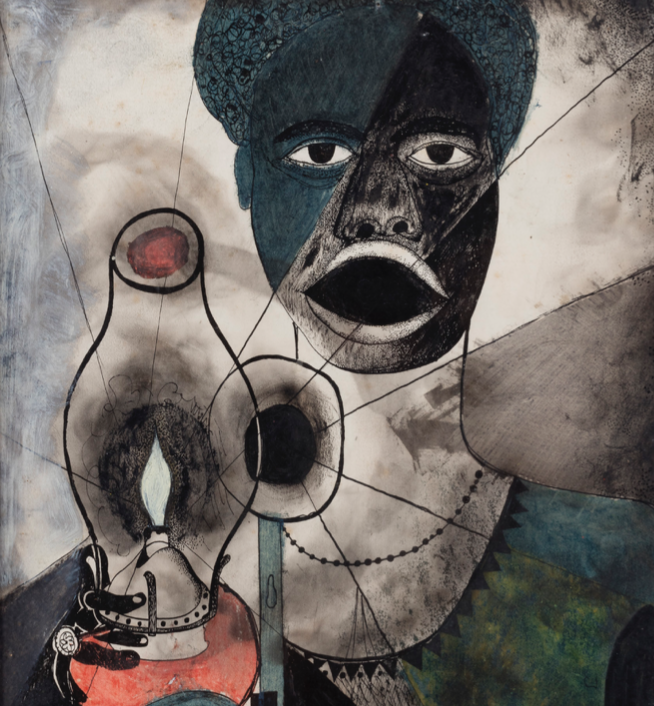
Modernity does not always advance in the full light. Sometimes, it survives through cracks, in spaces of fragile freedom and under the watchful eye of power. In post-war Barcelona, when Francoism had crushed much of the cultural renewal processes promoted during the Republic, Club 49 made artistic creation a form of resistance. Music, painting, sculpture, photography, theatre, dance and cinema found in this initiative a territory from which to recover the historical avant-gardes and make known the new artistic expressions that questioned the limits of official culture.
This experience, fundamental to understanding the paths of modernity in Catalonia during the dictatorship, stars in one of the major exhibitions on the Catalan museum scene at the end of 2026. The MORERA. Museum of Modern and Contemporary Art of Lleida presents Club 49. Modernity monitored (1949-1970) , an exhibition curated by Muriel Gómez Pradas and Joan M. Minguet that can be visited from October 15, 2026 to January 31, 2027. The exhibition offers an approach to the trajectory of a collective that organized more than five hundred cultural activities and that, despite the political and ideological restrictions of the regime, contributed decisively to keeping contact with contemporary artistic languages alive.
To understand the emergence of Club 49, we must go back to the 1930s, when Catalan society was experiencing a period of openness and experimentation that had found one of its main driving forces in the avant-garde. The experience of ADLAN (Friends of New Art), active between 1932 and 1936, had shown that a part of the Barcelona petty bourgeoisie could act as an agent of cultural renewal, promoting artists and proposals that went beyond the aesthetic conventions of the time. The Civil War and Franco's victory violently interrupted this process. Repression, censorship and cultural isolation imposed a radically adverse scenario for those who had participated in the pre-war experiences of modernization.
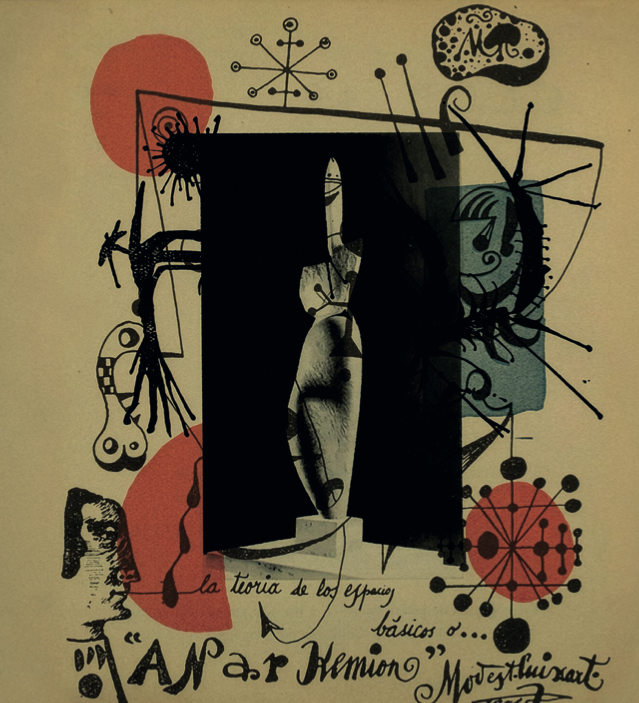
After the hardest years of the dictatorship, some of the protagonists of that impulse resumed their activity with a new initiative. Club 49 was born in 1949 with the desire to recover that spirit of renewal, but in circumstances that forced them to act with caution. Its history is, precisely, that of this tension between the desire for openness and the need to move within narrow political margins. The modernity that it defended could not be deployed without conditions: it had to find the spaces, allies and formulas that would allow it to sustain a pluralistic cultural activity without constantly exposing it to the repression of the regime.
For more than two decades, Club 49 articulated a program that eschewed conventional hierarchies between disciplines and questioned the established criteria for what deserved to be considered culture. Classical music shared prominence with jazz; established artists coexisted with emerging creators; painting and sculpture dialogued with photography, cinema and other visual languages. This breadth of interests responded to an open conception of creation, understood as a space for research, exchange and experimentation.
Its activity was not limited to autonomous programming either. Club 49 established a network of collaborations with entities that already had a presence in Barcelona's cultural life, such as the Hot Jazz Club, the Sala Gaspar and the cultural institutes of democratic countries. This ability to weave partnerships was essential to expand the circuits of artistic dissemination and facilitate contact with cultural expressions that had difficulty finding a place in official channels. The activities were carried out both in public spaces and in private homes, and, although Barcelona was its main center of operations, the group also promoted initiatives in other parts of Catalonia.
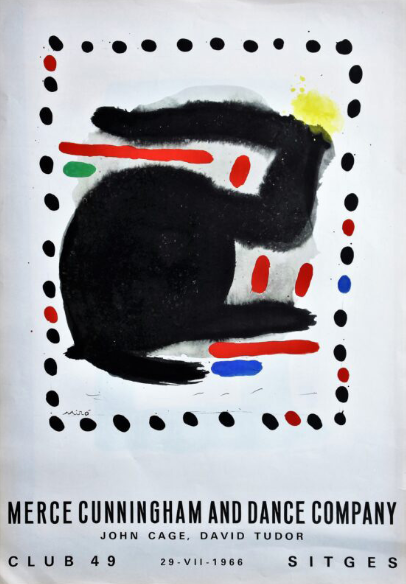
Poster. Joan Miró, Mercé Cunnigham and Dance Company, 1966. Joan Miró Foundation.
This network of relationships, spaces and disciplines constitutes one of the most significant aspects of the experience. Beyond the programming, Club 49 contributed to maintaining a cultural community connected to the artistic transformations of its time. Its importance lies both in the activities it organized and in the possibility of preserving a critical and experimental attitude in a context that favored ideological homogenization and the imposition of a cultural narrative controlled by power.
The MORERA exhibition is based on an exhaustive research in public and private archives to reconstruct this trajectory and make visible a history that cannot be explained solely through the best-known names in Catalan art. The invitation cards, the documents linked to the internal life of the group and the materials that testify to the programmed activities allow us to recover the daily dimension of this collective adventure. The exhibition is not limited, therefore, to presenting a succession of events, but seeks to restore the contexts, relationships and strategies that made it possible to sustain a cultural activity of great amplitude in adverse conditions.
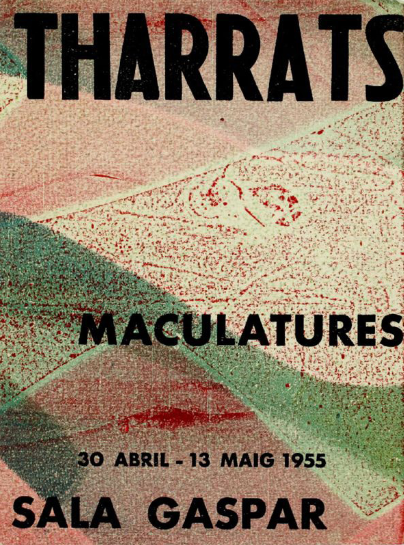
Brochure. Presentation of the Maculatures by Tharrats. Club 49, 1955. MACBA.
This reconstruction also opens up a way to review the relationships between art, politics and society during the Franco regime. How could freedom of creation be defended in a system that restricted forms of expression? What scope for action did independent cultural networks allow? And to what extent did initiatives that worked discreetly contribute to preparing the ground for subsequent transformations? The trajectory of Club 49 allows us to address these questions without reducing its activity to a simple opposition between official culture and resistance, and highlights the complexity of the mechanisms that allowed certain spaces of modernity to be kept open.
The exhibition is thus part of a necessary review of post-war Catalan cultural history, which calls for observing not only the ruptures caused by the dictatorship, but also the continuities, the complicity and the initiatives that prevented artistic renewal from being completely erased. In this sense, Club 49 represents an essential chapter for understanding how the link with the avant-gardes was preserved and how the conditions were built for the recovery of a plural contemporary culture.

You may be
interested
...