international
Basque culture comes to Times Square in New York
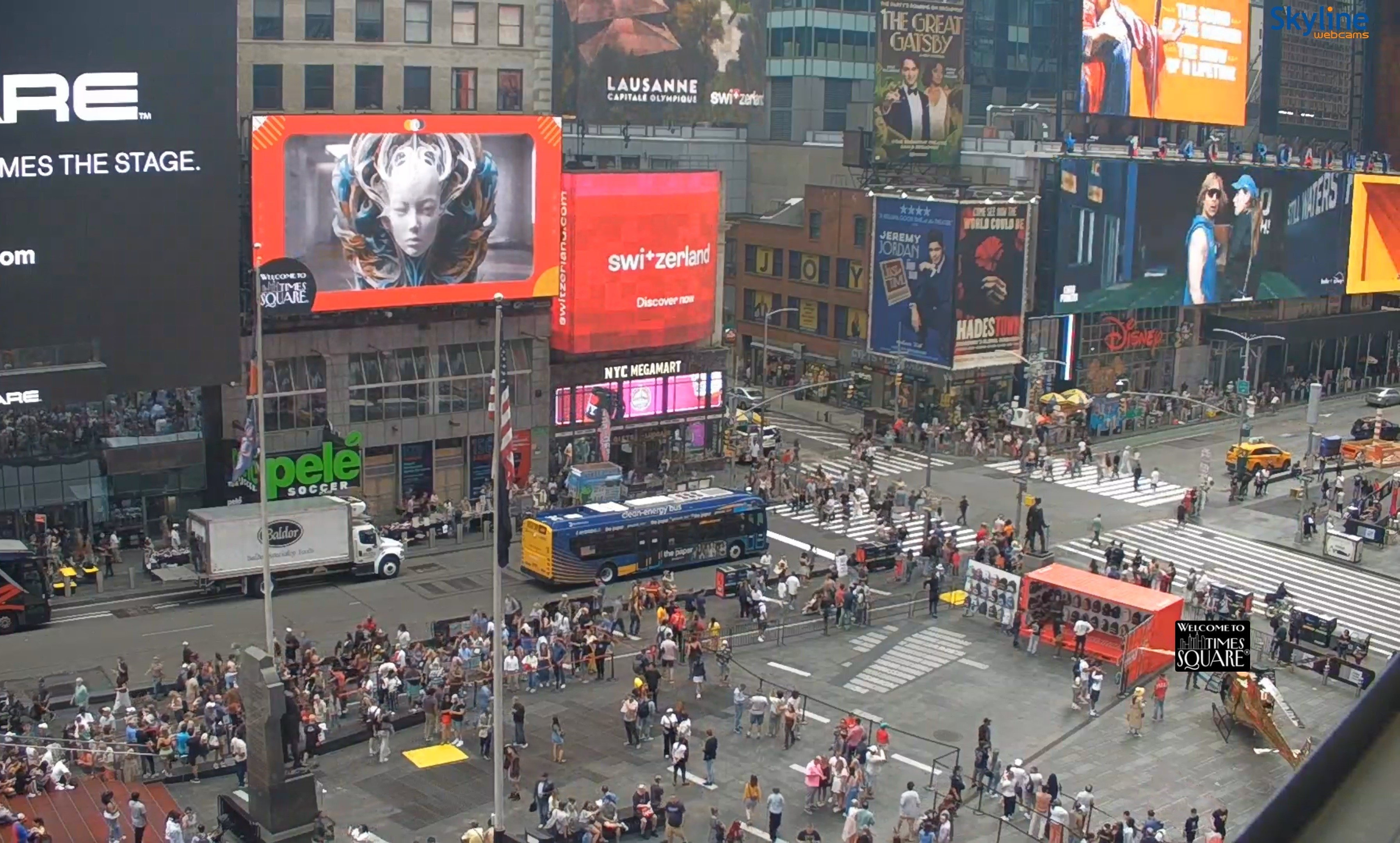
Basque culture has found a new international platform in New York thanks to the artist Patxi Xabier Lezama. His most recent work, a sculpture of Mari, a central figure in Basque mythology, was projected for 24 hours in Times Square on September 6th. This initiative not only highlights the cultural richness of the Basque Country, but also establishes a dialogue between tradition and modernity in one of the world's great artistic centers.
Lezama's installation in Times Square, located at 1560 Broadway between 46th and 47th Streets, represents a significant step in the dissemination of Basque culture. Mari, who symbolizes the land and nature in the Basque imagination, acquires a new dimension in this work, fusing ancestral elements with a contemporary context. The image of Mari, projected in an environment dominated by digital screens and a constant flow of visitors, introduces a cultural reference that contrasts with the technological landscape of New York.
An artist in constant evolution
Patxi Xabier Lezama has been active in the New York art scene, participating in events such as ArtExpo New York and the World Congress of Art and Culture (COMAC). His work seeks to reinterpret Basque tradition through a contemporary sculptural language, addressing themes such as identity, memory, and the relationship with nature. His presence in spaces linked to the Hispanic cultural community, such as El Barrio's Artspace and the Spanish Benevolent Society Gallery, has been key in bringing Basque culture to new audiences.
La Nacional, a historic institution of the Spanish community in New York, has maintained connections with prominent figures in the arts, such as Pablo Picasso and Salvador Dalí. The addition of Mari's figure in Times Square not only broadens the visibility of Basque culture but also strengthens its presence in a global artistic context.
A new Basque sculpture
Lezama's work is situated within the New Basque Sculpture movement, which seeks to approach tradition from a contemporary perspective. Characters and symbols from Basque mythology are recovered and reinterpreted, allowing figures like Mari to transcend their local dimension and become part of a universal discourse. This dialogue between the particular and the universal is what makes his work relevant in a setting like New York, where cultural diversity is one of its highest values.
The projection of Mari in Times Square thus symbolizes a new stage in the dissemination of Basque culture, which seeks to connect with a global audience through art. The figure of Mari, now part of the visual landscape of one of the world's most iconic cities, is an example of how tradition can be reinterpreted and presented in a contemporary context, building bridges between cultures and generations.
You may be
interested
...