Exhibitions
Olga de Amaral, architectures of thread
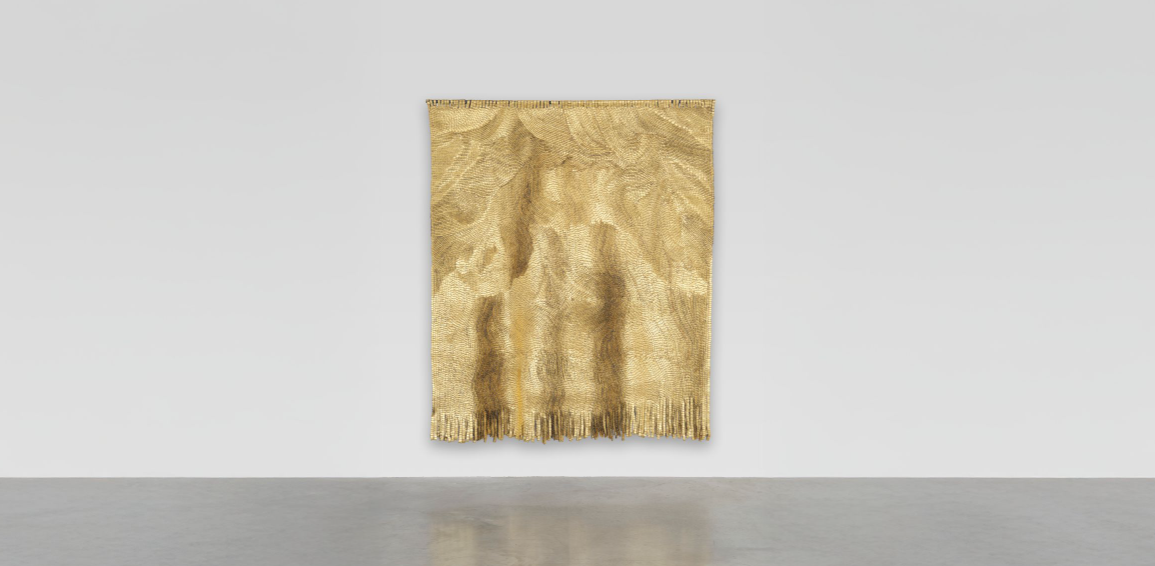
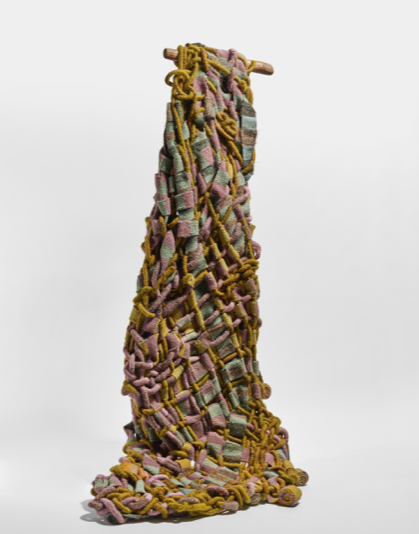
Olga de Amaral works in this territory of constant transformation, of searching and yearning. Thread, fiber, and fabric transcend their usual uses to acquire another dimension: they expand into space, gain substance, project light, and construct volumes that exist between painting, sculpture, and architecture. In her work, weaving ceases to be a technique and becomes a way of thinking about matter and, above all, our relationship with it.
The Pulitzer Arts Museum presents Olga de Amaral: Weaving the Infinite , an exhibition of 130 textiles and works on paper created over 65 years, running from September 10, 2026, to January 31, 2027. This broad chronological scope allows viewers to trace the evolution of an artist who has been instrumental in the development of fiber art and who, from Colombia, has helped to challenge the traditional hierarchies that for decades have relegated textile practices to the margins of art history.
Born in 1932, Amaral initially trained in architectural drawing in Bogotá and later studied weaving at the Cranbrook Academy of Art in Michigan. This dual training is fundamental to understanding her career. In her work, structure is never a secondary element. The weaving is organized as if it were a construction, and space becomes an inseparable part of the piece.
When she returned to Colombia in 1955, she began experimenting with woven forms that would soon break free from the conventions of the loom. Her pieces gained thickness, scale, and autonomy, eventually occupying a border zone between painting, sculpture, and architecture. The surface ceased to be something merely contemplated and became something that occupies space.
This shift is precisely one of the most interesting aspects of her work. Amaral doesn't simply expand the technical possibilities of weaving; she modifies its artistic status. Where a flat, ornamental surface was traditionally expected, she introduces volume, shadow, texture, and physical presence. The fabric ceases to represent a space and becomes space itself.
The Pulitzer exhibition allows visitors to observe this transformation from her early works of the 1950s to her large textile compositions of the 2000s. The exhibition combines well-known pieces with rarely exhibited ones, constructing an interpretation that avoids presenting Amaral's trajectory as a linear evolution and instead shows a constant investigation into matter, light, geometry, and scale.
One of the most appealing aspects of the exhibition is the inclusion, for the first time, of materials from Telas Amaral , the commercial design studio the artist founded to produce fabrics, garments, and interior design elements. The inclusion of samples and textiles linked to this business allows us to reconsider the overly simplistic separation between art and design.
In Amaral's work, these two dimensions were never entirely isolated. His commercial practice fueled a material investigation that also found its place in his artistic production, while his experience as an artist allowed him to take textile design into territories of greater formal complexity. The exhibition makes this relationship visible and compels us to reconsider a distinction between applied arts and fine arts that, to a large extent, belongs more to institutions than to the creative processes themselves.
Also revealing is the presence of works on paper and historical and contemporary textiles from Amaral's personal collection. These materials demonstrate her sustained interest in both local and international textile traditions. Rather than understanding them as folkloric repertoires or decorative references, the artist incorporates them into a contemporary investigation of structure, rhythm, repetition, and matter.
Her work thus arises from a dialogue between worlds: between Colombia and the international languages of contemporary art; between artisanal tradition and experimentation; between architecture and weaving; between the intimate piece and the monumental installation.
But perhaps Amaral's most powerful contribution lies elsewhere: in demonstrating that monumentality does not necessarily depend on heavy materials or traditional sculptural gestures. A woven surface can acquire an architectural presence while still retaining the inherent fragility of its fibers. It can occupy a room without imposing itself upon it. It can construct a space without erecting walls.
In his works, emptiness is as important as matter. The shadows cast by the textures, the irregularities of the surfaces, and the variations in color transform light into an active element. The viewer does not simply contemplate an object: they are presented with a spatial experience.
Weaving the Infinite thus allows us to do more than simply trace the extensive career of an artist. It proposes a reconsideration of the place of textiles within contemporary art and a review of a history that for too long has separated artistic creation from practices linked to weaving, design, and craftsmanship.
Olga de Amaral has worked for decades precisely in that intermediate territory. And it is there that much of her radicalism lies. Her textiles are not painting that has replaced the brush with thread, nor sculpture made with fibers. They are something else: sensitive constructions in which the material seems to think for itself.


You may be
interested
...