News
Genghis Khan turned into a landscape
A 40-meter-tall, 250-ton stainless steel statue transforms the Mongolian steppe into a monumental stage where history, identity, and tourism meet.
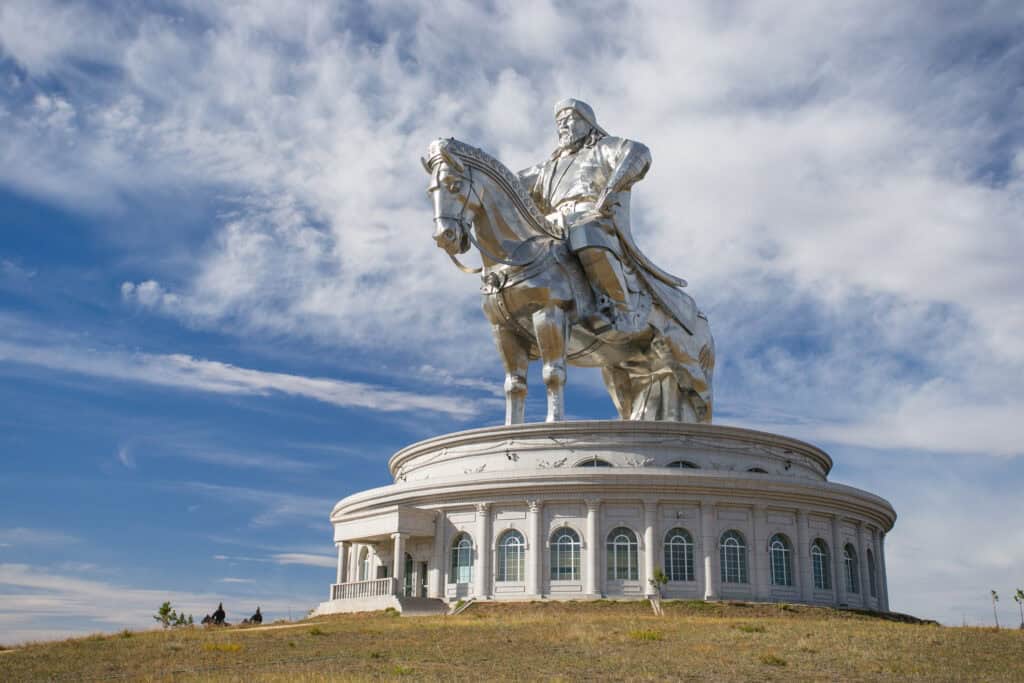
In the vastness of the Mongolian steppe, some 54 kilometers east of Ulaanbaatar, a statue of Genghis Khan on horseback rises above the landscape like a statement of intent. Constructed in 2008 from 250 tons of stainless steel, the sculpture reaches 40 meters in height and depicts the founder of the Mongol Empire gazing towards the horizon, a golden whip in his right hand.
But perhaps the most extraordinary thing about this work isn't its size. What's truly unique is that visitors can literally enter it. An elevator located at the back of the horse takes you inside the monument, and from there, a path leads through the animal's chest and neck to a panoramic platform next to its head. The sculpture thus ceases to be merely something to contemplate and becomes a building, a viewpoint, and a tourist experience.
The operation is as spectacular as it is revealing. The monument doesn't simply represent Genghis Khan; it allows one to experience it. The horse's body becomes architecture, and the conqueror's body, a vantage point overlooking a territory that seems to stretch to infinity. From below, the figure dominates the landscape; from above, the visitor contemplates the same landscape through the monument. The human scale is caught between these two extremes.
The complex is located in Tsonjin Boldog, in the Töv province, a site associated with the tradition that Temujin, Genghis Khan's birth name, found a golden whip there. In Mongolian culture, finding a whip can be interpreted as a sign of good fortune, and this legend has contributed to making the site highly symbolic. The complex covers approximately 212 hectares and is situated near the Tuul River.
The monumental scale doesn't end with the statue. Its circular base, approximately 10 meters high, houses part of the complex's facilities, while 36 columns represent the great khans of Mongolian history. At the entrance, nine figures linked to Genghis Khan's generals also appear. The complex includes a museum dedicated to the conqueror's history and Mongolian culture, exhibition spaces, restaurants, shops, and areas for cultural activities.
All of this raises an uncomfortable but necessary question: are we looking at a sculptural work, a national monument, or a gigantic tourist infrastructure?
It's probably all three.
The statue was conceived with an ambition that goes beyond mere historical representation. Its creators have explained their intention to make it an international symbol of Mongolia, comparable, in iconic terms, to the Eiffel Tower, the Statue of Liberty, the Great Wall, or the Taj Mahal. This is a significant aspiration because it reveals how contemporary monuments no longer simply build memory; they also build a brand.
And Mongolia has in Genghis Khan a figure virtually unparalleled. Temujin managed to unify warring tribes and founded the Mongol Empire in the 13th century. Under his successors, that territory would become the largest contiguous empire in history. His figure, however, contains a contradiction that its monumental scale tends to oversimplify: for Mongolia he is a national hero and a symbol of identity, while in much of the world his name is also associated with military campaigns, violence, and the devastation of vast territories.
The statue deliberately chooses not to depict the warrior in combat. Genghis Khan appears seated, motionless, his gaze fixed on the distance. There are no enemies, no blood, no battle. Only authority. The golden whip functions as both an attribute and a narrative device. The conqueror is transformed into an almost mythical figure who seems to watch over the vastness of his former land.
This choice alters our perception of the figure. The violence disappears, leaving only the symbol. The monument does not aim to explain Genghis Khan, but rather to transform him into a recognizable image. The complex story is compressed into a monumental silhouette.
And there appears one of the most interesting paradoxes of the project: the larger the sculpture, the simpler the story it represents.
The gleaming stainless steel surface contributes to this transformation. Against the backdrop of the earth, the green of the meadows, and the earthy tones of the steppe, the metal reflects the light, making the horse appear almost futuristic. The effect is both strange and fascinating. The image of a 13th-century ruler is materialized through contemporary industrial technology. It is the past transformed into steel.
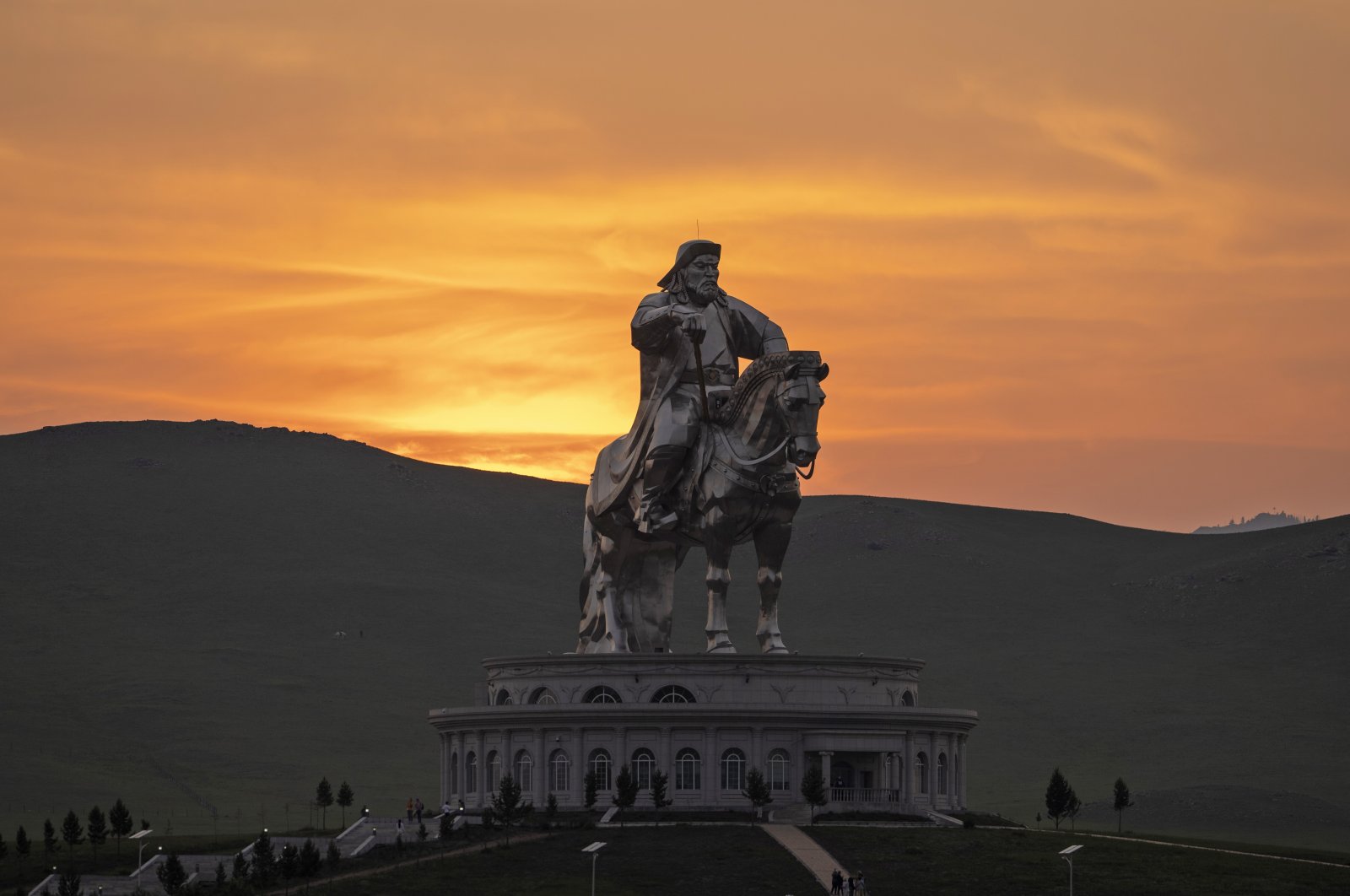
The choice of material also creates a tension between permanence and landscape. The steppe is a territory in constant flux: the light, the weather, the animals, the seasons, and the communities that traverse it all change. The statue, on the other hand, aspires to permanence. Its metallic surface seeks to withstand the test of time while everything around it continues to transform.
But the monument is not isolated. It's part of a tourism strategy that transforms historical memory into an experience. The complex invites visitors to enter the monument, visit the museum, admire the landscape from the horse's head, or even combine their visit with excursions to the nearby Gorkhi-Terelj National Park. A short distance away is also a theme park dedicated to recreating 13th-century Mongolian life.
The result is a kind of vast historical park where the past is experienced from different perspectives: contemplated, photographed, explored, and explored. Monumentality thus becomes a form of cultural tourism.
However, reducing the statue to a mere tourist attraction would be unfair. Its true power lies precisely in the contradiction it contains. It is a work of national propaganda and, at the same time, an architectural artifact of extraordinary effectiveness. It is a historical representation and a tourist attraction. It is a sculpture that can be explored from within and a viewpoint from which to contemplate what it represents.
Perhaps that's why its image works so well on the steppe. In a territory characterized by its vastness and the absence of large urban centers, erecting a 40-meter-tall human figure doesn't simply mean placing a monumental object: it means altering the scale of the landscape.
From afar, Genghis Khan appears to blend into the horizon. Up close, the visitor discovers that the horizon can be viewed from inside his horse.
That investment is probably the best idea of the entire project. The monument, intended to represent the greatness of a historical figure, also becomes a mechanism for generating new perspectives on the landscape. History is transformed into architecture, and architecture into landscape.
In Mongolia, where Genghis Khan continues to occupy a central place in the construction of national identity—his name appears even in institutions, infrastructure, and spaces of daily life—the statue functions as a gigantic visual synthesis of that relationship between memory and present.
Its scale, its tourist appeal, or even its aesthetics can be debated. It may seem excessive, kitsch, monumental, or downright extravagant. But it's difficult to deny one virtue: it has managed to bring a 13th-century figure into dialogue with contemporary Mongolia using one of the most recognizable languages of our time: that of spectacle architecture.



You may be
interested
...