Exhibitions
The Hunt, a landscape before the future
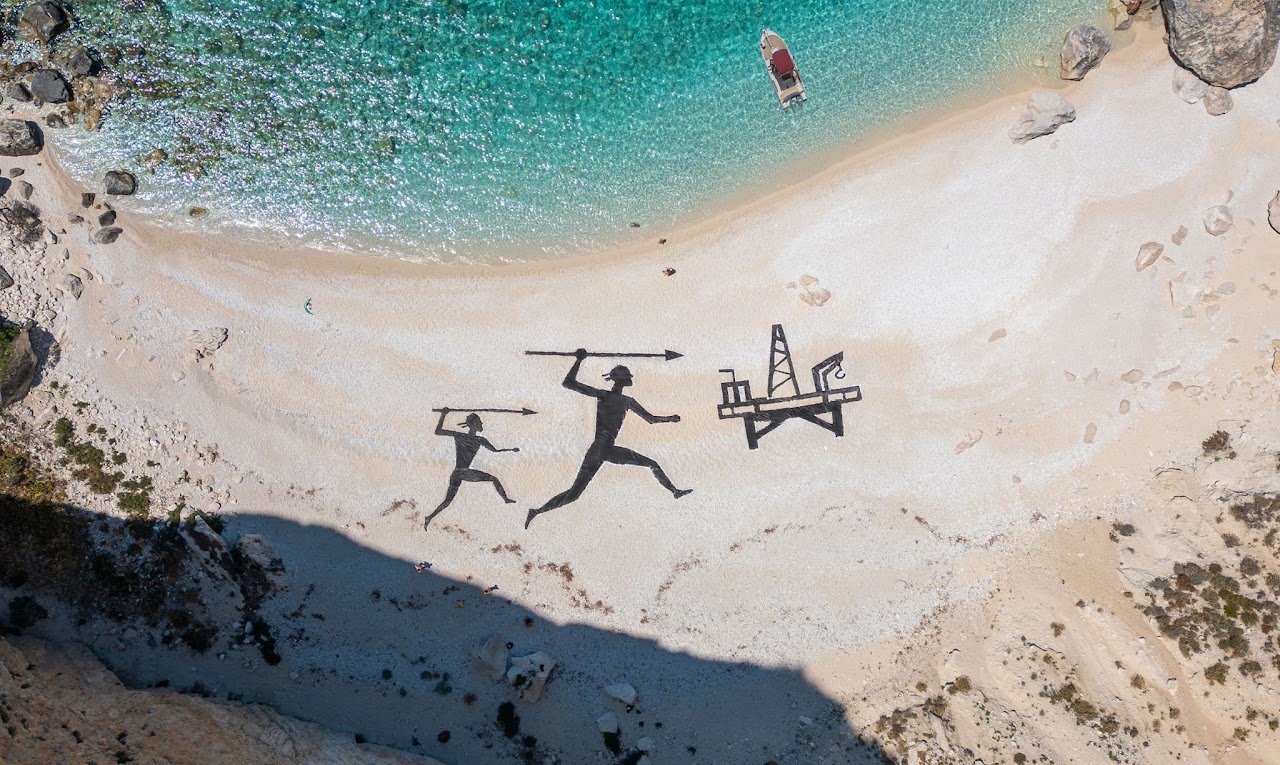
On Aspri Ammos beach, on the island of Othonoi, the westernmost of Greece's inhabited islands, the landscape becomes both the medium and the subject of an artistic intervention. There, the artist The Krank has created The Hunt , a 500-square-meter temporary installation that uses the visual language of prehistoric art to reflect on the relationship between humankind, the land, and the exploitation of natural resources.
The installation, created in July 2026 during the Ionian Lab artist residency organized by Space52 and Kalogerou1844, features two black figures of prehistoric hunters facing the silhouette of a contemporary offshore oil platform. The image establishes a dialogue between two moments separated by thousands of years: a past in which survival depended on a direct relationship with the environment and a possible future determined by the industrial extraction of energy.
The choice of location is not accidental. Othonoi is located approximately 10 kilometers from the nearest boundary of Block 2, in the northwest Ionian Sea, an area where offshore hydrocarbon exploration activities are planned. However, The Hunt does not intend to literally represent an environmental conflict or become an illustration of an energy project. Its approach stems from a more subtle question: how our perception of a landscape can change even before any physical infrastructure appears on it.
In this sense, the territory becomes an inseparable part of the work. There is no gallery to delimit the experience, nor a museum space to act as an intermediary. The beach at Aspri Ammos constitutes the surface upon which the intervention unfolds, and the sea horizon actively participates in the composition. The work introduces into this landscape an image of a possible future, making visible that which does not yet exist.
The proposal is part of a tradition closely linked to land art, an artistic movement that emerged primarily in the United States and Europe in the late 1960s and early 1970s, shifting part of the creative process outside of conventional exhibition spaces. Artists such as Robert Smithson, Richard Long, Nancy Holt, and Walter De Maria questioned the autonomy of the art object and proposed new relationships between artwork, territory, landscape, and experience.
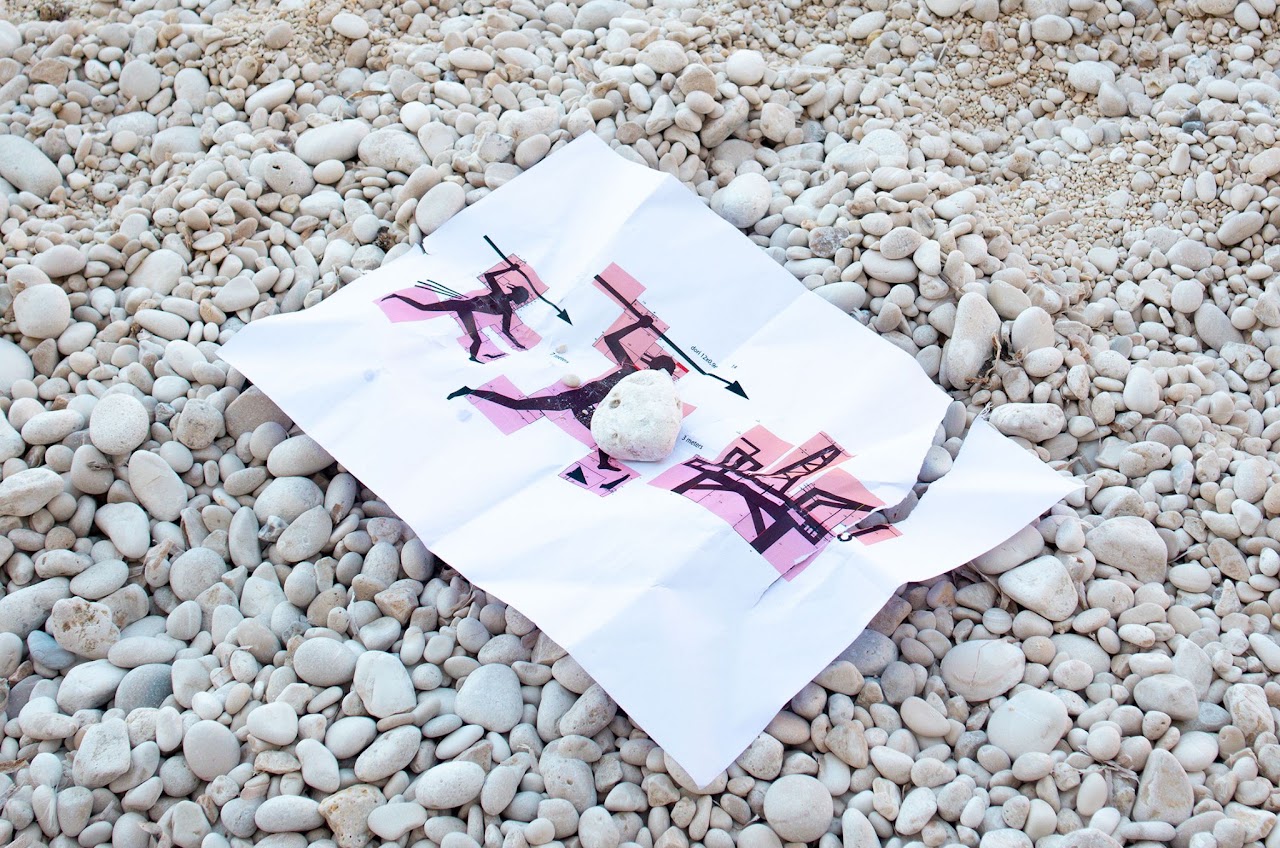
As is often the case with land art, in The Hunt the site is not merely a backdrop. Scale, topography, distance, and perspective all influence how the intervention is interpreted. But The Krank introduces a unique element: the work does not seek to impose itself on the landscape through a permanent structure. On the contrary, its ephemeral nature is essential to its meaning.
The installation remained on the beach only long enough to be documented through photographs and video. Afterward, all materials were removed, and the site was restored to its original state, without any permanent alteration. In this way, the work also prompts reflection on the very nature of contemporary art and on the possibility of intervening in a territory without leaving a lasting physical trace.
The tension between permanence and disappearance takes on special importance because the work was conceived, to a large extent, to exist through its documentation. From the ground, the complete composition could barely be perceived as a single image. It is the aerial photograph that allows the scene to be contemplated in its entirety and the relationship between the figures of the hunters and the silhouette of the oil platform to be reconstructed.
Documentation thus ceases to be a secondary record of the intervention and becomes a fundamental part of its existence. The artwork physically disappears, but remains in the images that allow it to be contemplated again. A particularly significant paradox arises within land art: an intervention carried out directly on the land finds its most lasting form outside of it.
The Krank's chosen visual language deliberately alludes to the earliest known human representations. The figures of the hunters evoke cave paintings and images associated with the earliest forms of depicting the relationship between humankind and nature. Opposite them appears a structure belonging to a completely different technological era: the offshore platform, a symbol of the industrial extraction of energy resources that lie beneath the seabed.
The scene can therefore be interpreted as a kind of impossible encounter between two eras. The prehistoric hunter observes a territory on which he directly depends for survival; contemporary man observes that same territory as a space susceptible to industrial exploitation. Between these two extremes lies a long history of the transformation of nature and of increasing human intervention on the planet.
But The Hunt avoids offering a definitive answer. The installation doesn't depict a landscape after its transformation, but rather before it can occur. The future remains in the realm of possibility. The platform doesn't physically exist on the beach: it appears only as an image constructed by the artist. This absence is precisely what allows the work to function as a question.
What happens when a territory begins to change in our imagination before it physically changes? Can a still-nonexistent infrastructure alter how we perceive a landscape? What relationship do we maintain today with the places we inhabit when we know they could become sites of extraction?
Most offshore exploration projects communicate through maps, technical studies, administrative documents, or institutional statements. The Hunt proposes a different approach to that same geography. Instead of translating the territory into technical language, The Krank introduces a simple, almost archetypal image: two hunters gazing toward what might be coming.
The formal simplicity of the scene contrasts with the complexity of the issues it raises. The Mediterranean landscape, the memory of early human societies, energy exploitation, the transformation of the territory, and uncertainty about the future are all brought together in a single composition.
Within the tradition of land art, The Hunt thus recovers one of its fundamental questions: the possibility of using the territory itself as a space for thought. But it does so from a contemporary perspective, in which the intervention does not aspire to conquer the landscape or remain within it, but rather to temporarily modify our way of observing it.
You may be
interested
...