News
The earthquake shakes Colombia's cultural heritage and leaves emblematic spaces in Pereira in ruins
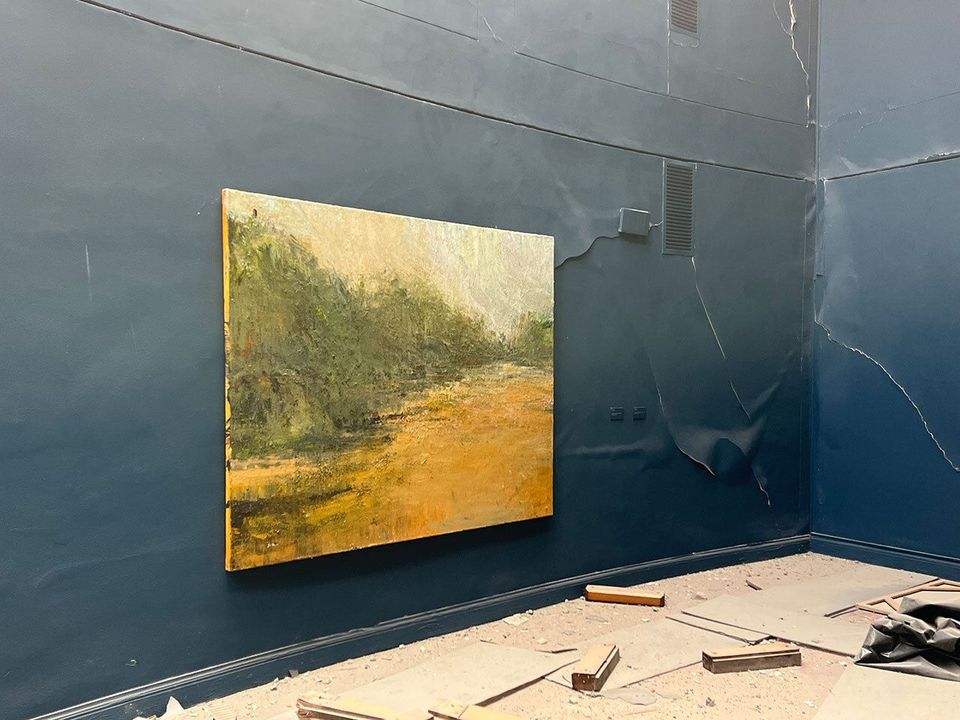
The earthquake that shook the Coffee Region and much of western Colombia has left a deep mark not only on homes and public buildings, but also on the region's cultural heritage. Museums, theaters, cultural centers, and historical collections are among the spaces affected by the quake, which has forced the interruption of activities, the evacuation of facilities, and, in some cases, the partial or total loss of buildings and works of art.
Pereira has emerged as one of the main areas of concern. The city, along with Manizales, is among the areas that have suffered the most severe consequences of the disaster. In addition to the human and material losses, there is now the need to preserve a cultural infrastructure built over decades that constitutes an essential part of the region's collective memory.
The International Council of Museums (ICOM) in Colombia has identified at least twenty museums affected across the coffee-growing region, Valle del Cauca, Cauca, and Chocó. However, this assessment is still preliminary. The organization cautions that a complete picture of the damage to both buildings and collections is not yet available, especially since a significant number of community museums in the country are not officially registered.
Óscar Gaona, president of the Board of Directors of ICOM Colombia, explains that the damage ranges from superficial cracks to serious structural damage. In some centers, the problem is limited to structural elements that can be repaired; in others, the building's stability is compromised, and there have also been significant losses to the collections.
Among the materials that have suffered the most are the archaeological collections. Many of these consist of pre-Columbian ceramic pieces displayed in showcases and on shelves that could not withstand the ground movement. The falling pieces have caused breakage and losses that, in some cases, may be irreversible. Others will require specialized evaluation and restoration processes to determine if they can be reconstructed.
The Pereira Art Museum faces almost total demolition
One of the most serious cases is at the Pereira Art Museum. With five decades of history, the institution has established itself as one of the city's leading cultural landmarks. Its current location, on Avenida de las Américas, was inaugurated in 1996 and this year celebrates its thirtieth anniversary.
The building had survived the 1999 earthquake, one of the most devastating seismic events in the recent history of the Coffee Region, without significant damage. However, the new earthquake has jeopardized its structure.
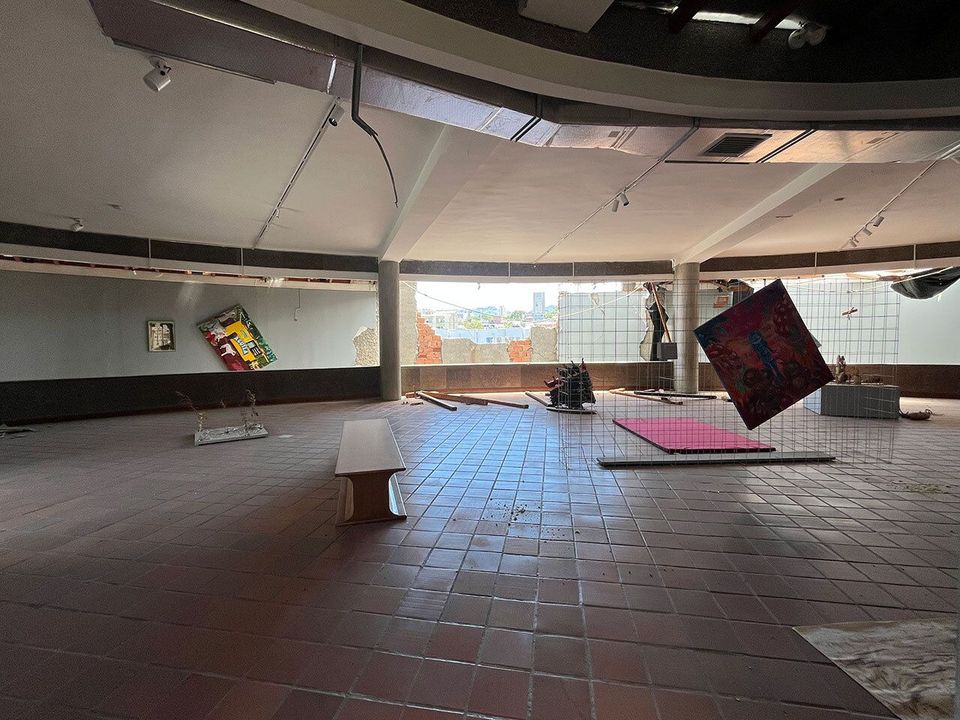
Courtesy Pereira Art Museum.
Initial technical studies determined that the building is uninhabitable and that virtually all of the masonry will need to be demolished. The beam and column structure of two of its wings remains in acceptable condition, but the western wing has suffered much more severe damage. One of its columns was affected, causing part of the building to shift and become tilted.
The conclusion is stark: the museum will have to undergo almost total demolition. Only the structural framework of a large part of the building can be preserved.
For the institution, however, the main challenge is not solely the building. The museum team is working against the clock to protect the approximately 530 works that comprise its contemporary art collection, one of the most important in the city. These include works by artists such as Jesús Rafael Soto and María de la Paz Jaramillo, as well as a large-scale piece from Olga de Amaral's workshop, considered the largest work produced by that workshop throughout its history.
The priority now is to move, protect, and assess the pieces before further movement, leaks, or environmental conditions can worsen the damage.
The Santiago Londoño Theatre, another loss for the city
The earthquake has also struck one of the main symbols of Pereira's performing arts life: the Santiago Londoño Londoño Theater.
Located in the heart of the city, one block from the Governor's Office, the municipal theater has been for decades one of Pereira's main venues for artistic and cultural activity. Studies conducted after the earthquake by specialized engineers from various parts of the Risaralda department determined that the building suffered extremely severe damage.
The technical assessment indicates a total loss of the building because several of its beams and columns failed to withstand the intensity of the earthquake. The potential destruction of the theater represents a particularly significant blow to a city whose cultural programming has relied on this space for years as one of its main meeting points.
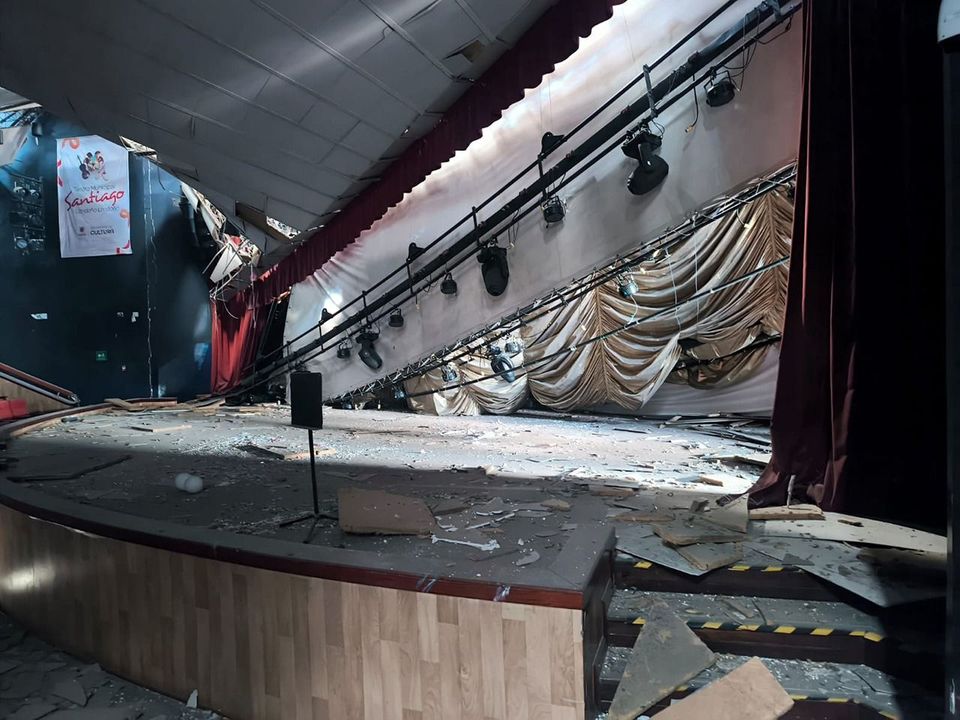
Courtesy of Teatro Santiago Londoño.
The Lucy Tejada Cultural Center, another space under evaluation
The emergency also affects the Lucy Tejada Cultural Center, built in 2006 as part of a process of redefining an urban space that over time became one of the great cultural epicenters of Pereira.
The complex occupies an entire city block and offers a wide variety of activities. Its facilities host training programs in theater, visual arts, dance, and music for people of all ages. More than 14,000 students participate in these programs.
The center also houses a public library, a radio station, the Lucy Tejada Auditorium, and various administrative offices. Given its size and the diverse services it provides, any structural damage would not only jeopardize a building but also a vast network of cultural and educational activities that directly impact the community.
A cultural heritage that is still difficult to quantify
The regional assessment remains incomplete. ICOM Colombia estimates that at least twenty museums have suffered some type of damage, although other preliminary assessments place the number of affected museums specifically within the area closest to the epicenter of the damage at fourteen.
Libardo Díaz, director of the Rayo Museum in Roldanillo, has indicated that his institution also suffered significant damage and that, within the group of affected museums, the Pereira Art Museum is among those with the most serious situation.
The difficulty in establishing a definitive number stems, among other reasons, from the existence of numerous community museums that are not included in official records. In the Valle del Cauca region alone, there could be around eighty such institutions, according to estimates compiled by ICOM Colombia.
The true magnitude of the cultural disaster, therefore, remains to be determined.
After the human rescue, the rescue of memory also begins.
In the first days after the earthquake, the absolute priority was locating the missing, caring for the injured, and ensuring the safety of those who had lost their homes. But once the immediate emergency was over, another equally complex task emerged: preserving the places and objects that build the collective memory of the communities.
Museums are in a particularly delicate situation. A broken work of art can be restored, but it cannot always be returned to its original state. A building can be rebuilt, but its disappearance also implies the loss of a part of the city's history.
In Pereira, the potential demolition of a large part of the Art Museum, the loss of the Santiago Londoño Theater, and the uncertainty surrounding other cultural spaces paint a picture that transcends material damage. It represents a fracture in the cultural fabric of a city that, for decades, has built its meeting places around museums, theaters, libraries, and educational centers.
While emergency teams continue working among the rubble and cultural institutions attempt to safeguard their collections, a second race against time begins. It is no longer simply a matter of rebuilding buildings, but of deciding what can be salvaged, how to preserve it, and how to recover a cultural infrastructure that, in some cases, took decades to build.
Culture under the new government
The reconstruction of Colombia's cultural heritage faces an added uncertainty: the political shift that began with Abelardo de la Espriella's election as President. The new president, who took office on August 7, has proposed a significant reduction in the size of the state as one of his government's main priorities. During his campaign, he promised to cut the state structure by 40%, aiming to reduce spending and generate savings of between 25 and 30 trillion pesos annually.
This austerity program now raises a particularly delicate question for the cultural sector. De la Espriella's government program proposes reorganizing cultural policy based on merit, auditing, and management criteria, but it also outlines a model aimed at transforming culture into a sector with greater economic potential by promoting the audiovisual and music industries, intellectual property, creative entrepreneurship, and attracting major events. Among its proposals are a cultural voucher for young people and an annual fund of 125 billion pesos earmarked for seed capital and co-investment in creative projects.
The question is how this model will fit into an emergency like the one caused by the earthquake. The new government, barely into its term, has found itself facing the need to undertake a massive reconstruction effort that threatens to further strain its plans to reduce public spending. The magnitude of the damage has forced the government to place infrastructure recovery among its immediate priorities, precisely when its economic program aims to reduce the size of the state.
For the affected museums, the question is especially urgent. Will there be public funds to rebuild the Pereira Art Museum, restore the Santiago Londoño Theater, or repair the damaged cultural centers? What role will the Ministry of Cultures, Arts, and Knowledge play in the face of the loss of buildings and collections? And, above all, how will the austerity policy be reconciled with the State's obligation to protect cultural heritage?
You may be
interested
...