News
Ukraine between war and memory: Kyiv reconfigures its symbols amid conflict
Lenin's former pedestal could house a statue of Ivan Mazepa as the country redefines its historical identity amid war with Russia.
The war in Ukraine continues with no end in sight, solidifying its position as one of the longest and most devastating armed conflicts in 21st-century Europe. Beginning with the Russian invasion in February 2022, the conflict has evolved into a war of attrition in which the front lines barely shift significantly, while both sides intensify their use of artillery, long-range missiles, and, increasingly decisively, unmanned systems.
Throughout 2026, various analyses agree that the conflict has entered a phase of operational stalemate, though not inactivity. Russia maintains control of approximately one-fifth of Ukrainian territory, while Ukraine combines defensive strategies with targeted attacks on logistical infrastructure in occupied areas and on Russian territory.
In cities like Kyiv, daily life oscillates between cultural normality—festivals, artistic activities and leisure spaces—and the constant threat of attacks, a duality that reflects social resistance to a war that, despite its prolongation, continues to profoundly mark the political, economic and emotional reality of the country.
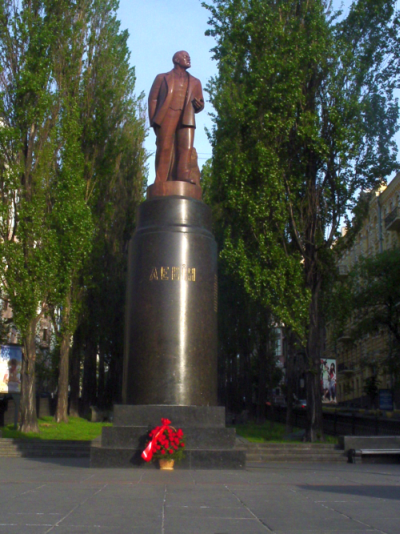
A pedestal that once held a monumental statue of Lenin in Kyiv — and which has remained empty since 2013 — could once again occupy a symbolic place in the urban landscape of the Ukrainian capital, this time dedicated to Ivan Mazepa, a 17th-century historical figure and considered by many in Ukraine to be a national hero.
For nearly six decades, a 12-foot-tall sculpture of Vladimir Lenin, carved from red quartz, dominated the intersection of two of the city's main thoroughfares. Its removal occurred in the context of the Euromaidan uprising, when a wave of protests marked a political and social turning point in the country. In the years that followed, the decommunization process spearheaded by the Ukrainian authorities led to the banning of Soviet symbols, including monuments to Lenin. According to data compiled by The New York Times , while there were approximately 5,500 statues of Lenin in Ukraine in 1991, by 2017 none remained.
In this context of symbolic reconfiguration of public space, President Volodymyr Zelensky recently proposed—during a speech commemorating Ukraine's Constitution Day—that a bust of Mazepa occupy the site of the toppled monument. Through his account on the social media platform X, Zelensky emphasized that Mazepa, who led the Cossack Hetmanate from 1687 to 1709, deserves sculptural recognition in the capital, thus reinforcing his presence in the Ukrainian national historical narrative.


You may be
interested
...